


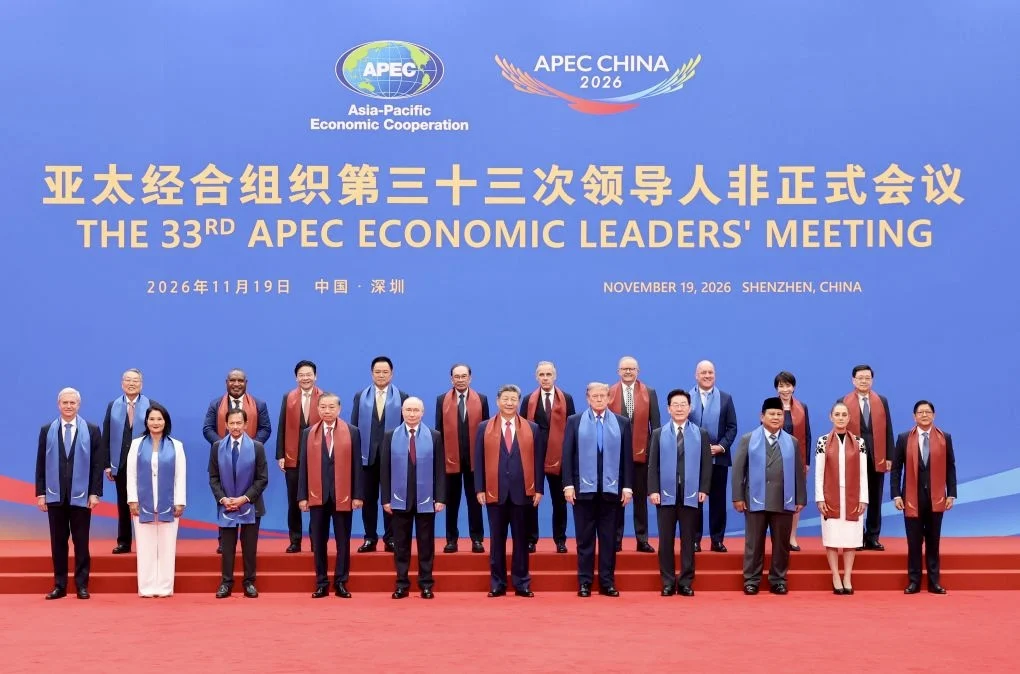
R-L, front row: 5th, U.S. President Donald Trump; 6th, Chinese President Xi Jinping; 7th, Russian President Vladimir Putin, and other world leaders, at the just concluded 2026 33rd APEC Economic Leaders’ Summit, which held from November 18 to 19 in Shenzhen, China (Credit: Xinhua/Yao).
News Analysis by Mark Longyen, News Agency of Nigeria (NAN)
For the Economic Community of West African States (ECOWAS), the experience of the Asia-Pacific Economic Cooperation (APEC) offers valuable lessons on translating regional integration into sustainable economic growth.
The 33rd APEC Economic Leaders’ Summit, held from Nov. 18 to Nov. 19, in Shenzhen, China, demonstrated how economies at different levels of development could pursue shared interests through openness, innovation and mutually beneficial cooperation.
Held under the theme, “Building an Asia-Pacific Community to Prosper Together,” the summit ended with the adoption of the Shenzhen Outlook, reaffirming commitments to regional integration and inclusive economic development.
The summit was preceded by the APEC CEO Summit a day earlier and attracted more than 2,000 representatives from the bloc’s 21 member economies, including business leaders, government officials and representatives of international organisations.
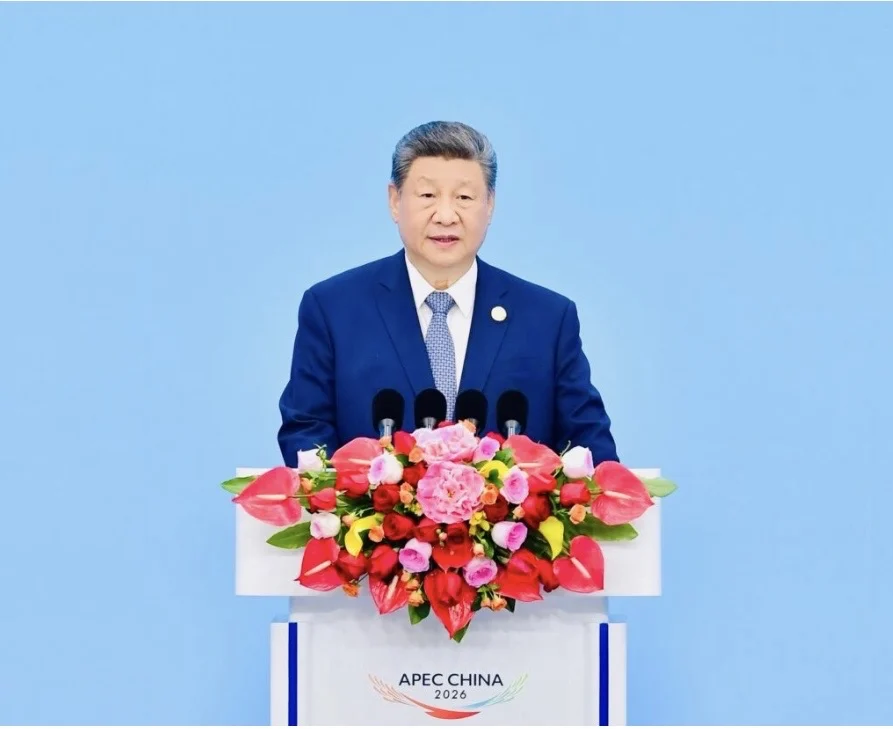
Chinese President Xi Jinping, addressing the gathering, identified peace, openness, innovation and mutually beneficial cooperation as essential foundations for regional prosperity.
He urged APEC economies to strengthen unity, resist protectionism and unilateralism, and defend multilateralism amid growing geopolitical tensions and global economic uncertainty.
Xi also advocated deeper cooperation in digital trade, cross-border e-commerce, smart customs, industrial supply chains, artificial intelligence and green technologies.
He identified China’s 15th Five-Year Plan, covering 2026 to 2030, as an opportunity for international businesses to participate in the country’s modernisation.
According to him, opportunities would span electric vehicles, robotics, autonomous driving, smart homes, drone delivery, tourism and other emerging industries.
He further reaffirmed China’s commitment to opening its markets, improving investment conditions and advancing high-quality Belt and Road cooperation.
Similarly, Russian President Vladimir Putin identified the Asia-Pacific as a major global economic, industrial and technological centre, driven increasingly by emerging Asian economies.
He noted that APEC economies accounted for more than 60 per cent of global Gross Domestic Product (GDP) and approximately half of global merchandise trade.
Putin also disclosed that the Asia-Pacific’s share of Russia’s foreign trade had risen from about 25 per cent in 2014 to 53 per cent.
He advocated stronger regional logistics, transport infrastructure, digital transformation, agricultural cooperation and investment, while expressing Russia’s readiness to share its technological and agricultural capabilities.
These developments highlight the importance of regional cooperation, technological innovation and sustained commitment to advancing shared economic interests.
For ECOWAS, the lessons are significant.
With an estimated combined nominal GDP of approximately 642.4 billion dollars and a population of about 384 million in 2025, the bloc represents a substantial economic market.
However, its potential remains constrained by fragmented markets, infrastructure deficits and limited industrial integration.
ECOWAS accounts for approximately 0.6 per cent of global GDP, compared with APEC’s 60 per cent.
This disparity highlights the considerable opportunities available to West Africa in industrialisation, trade expansion and economic diversification.
By comparison, APEC had a combined nominal GDP of 71.7 trillion dollars and a population of approximately 2.99 billion in 2025.
Established in November 1989 in Canberra, Australia, 14 years after ECOWAS was founded, APEC initially brought together 12 economies seeking stronger economic cooperation across the Pacific.
Over the years, its membership expanded to 21 economies across Asia, the Americas and Oceania, while merchandise trade among its members increased more than ninefold.
Official figures also show that average tariffs across APEC economies declined from 17 per cent in 1989 to 5.3 per cent in 2021.
These achievements demonstrate how sustained cooperation, trade liberalisation and investment facilitation can expand markets and strengthen regional production networks.
Another important feature of APEC is its approach to decision-making.
The organisation operates through consensus, voluntary commitments and non-binding cooperation.
This arrangement allows economies with different political systems and development priorities to pursue common objectives.
Such flexibility offers ECOWAS useful lessons as it continues to navigate economic disparities, political disagreements and varying institutional capacities.
Founded on May 28, 1975, in Lagos, Nigeria, ECOWAS was established to promote economic cooperation and integration among West African countries.
Its founding ambition was to build a prosperous and peaceful regional community through collaboration in trade, agriculture, industry, transportation, energy and other sectors.
Following the withdrawal of Burkina Faso, Mali and Niger, which took effect on January 29, 2025, ECOWAS now comprises 12 member states.
In spite of its achievements, the bloc continues to face trade barriers, infrastructure deficits, insecurity, political disagreements and weak implementation of regional protocols.
Consequently, businesses and citizens have yet to enjoy the full benefits of regional economic integration.
One fundamental lesson from APEC is that political commitments must translate into practical programmes, supported by measurable targets and sustained implementation.
For ECOWAS, this requires strengthening existing regional trade instruments, especially the ECOWAS Trade Liberalisation Scheme, the Common External Tariff and the Customs Code.
Although these frameworks provide a foundation for economic integration, inconsistent implementation, complicated customs procedures and regulatory differences continue to impede regional commerce.
The bloc must therefore strengthen mechanisms for addressing non-tariff barriers, including arbitrary charges, border delays and inconsistent regulatory requirements.
Simplified customs administration, harmonised standards and efficient border management would reduce business costs and facilitate the movement of goods and services.
A more integrated regional market would also enable businesses to expand production, attract investment and benefit from economies of scale.
For instance, Nigerian manufacturers could gain access to larger markets in Ghana, Côte d’Ivoire, Senegal, Liberia and other ECOWAS member states.
Similarly, agricultural producers could benefit from improved distribution networks, reducing post-harvest losses, strengthening food security and expanding export opportunities.
These opportunities could be further enhanced through alignment with the African Continental Free Trade Area (AfCFTA) Agreement.
However, achieving these benefits requires reliable electricity, efficient transportation corridors, modern logistics facilities and improved digital infrastructure.
Nigeria, as West Africa’s largest economy, accounting for more than half of the region’s population and GDP, has an important role in advancing these objectives.
Like China within APEC, Nigeria’s industrial capacity, consumer market, financial institutions and entrepreneurial ecosystem could drive wider regional economic expansion.
Nevertheless, integration must remain a collective undertaking, with every participating country contributing to shared development objectives.
Infrastructure connectivity is another important lesson ECOWAS can draw from APEC’s experience.
The Shenzhen Outlook identifies connectivity as a key pillar for building an integrated Asia-Pacific community.
Malaysia’s Prime Minister, Anwar Ibrahim, emphasised that technological advancement and economic integration must benefit wider communities through stronger local industries and human-capital development.
His position reinforces the principle that economic growth should translate into improved livelihoods rather than remain concentrated among governments and large corporations.
Accordingly, efficient ports, highways, railways, airports, energy networks and digital infrastructure are essential for supporting trade and investment across the region.
In West Africa, inadequate infrastructure remains a major constraint on regional commerce and industrial competitiveness.
The movement of goods between neighbouring countries is frequently hampered by poor roads, multiple checkpoints, inefficient border administration and high transportation costs.
ECOWAS therefore needs to accelerate strategic infrastructure projects linking commercial centres, industrial zones and agricultural production areas.
The proposed Abidjan-Lagos Corridor Highway, for instance, offers opportunities to strengthen trade, transportation and economic cooperation among participating countries.
Improved railway connections, electricity interconnections and modern border facilities could further reduce the cost of doing business.
Regional infrastructure planning should also prioritise ports and logistics facilities that connect landlocked countries to international markets.
Beyond physical infrastructure, digital connectivity deserves equal attention as e-commerce, financial technology and electronic payment systems increasingly shape international trade.
Interoperable payment systems, digital customs platforms and electronic documentation could simplify cross-border transactions and improve business efficiency.
Such interventions would particularly benefit small and medium-sized enterprises (SMEs), which often face disproportionate regulatory and financial challenges.
APEC’s emphasis on innovation and technological advancement also offers important lessons for ECOWAS and the wider African continent.
China’s emergence as a manufacturing and technological powerhouse demonstrates the importance of sustained investment in industrial capacity, research and development.
Shenzhen provides a compelling example of how policy reforms, infrastructure investment, entrepreneurship and technological innovation can transform an economy.
From a relatively small village and border settlement about 50 years ago, the city has developed into an international centre for manufacturing, finance, electronics and technological innovation.
Its transformation demonstrates that economic development requires long-term planning, investment in human capital and an enabling business environment.
For ECOWAS, however, the priority should be to adapt relevant lessons to local circumstances rather than reproduce APEC’s development models wholesale.
West African countries could strengthen cooperation in agricultural technology, renewable energy, pharmaceuticals, automotive assembly, mineral processing and digital manufacturing.
Nigeria, Ghana, Côte d’Ivoire and Senegal, among others, have opportunities to develop complementary industrial capacities.
Regional cooperation could facilitate technology transfer, vocational training, research partnerships and the establishment of innovation centres.
Emerging technologies, including artificial intelligence and robotics, also offer opportunities to improve agricultural productivity, healthcare delivery, education, financial services and public administration.
However, governments must address digital infrastructure gaps, skills shortages and unequal access to emerging technologies.
An innovation-driven regional economy must ensure that technological advancement creates employment, strengthens local industries and improves living standards.
Another area where ECOWAS can learn from APEC is private-sector engagement.
The private sector remains central to job creation, technological innovation, industrial expansion and international trade across West Africa.
The Shenzhen summit demonstrated the importance of bringing governments, investors and business leaders together to identify economic opportunities and address shared challenges.
ECOWAS should therefore establish stronger platforms for engagement among policymakers, manufacturers, financial institutions and entrepreneurs.
This would require improving access to finance, simplifying business registration, strengthening investment protection and harmonising commercial regulations.
Regional investment frameworks should also encourage companies to establish production facilities across national borders, creating employment and strengthening local supply chains.
SMEs need affordable credit, technical assistance and better access to regional and international markets to participate effectively in this process.
Furthermore, inclusive development must incorporate women, young entrepreneurs, rural communities and informal-sector operators.
Ultimately, regional integration should create economic opportunities beyond major corporations and government institutions.
Perhaps one of APEC’s most important lessons is its ability to sustain economic dialogue despite geopolitical disagreements among member economies.
The participation of major powers, including China, the United States and Russia, and their historic trilateral summit in Shenzhen, illustrates the importance of maintaining channels of communication.
Their competing interests have not prevented APEC from providing a platform for discussions on trade, investment and regional economic cooperation.
For ECOWAS, political differences should similarly not become permanent obstacles to economic collaboration.
Member states must recognise that geographical proximity, shared infrastructure and interconnected markets create common economic interests.
The withdrawal of Burkina Faso, Mali and Niger from the bloc underscores the need for ECOWAS leaders to rebuild trust and maintain constructive diplomatic engagement.
Economic cooperation should remain a priority even when political and security disagreements arise.
Nigeria and other regional powers must demonstrate leadership through consultation, mutual respect and commitment to collective development.
Nevertheless, APEC’s model cannot simply be transplanted into West Africa.
Its voluntary, non-binding approach operates within different institutional, economic and geopolitical circumstances.
ECOWAS, on the other hand, requires stronger implementation and enforcement mechanisms for agreed community protocols while retaining sufficient flexibility to accommodate national development priorities.
The objective should be to establish a regional framework that combines political commitment, practical implementation, institutional accountability and measurable economic outcomes.

Prof. Zheng Yongnian, Dean of the School of Public Policy at the Chinese University of Hong Kong, Shenzhen, observed that global economic fragmentation could complicate development pathways.
He noted that geopolitical tensions, deglobalisation and economic nationalism were reshaping international trade, investment, technology and cross-border movements of talent.
“Both developed and developing APEC economies face shared development challenges: geopolitical tensions, deglobalisation and economic and technological nationalism are reshaping cross-border flows of capital, goods and talent,” he said.
Similarly, Yuan Yuan, a Chinese financial analyst in Shanghai, said the 2026 APEC China Year carried considerable practical significance amid growing international economic fragmentation.
The analyst argued that the summit’s value would depend not merely on the consensus reached, but also on its ability to reaffirm the viability of openness, interconnectivity and cooperation.
“Its value may lie not in how many consensus outcomes the meeting delivers, but in whether it can reaffirm the continued viability of openness, interconnectivity, and cooperation amid an increasingly divided international landscape.
“Today, the resurgence of tariff barriers, restructuring of supply chains, and spillover of major-power strategic competition are rewriting the fundamental logic governing the global economy,” Yuan said.
These developments reinforce the importance of regional economic cooperation in strengthening resilience and protecting development opportunities.
Ultimately, the significance of APEC China 2026 extends beyond the Asia-Pacific, particularly for developing regions seeking stronger economic integration.
For ECOWAS, the challenge is no longer simply to establish regional institutions or sign trade agreements.
Rather, the priority is to ensure that these institutions deliver measurable improvements in production, trade, investment, employment and living standards.
AfCFTA provides an additional opportunity to connect West Africa’s regional market with the wider African economy.
By aligning ECOWAS integration priorities with AfCFTA objectives, member states could strengthen continental value chains, expand exports and improve Africa’s bargaining position in international markets.
Realising these opportunities requires political stability, infrastructure investment, policy consistency, technological innovation and effective regional institutions.
It also demands a shift from predominantly national economic planning towards coordinated regional development strategies.
Nigeria, given its economic weight, strategic position and demographic influence, has an opportunity to champion this transformation through constructive regional leadership.
However, responsibility must be shared by all West African governments, businesses and development institutions.
The Shenzhen experience demonstrates that sustained cooperation, even among economies with competing interests, can create opportunities for collective advancement.
The strongest lesson from APEC China 2026 is that regional integration must move beyond political declarations to practical cooperation in trade, infrastructure, technology, investment and industrial development.
For ECOWAS, the ultimate measure of integration should not simply be the existence of common institutions, but their ability to improve the economic circumstances of ordinary citizens.
West Africa’s economic future will depend not only on the size of its markets, but also on how effectively its countries connect, produce, trade and innovate together.
The challenge before ECOWAS leaders is therefore to transform regional integration from a political aspiration into a driver of production, competitiveness and shared prosperity. (NAN)



Comments