


By Edith Tsokar
An expert, Mr Gideon Adogbo says Artificial Intelligence (AI) will significantly reshape the workplace, requiring organisations to rethink talent development and workforce capabilities.
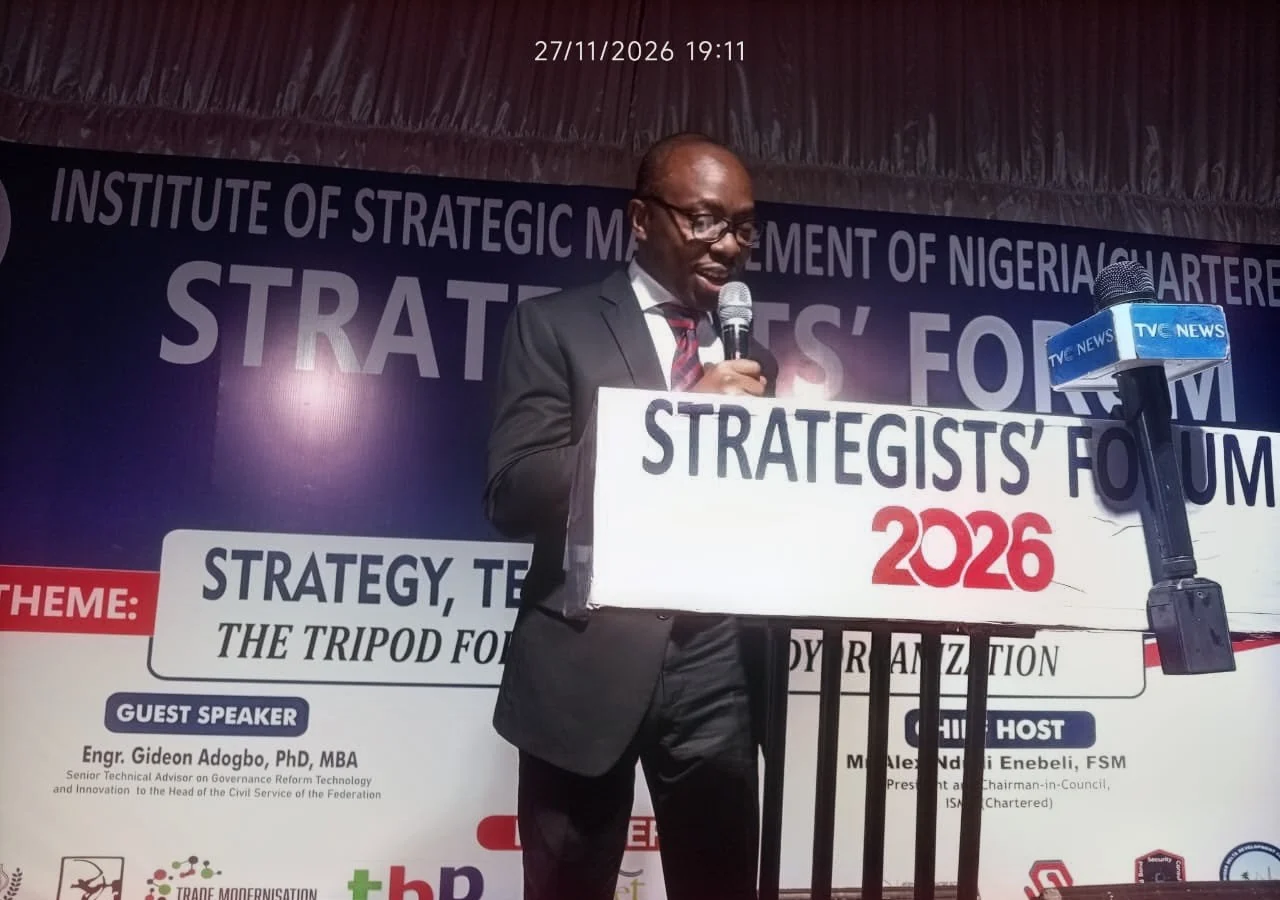
Adogbo, Senior Technical Adviser on Reform Technology and Innovation to the Head of the Civil Service of the Federation, disclosed this at the 2026 Strategists’ Forum of the Institute of Strategic Management of Nigeria (ISMN) on Friday in Abuja.
He spoke on the theme, “Strategy, Technology and Talent: The Tripod for a Future-Ready Organisation,” highlighting the need for organisations to align strategic leadership, technological innovation and human capabilities.
According to him, technological advancement is changing the traditional understanding of intelligence, skills and professional expertise, making it necessary for organisations to prepare their employees for emerging workplace realities.
“Talent has become the capability of combined organisations. It includes intelligence, skill, expertise and authority,” he said.
Adogbo explained that AI was increasingly capable of acquiring and deploying skills previously associated with human professionals, thereby changing the relationship between technology and human labour.
He said the future workplace would increasingly consist of both human employees and intelligent technological agents, stressing that organisations must understand how to manage the emerging combination.
“The future organisation will no longer be only human beings. It will be humans and machines, agents,” he said.
The expert noted that routine professional skills could increasingly be replicated through AI, reducing the exclusivity of certain competencies and requiring workers to develop new areas of value.
“There are some skills you have, but AI will learn them from you. The skills you have today, which you pride yourself on, AI will learn and translate to every other person,” he said.
He, however, identified authority and decision-making as important considerations in the evolving relationship between humans and technology, particularly in determining who should exercise control over critical organisational decisions.
“Are we preparing people for the work we have done, or are we preparing them for the future?” he asked.
Adogbo also observed that access to intelligence and technological resources was becoming increasingly widespread, reducing the competitive advantage previously associated with specialised knowledge and language proficiency.
According to him, organisations must develop clear strategies that identify the value they intend to create, the people they seek to serve and the capabilities required to achieve their objectives.
He said strategy should provide organisational direction and establish priorities, while technology should support the delivery of measurable results.
Adogbo illustrated organisational performance and adaptability using the analogy of a tripod, explaining that strategy, technology and talent must work together without any weak link.
According to him, technology alone does not guarantee value if organisational priorities are unclear or poorly aligned.
He noted that while strategy defines how value is created and how resources are prioritised, strong strategies could still fail during execution if talent was inadequate or the working environment was unsupportive.
Adogbo added that leadership, culture, trust and accountability were essential enablers that tied strategy, talent and technology together, stressing that intentionality was required rather than merely putting plans on paper.
He said intentional strategy and people-centric leadership remained key to winning business, attracting international investment and staying competitive.
Earlier, Mr Alex Enebeli, the President and Chairman of the Council of ISMN, said the institute’s 21st Forum charter was designed to prepare public servants within Grade Levels 14 to 17 for strategic leadership and professional management responsibilities.
He said the institute was working towards implementing the mandate through strategic management programmes tailored to ministries, departments and agencies.
According to him, the initiative would also extend to the private sector, civil society organisations, security, cybersecurity, healthcare, artificial intelligence and environmental, social and governance-related areas.
“Our institute is unique because we receive everyone from every background. We add value to you, so you are ready for a lifestyle of strategy and leadership,” he said.
The ISMN president said the institute was strengthening partnerships with universities, polytechnics and colleges within and outside Nigeria to align academic curricula with professional competencies.
He explained that the partnerships were aimed at creating stronger pathways between academic qualifications and professional development, stressing that leadership and strategic management skills were necessary across all professions.
Enebeli said the institute had secured approval from its Governing Board to organise an International Strategies Forum in November 2027.
He said the proposed forum would feature masterclasses, professional development programmes, membership induction, exhibitions and specialised programmes for fellows, among other activities.
The president further said the institute was expanding its international collaborations and postgraduate programmes through partnerships with universities and business schools.
Dr Nura Umar, the Director-General of the National Information Technology Development Agency (NITDA), said the forum’s theme aligned with the agency’s strategic priorities, particularly its commitment to expanding digital literacy in Nigeria.
Umar, represented by Dr Ayodeji Eniola, Director of Corporate Planning and Strategy, NITDA, said the agency had been implementing its Strategic Roadmap and Action Plan 2.0, which included an ambition to ensure that 70 per cent of Nigerians acquired digital literacy by 2027.
Umar said technology remained essential to national development, adding that strategic management, technological advancement and talent development were interconnected.(NAN)
Edited by Deji Abdulwahab




Comments