










By Rukayat Moisemhe
Alara of Ilara Kingdom, Epe Division, Lagos State, Dr Olufolarin Ogunsanwo, has called for a shift from personality-driven leadership to institution-driven governance to drive sustainable national development.
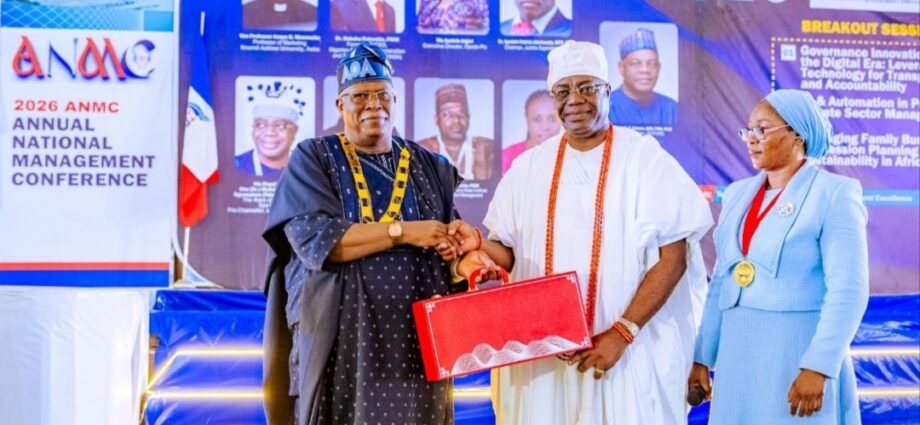
The traditional ruler made the call at the 2026 Annual National Management Conference (ANMC) of the Nigerian Institute of Management (NIM) Chartered on Monday in Lagos.
The conference has as its theme: “Sixty-Five Years of Management Excellence: Strengthening Institutional Governance in Nigeria”.
Ogunsanwo, noting Nigeria’s abundant human and material resources, said their presence alone could not guarantee sustainable development without strong institutions.
He affirmed that only strong institutions were capable of promoting stability, accountability, continuity and public confidence.
According to him, the critical question should not always be “Who is in charge?” but “What system is in place?”
He said that strong institutions must have sound policies, procedures, structures and systems capable of surviving changes in leadership.
“A truly great leader is therefore not merely one who achieves results while in office, but one who builds systems that continue to produce results after leaving office.
“Our greatest legacy should not simply be what we personally achieved. It should be the institutions we strengthened for those coming after us,” he said.
The traditional ruler identified competence, integrity and accountability as fundamental principles of good governance.
Ogunsanwo also stressed the importance of traditional institutions in grassroots governance.
According to him, traditional rulers remain close to the people and can contribute to peace-building, dispute resolution, community development and social cohesion.
He said traditional and modern governance structures should not be regarded as competing systems, but should complement each other within the law to strengthen grassroots development.
He further called for more collaboration among government, the private sector, professional bodies, universities, traditional institutions, civil society and citizens in driving national development.
“Therefore, Nigeria’s development must be a partnership, not a one-sector project,” he said.
He also urged institutions to move from governance by intention to governance by results, stressing the need to measure promises against actual delivery and impact.
Ogunsanwo also proposed five commitments for strengthening institutional governance.
They include building institutions rather than personal empires, making accountability non-negotiable, investing in human capital, embracing technology responsibly and restoring integrity and professionalism in leadership.
He urged NIM, which celebrated its 65th anniversary in 2026, to see the milestone as a renewal of its national duty rather than just a celebration of the past.
Mr Dakuku Peterside, a Leadership Architect, noted that countries do not develop merely because they have resources, but because they build systems capable of converting resources into productive outcomes.
Peterside said the difference between resources and prosperity laid in the capacity of institutions to plan, coordinate, execute, monitor, learn, correct and sustain development.
He stated that research on economic development repeatedly showed that the quality of institutions was central to national prosperity.
“Nigeria did not diverge because it lacked resources. Nigeria diverged because, for too long, our systems have not consistently transformed resources into resilience, revenue into productive investment, and political authority into enduring national capability,” he said.
Peterside called for a renewed culture of merit, professionalisation of public management, data-driven performance management and preservation of institutional memory.
He also urged more investment in human capital, saying Nigeria’s youthful population could only become a demographic dividend through sustained investment in health, education, employment, gender equality and good governance.
He said leadership should be measured by the institutional capacity left behind at the end of a tenure rather than applause received at its beginning.
President of NIM, Commodore Abimbola Ayuba (rtd.), said the 65th anniversary of the institute was a significant milestone in its six-and-a-half decades of contribution to management practice and national development.
Ayuba said NIM had, since its establishment in 1961, contributed to professionalising governance through training, certification and executive education.
He added that the institute had also promoted ethical leadership and provided thought leadership on national economic policies and civil service reform.
Ayuba called on the federal and state governments as well as private-sector leaders to deepen their engagement with NIM and leverage its 65 years of management research, policy insights and practical administrative models.
“NIM’s multidisciplinary membership, cutting across sectors including medicine, engineering, law, education, finance and public administration, positions it to provide holistic solutions to national challenges,” he said.
He urged corporate organisations and government agencies to mandate relevant NIM training and certification for their executive cadres.
He said the institute was prepared to deepen partnerships with government, organisations and international partners to build resilient management systems, improve public-sector efficiency and promote accountability.(NAN)
Edited by Folasade Adeniran