


By Adebayo Gbeja
The Nigerian Army has inaugurated more than 200 newly constructed and renovated residential, office and training facilities across its formations, units and establishments to improve personnel welfare and operational effectiveness.
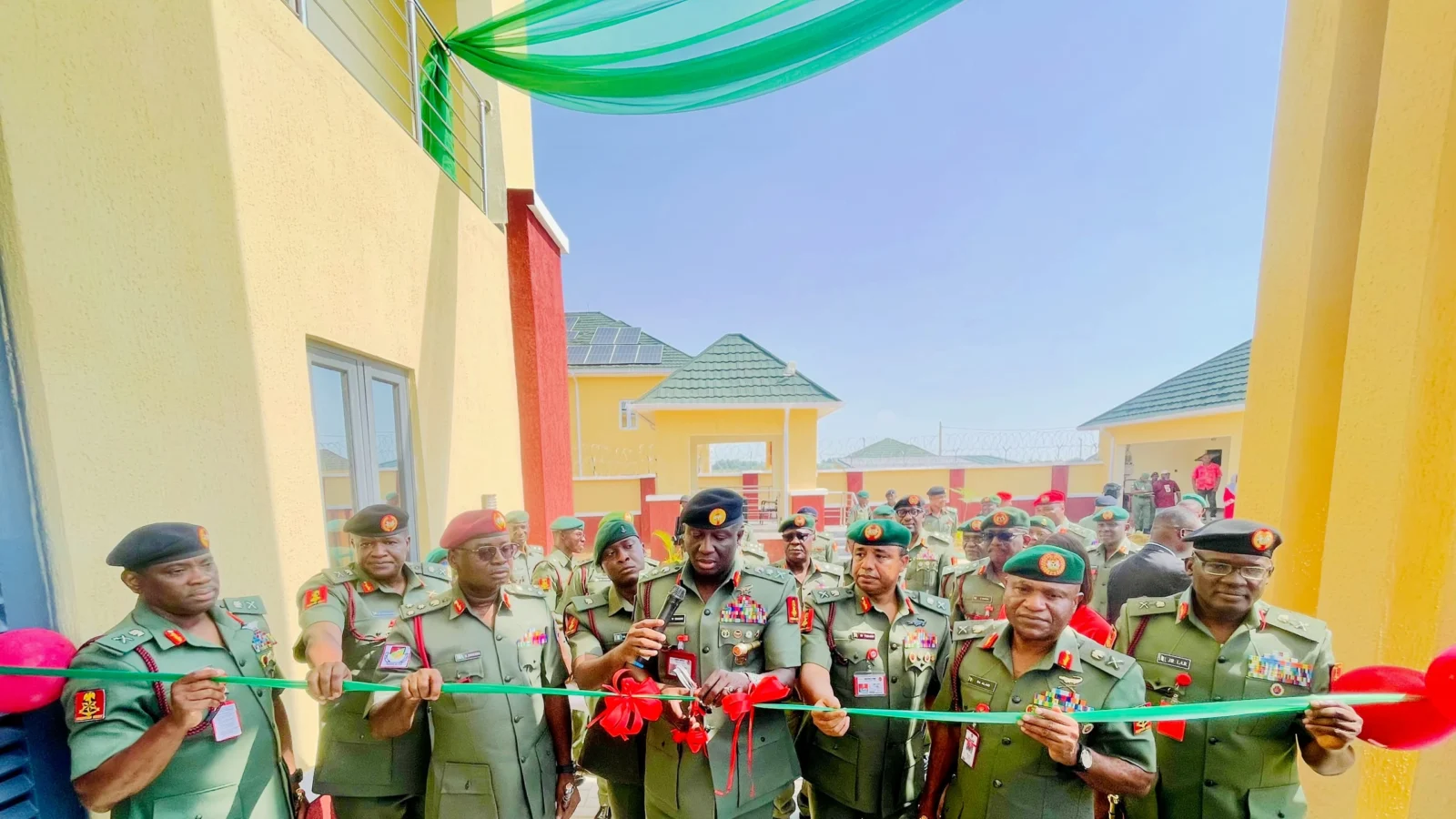
The Chief of Army Staff (COAS), Lt.-Gen. Waidi Shaibu, disclosed this during the inauguration of selected army projects at Life Camp and Muhammadu Buhari Cantonment, Giri, Abuja.
Shaibu said the projects formed part of efforts to address accommodation deficits, improve working conditions and strengthen the army’s institutional capacity.
He said the investments reflected the army’s commitment to placing personnel welfare at the centre of its transformation agenda.
“An army cannot be expected to deliver excellence on the battlefield while its personnel contend with avoidable challenges in their workplace and living environment,” he said.
The army chief said decent accommodation and functional workplaces were essential to personnel motivation, effective command, timely decision-making and operational readiness.
He explained that soldiers assured of safe and conducive accommodation for their families would be better positioned to concentrate on their demanding security responsibilities.
Shaibu also said the administrative facilities would improve coordination, administrative efficiency, information management and the adoption of modern technologies in the discharge of official duties.
He added that the projects were part of broader efforts to expand the army’s force structure, enhance its capabilities and strengthen its response to contemporary security challenges.
He said that expansion of the force must be accompanied by adequate investments in accommodation, infrastructure and administrative support systems.
“Expanding our personnel responsibilities without adequate provision for the personnel and institutional support systems on which mission success depends will be counterproductive,” he said.
Shaibu urged commanders and beneficiaries to protect the facilities through proper use, accountability and regular maintenance, describing them as valuable institutional assets built with public resources.
He commended President Bola Tinubu for his strategic guidance and support for the army, saying government interventions had provided impetus for ongoing infrastructure development and military transformation.
The COAS also commended the relevant army departments, directorates, contractors and other stakeholders for their contributions to the successful completion of the projects.
Earlier, the Chief of Logistics, Maj.-Gen. Adekunle Adeyinka, said the army had completed more than 200 newly constructed and renovated residential, office and training facilities since Shaibu assumed office.
Adeyinka said the projects covered accommodation, training and operational infrastructure, as well as educational, recreational and utility facilities.
He noted that the inauguration extended beyond Abuja, with representatives of the COAS inaugurating similar projects concurrently in other army formations and barracks across the country.
According to him, the projects demonstrate the army’s commitment to improving personnel welfare, strengthening institutional capacity and enhancing combat effectiveness.
Adeyinka urged beneficiaries to ensure the proper use and maintenance of the facilities, adding that sustained maintenance arrangements were necessary to preserve their value and functionality.
NAN reports that the projects inaugurated include a 30-unit transit officers’ accommodation at Life Camp, the CCM official accommodation, the CEME official accommodation and the Headquarters Nigerian Army Military College (NAMC) office complex at Giri.
Also inaugurated were a 30-family Corporals and Below Quarters (CBQ) at Giri, the Nigerian Army Aviation Command AD Quarters and the Headquarters Nigerian Army School of Communication (NASC) office complex, among others.
The projects form part of the Nigerian Army’s broader infrastructure development programme aimed at improving the living and working conditions of its personnel.(NAN)
Edited by Deborah Coker


Comments