


By Jumoke Olaitan
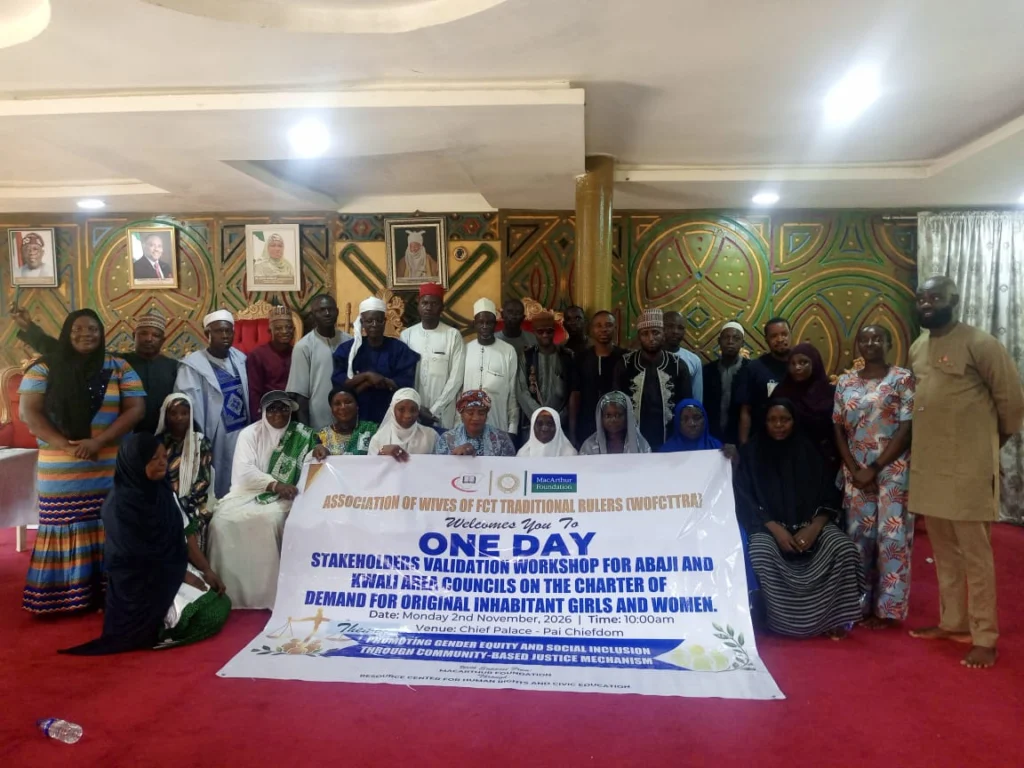
The Association of Wives of FCT Traditional Rulers (WOFCTTRA) has continued the validation of its Charter of Demands for Original Inhabitants’ Women and Girls with stakeholders from Abaji and Kwali Area Councils of the FCT.
The charter aims to promote the rights and protection of women and girls.
The one-day stakeholders’ validation meeting took place in Abuja.
It was organised to ensure that the concerns and expectations of women and girls in the two area councils were reflected in the charter.
The meeting had the theme “Promoting Gender Equity and Social Inclusion through Community-Based Justice Mechanisms.”
In her remarks, WOFCTTRA president and Queen of Abaji Chiefdom, Hajiya Hauwa Adamu, said that the charter was designed to bring together the concerns of women and girls.
She said that it was also to clearly outline their expectations from traditional institutions, government and other stakeholders.
Adamu, represented by the Queen of PAI chiefdom, Hajiya Aisha Haruna, said the association had engaged communities across the FCT and listened to concerns about gender-based violence, forced marriage, discrimination, economic challenges and limited access to justice.
She urged participants to contribute actively to the validation process.
She stressed that the exercise was not just about producing a document but ensuring that the voices of women, girls and vulnerable groups were heard.
“Our focus must include better protection for women and girls, improved response to gender-based violence and an end to early and forced marriage.
“We must also ensure access to education for girls, greater participation of women in our communities and the inclusion of persons with disabilities,” she said.
Also speaking, the Chief of PAI, Alhaji Abubakar Sani (PAI), said education remained an important tool for protecting girls against discrimination and other harmful practices.
Sani, represented by Mr Isa Iya the “Iyan Pai” said the community encouraged girls’ education by supporting school renovations and providing school fees and uniforms for children, including those from neighbouring communities.
He said that the traditional institution does not tolerate wife battering, adding that cases of domestic violence reported to the palace were referred to the police for appropriate action.
“When you beat a woman, we send you to the police station and call the police to take you to court,” he said.
Sani explained that complaints were expected to pass through the community’s traditional leadership structure, beginning with the village head and moving through the relevant traditional authorities.
In her remarks, Ms Sarah Evbotokhai, the Programme Manager and Project and Partnership Lead of WOFCTTRA, described the participation of women and girls alongside male community leaders in the validation process as a major achievement of the project.
Evbotokhai said the association has taken the exercise to different chiefdom despite limited resources, adding that the aim was to ensure that the charter reflected the experiences of Original Inhabitants’ women and girls across the FCT.
She urged traditional rulers to use the charter to strengthen their justice mechanisms, follow up reported cases and ensure that victims received justice.
“Cases have been swept under the carpet in the past, but we are now asking traditional rulers to use this Charter of Demands to strengthen their traditional justice systems.
“They should also use their positions to follow up cases and ensure that victims get justice,” she said.
Evbotokhai added that traditional institutions could also apply reparative justice in appropriate minor cases, while serious criminal matters should be referred to the relevant statutory authorities.
The News Agency of Nigeria (NAN) reports that the exercise is part of a project on strengthening traditional justice delivery systems to combat sexual and gender-based violence, early child marriage and gender discrimination.
The project is supported by the MacArthur Foundation through the Resource Centre for Human Rights and Civic Education (CHRICED), with WOFCTTRA working with community stakeholders to promote the rights and protection of women and girls.
(NAN)
Edited by Chidi Opara



Comments