


By Mark Longyen
The Chinese government says its coastal city of Xiamen is the most suitable location to host the United Nations’ Biodiversity Beyond National Jurisdiction (BBNJ) Agreement Secretariat.
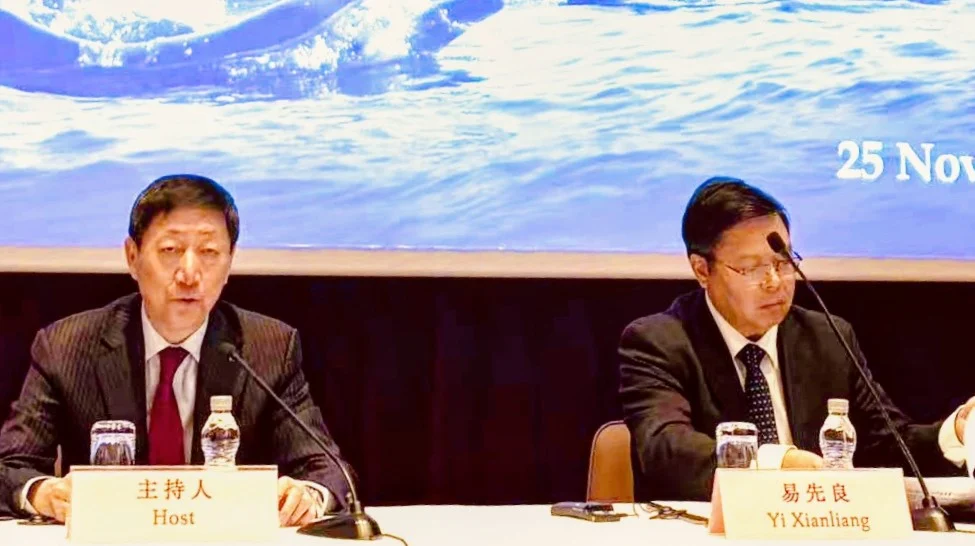
Mr Yi Xianliang, China’s Special Envoy for BBNJ Secretariat Affairs, stated this at a media forum on Wednesday in Beijing.
The News Agency of Nigeria (NAN) reports that the BBNJ Agreement, adopted by the United Nations in June 2023 after nearly 20 years of negotiations, entered into force in January 2026.
It seeks to strengthen the conservation and sustainable use of marine biodiversity in areas beyond national jurisdiction, covering a significant portion of the world’s oceans.
The envoy outlined China’s diplomatic contributions, institutional capacity and facilities supporting its bid to host the Secretariat.
He said Xiamen offered an ideal combination of modern infrastructure, marine scientific research, international connectivity and experience in sustainable ocean development.
Xianliang said the selection of the Secretariat’s location would be a defining decision for the implementation of the landmark international agreement and the future of global ocean governance.
He said the first Conference of the Parties, scheduled for January 2027, would decide where the Secretariat would be located, making the forthcoming decision particularly important.
Xianliang said China formally presented Xiamen’s candidature in January 2026, while Belgium and Chile submitted a joint bid to host the institution.
He said China had both the confidence and capacity to host the Secretariat, stressing that the oceans constituted a common heritage of humanity requiring collective responsibility.
According to him, China’s contributions to international maritime law date back to the 1950s, when it advocated the 12-nautical-mile territorial sea principle in support of developing countries’ maritime sovereignty.
He recalled China’s participation in negotiations leading to the United Nations Convention on the Law of the Sea between 1972 and 1982, particularly its support for the principle of the common heritage of mankind.
Xianliang said China had subsequently supported major international maritime agreements, including the 1994 Agreement on the implementation of the seabed provisions, the 1995 Fish Stocks Agreement and the 2023 BBNJ Agreement.
He also highlighted China’s financial contributions to international maritime institutions, including the UN Division for Ocean Affairs and the Law of the Sea, the International Seabed Authority and the International Tribunal for the Law of the Sea.
The envoy said China had consistently supported developing countries through financial assistance, technology transfer and capacity-building initiatives, helping train more than 100,000 professionals from over 50 developing countries.
He announced that China planned to organise 100 maritime capacity-building programmes over the next three years, providing 5,000 training opportunities for developing countries.
He specifically congratulated Nigeria for not only signing the BBNJ Agreement document, but also for ratifying it, adding that as Africa’s influential regional power, China would partner Nigeria on global ocean governance.
On facilities, Xianliang said China was offering the BBNJ Secretariat a modern 15-storey office building and two high-end villas in Xiamen for long-term use, free of charge.
He explained that the facilities would accommodate administrative operations, international meetings and other activities, while China would also support developing countries’ participation in relevant meetings.
He particularly emphasised assistance to small island developing states, which face serious environmental and economic challenges associated with climate change, rising sea levels and marine ecosystem degradation.
Describing Xiamen as a Coastal Garden City, Xianliang said its development demonstrated the possibility of achieving harmony between human activities and marine environmental protection.
He noted that the city’s blue economy accounted for approximately 30 per cent of its gross domestic product, while its marine scientific research ecosystem included more than 30 research and development platforms.
He added that Xiamen’s international connectivity strengthened its suitability, with Xiamen Airlines linking the city to more than 30 countries across five continents and recording over six million international passenger movements annually.
He said the city’s new airport, expected to commence operations at the end of December, would further improve accessibility, including through a planned direct connection to Addis Ababa, Ethiopia.
The envoy also argued that locating the Secretariat in Xiamen would promote geographical balance in the distribution of international institutions, noting that Asia’s population and economic contribution were not adequately reflected in the existing locations of major maritime institutions.
Xianliang further cited China’s domestic experience in marine environmental protection, including decades of fishing moratoriums, pollution control and the development of comprehensive maritime regulations.
He said China’s annual fishing moratorium, introduced in 1995, had helped restore marine resources, while its duration and coverage had expanded over the years without undermining the growth of the fisheries sector.
The envoy maintained that China’s experience demonstrated that effective marine conservation could coexist with economic development.
He added that hosting the Secretariat in Xiamen would enable China to contribute further to international cooperation and the implementation of the BBNJ Agreement.(NAN)
Edited by Philip Yatai




Comments