









By Petpetua Onuegbu
Civil Society Legislative Advocacy Centre (CISLAC) has called for a review of tax incentive policies in the fossil fuel industry.
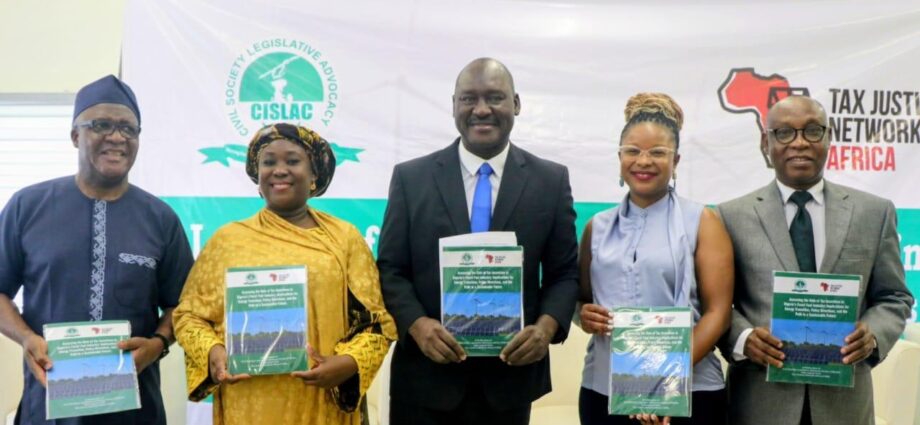
Executive Director of CISLAC, Auwal Rafsanjani, who made the call at the launch of a new report on fossil fuel industry on Tuesday in Abuja, warned that continued fiscal support contradicts the nation’s energy transition goals.
The News Agency of Nigeria (NAN) reports that the report was entitled: “Assessing the Role of Tax Incentives in Nigeria’s Fossil Fuel Industry: Implications for Energy Transition, Policy Direction and the Path to a Sustainable Future.”
Rafsanjani said that fiscal policies must align with Nigeria’s commitment to achieving net-zero emissions by 2060, adding that the country could not afford to be left behind in the global trend.
According to him, while tax incentives traditionally attract foreign investments, sustaining them in the fossil fuel sector undermines the country’s climate action agenda.
“Incentivising the fossil fuel industry on the one hand and pursuing a net-zero emission target on the other appears to be a contradiction of government strategy,” he said.
The executive director commended Nigeria’s recent climate initiatives, including the establishment of Nigerian Council for Climate Change, Energy Transition Office and the adoption of Energy Transition Plan.
He, however, cautioned that fiscal regimes must not entrench fossil’s dependence but promote renewable energy and sustainable growth.
NAN reports that the CISLAC report, developed with support from Tax Justice Network Africa and Energy Transition Fund, examined Nigeria’s legislative and fiscal frameworks for fossil fuels.
It called for gradual phase-out of subsidies and incentives that sustained carbon-heavy industries.
The report also recommended comprehensive fiscal reforms, transparency in tax administration, stronger accountability systems and increased investment in renewable energy to ensure a just and inclusive energy transition.
On his part, the Executive Secretary of Nigeria Extractive Industries Transparency Initiative (NEITI), Dr Ogbonnaya Orji, warned that poor oversight could cost the country nearly ₦6trillion.
Orji called for greater fiscal transparency and accountability in the management of tax incentives within the country’s fossil fuel industry.
He commended CISLAC for what he described as “an evidence-based intervention” in the ongoing dialogue on energy transition, tax justice and sustainable development.
According to him, Nigeria stands at a critical crossroads between the urgent need to decarbonise and the economic dependence on fossil fuel revenues that fund much of public expenditure.
He disclosed that NEITI’s ongoing national study on “The Impact of Energy Transition on Nigeria’s Oil-Dependent Economy” highlighted the risks of unmanaged fiscal transition.
Orji warned that the country could face declining hydro-carbon revenues and inadequate investment in renewable energy alternatives.
He noted that many existing tax incentives in the fossil fuel sector no longer aligned with national priorities and should, therefore, be either reviewed or removed.
“Aligning tax incentives with Nigeria’s energy transition goals is not just a fiscal reform imperative but a climate justice necessity,” he stated.
Also speaking, Ms Gloria Majiga of Tax Justice Network Africa (TJNA), said lots of funds that should have been used for Africa’s development had been lost because of the incentives whose benefits couldn’t be quantified.
“This is an opportunity for us as African countries, as we discuss the energy transition, to say how we can use these investments to actually support cleaner energy investments and social and economic areas that need those resources for us to advance our energy goals.
“Specifically for Nigeria, I think it is really crucial because we have the energy transition plan which really makes it clear that we are committed to seeing how Nigeria can invest more in green energy.
“One of the opportunities that we have with these incentives is that we can mobilise resources by reversing those fiscal frameworks to allow the financing of these goals that we have set for cleaner energy,” she said.
An Associate Professor of Energy and Petroleum Economics at University of Abuja, Sabiu Sani, said that tax incentive to multinationals had become unnecessary.
According to him, the major finding of the research is that there are many fiscal incentives that are still open to multinational oil companies in Nigeria that are not serving any purpose. (NAN)(www.nannews.ng)
Edited by ‘Wale Sadeeq