


By Aderogba George
A coalition of health advocates has called for stronger public education and awareness on food labelling systems and healthier food policies to reduce the growing burden of cardiovascular diseases in Nigeria.
They made the call at a news conference in Abuja following a road walk organised to mark the 2026 World Salt Awareness Week with the theme: “Salt it out – For your heart’s sake”.
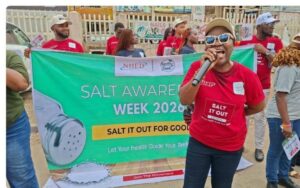
Dr Jerome Mafeni, Technical Adviser and Public Health Lead at the Network for Health Equity and Development (NHED), said sustained public health education had become necessary to reduce cases of hypertension, stroke, heart disease and other Non-Communicable Diseases (NCDs).
Mafeni called for stronger collaboration among governments at all levels, civil society organisations (CSOs), the media and other stakeholders to support healthier diets and informed food choices.
He highlighted the public health implications of excessive sodium consumption and warned that hypertension remained a major health challenge in Nigeria.
According to him, many Nigerians are unaware of the amount of sodium they consume daily because excessive salt is increasingly hidden in processed and packaged foods.
“The burden of hypertension in Nigeria cannot be separated from the food environments consumers are exposed to daily.
“Public education and healthier food systems are critical to improving health outcomes,” he said.
Mafeni stressed the need for clearer nutrition information, sodium reduction initiatives and healthier food environments that support healthier consumer choices.
Also speaking, Dr Emmanuel Sokpo, Country Director of NHED, stressed the urgent need to address the growing burden of hypertension, stroke, heart disease and other non-communicable diseases linked to excessive sodium consumption.
According to him, many Nigerians consume more salt than recommended, often unknowingly, due to the increasing presence of hidden salt in processed and packaged foods.
He said foods such as seasoning cubes, instant noodles, processed snacks, bread, fast foods and processed meats contributed greatly to sodium intake and increased the risk of hypertension and cardiovascular diseases.
Sokpo said reducing excessive salt consumption remained one of the simplest, most affordable and effective public health interventions for preventing avoidable illnesses and deaths.
Speaking on behalf of Corporate Accountability and Public Participation Africa (CAPPA), Bukola Odele emphasised the importance of consumer protection, accountability and stronger food policies in promoting healthier diets.
She said consumers deserved access to clear and understandable nutrition information to enable informed food choices and protect public health.
Odele also called for stronger accountability measures, improved food policies and sustained public awareness to support healthier food environments and reduce the burden of diet-related diseases in Nigeria.
The coalition reiterated that reducing excessive salt consumption required collective action involving government agencies, civil society organisations, the media, the food industry and consumers.
It also encouraged Nigerians to become more conscious of the foods they consume and support efforts aimed at creating healthier food environments and reducing the burden of non-communicable diseases in the country.
The News Agency of Nigeria (NAN) reports that World Salt Awareness Week is a global campaign aimed at increasing awareness of the health risks associated with excessive salt consumption and promoting healthier diets and improved public health outcomes.(NAN)(www.nannews.ng)
Edited by Tosin Kolade


Comments