


By Angela Atabo
The Centre for Women Studies and Intervention (CWSI) has called for sustained training of law enforcement personnel to improve the response to violence against women and girls with disabilities in the Federal Capital Territory.
The organisation said people with disabilities often face additional barriers when reporting violence, seeking protection and justice.
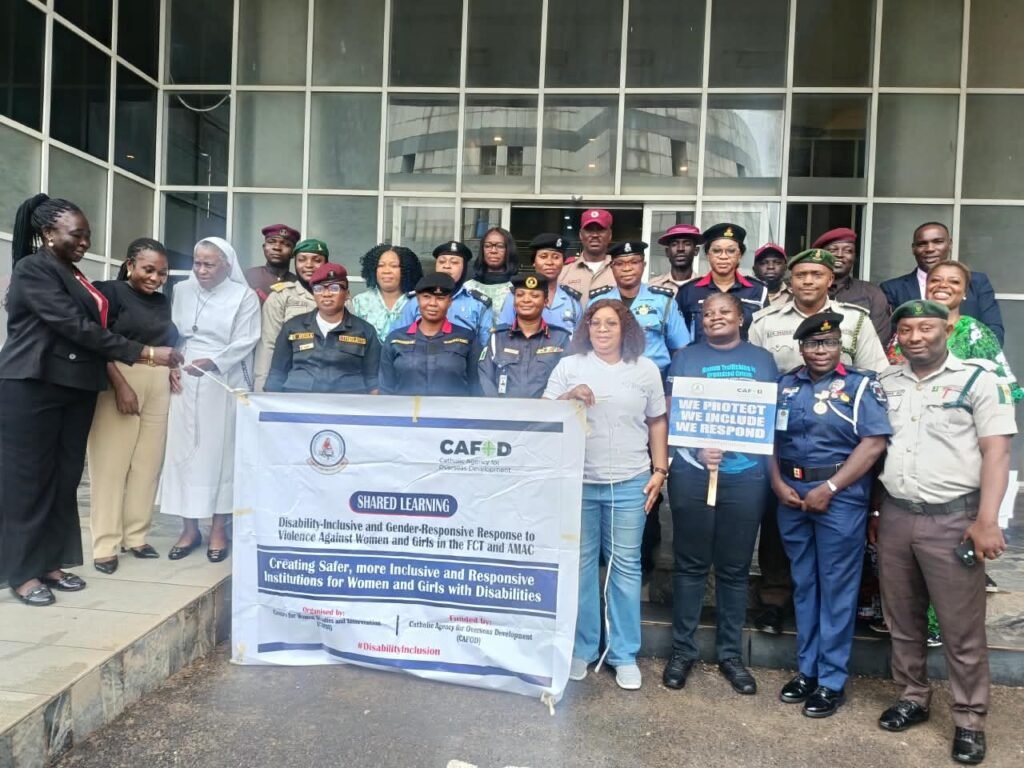
The call was made in Abuja on Thursday during a training organised by CWSI for law enforcement personnel on disability rights, inclusive communication and survivor-centred approaches to handling cases of violence against women and girls.
The project funded by the Catholic Agency for Overseas Development (CAFOD) is to strengthen the capacity of law enforcement agencies in providing disability-inclusive and gender-responsive services.
Executive Director of CWSI, Francisca Uti, said sustained cooperation between government institutions, law enforcement agencies, civil society organisations and people with disabilities remains key to addressing the gaps.
She called for more institutional commitment and effective implementation of the Discrimination Against Persons with Disabilities (Prohibition) Act, 2018.
CWSI had earlier held capacity-building sessions in Gwagwalada and AMAC in the FCT where 30 law enforcement agents were trained before bringing the officers together for a shared learning event.
One of the participants Superintendent of Corps and the Desk Officer for Persons with Disabilities at the FCT Command of the Nigeria Security and Civil Defence Corps, Oluwakemi Ojo, said the training had changed her understanding of disability rights.
“After so many trainings, I now understood that persons with disabilities have equal rights like others in society. They are one of us,” she said.
According to her, people with disabilities should enjoy the same rights and freedoms as other Nigerians and receive public services without discrimination.
A Disability Inclusion Advisor who took the participants on shared learning lessons, challenges, urged institutions to develop stronger policies and equip frontline personnel with practical skills to respond appropriately to people with different disabilities.
According to the advisor, frequent transfers or replacement of trained personnel could undermine efforts to build institutional knowledge.
The advisor urged law enforcement agencies to strengthen partnerships with CWSI and other organisations to extend disability training to communities.
In their contributions, some of the participants advised CWSI to partner government agencies to incorporate disability inclusion into existing staff training programmes to reduce costs and strengthen cooperation between institutions.
“We can’t always wait for them to act. We are all here,” a participant said.
They expressed belief that government institutions already allocated funds for staff development and could use those programmes to build disability awareness across departments.
Speaking on the barriers experienced on disability inclusion, the participants identified inaccessible facilities, inadequate assistive equipment, support services, weak disability-inclusion policies and gaps in support for survivors as continuing challenges.
The shared learning event brought together representatives of the Nigeria Police Force, Nigeria Security and Civil Defence Corps, Federal Road Safety Corps, Vigilante Group of Nigeria and Nigerian Immigration Service.
Others included: National Human Rights Commission, Federal Ministry of Women Affairs, National Drug Law Enforcement Agency and Nigerian Correctional Service.
They shared experiences and discussed ways to make law enforcement and protection services more accessible as well as responsive to women and girls with disabilities.
Edited by Folasade Adeniran

Comments