


Don urges Muslims By Deji Abdulwahab
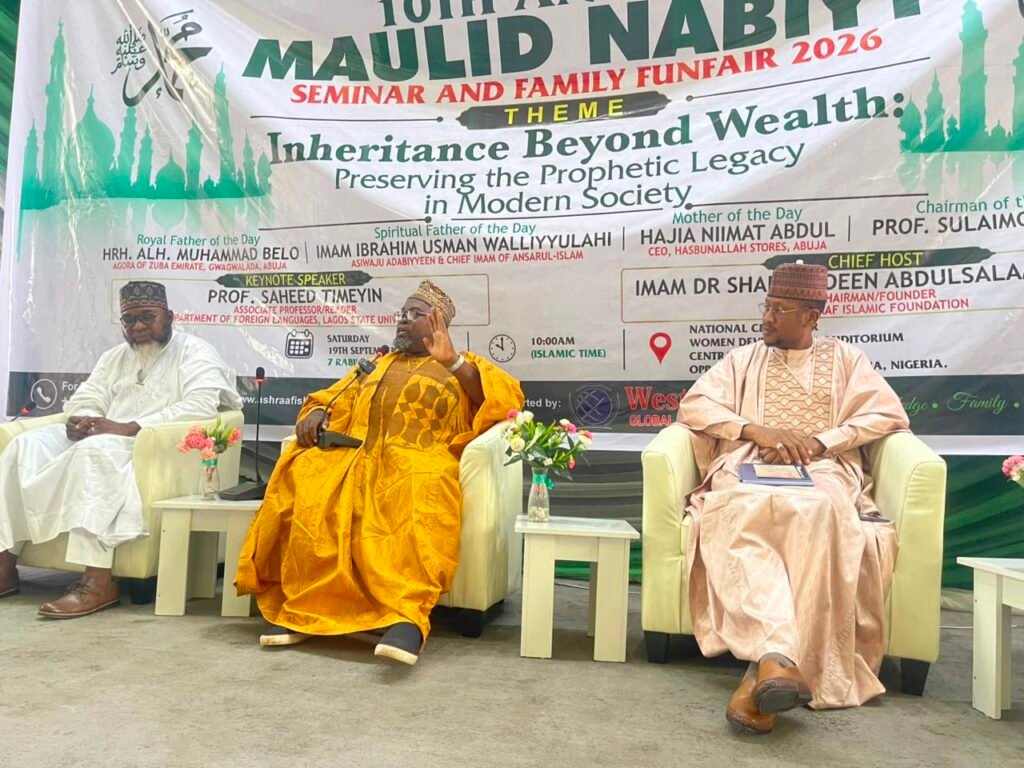
Prof. Saheed Timeyin, a lecturer in the Department of Foreign Languages, Lagos State University (LASU), has urged Muslim faithful to emulate the exemplary life and legacies of Prophet Muhammad.
Timeyin made the call at the 10th Annual Maulid Nabiyy Seminar and Family Funfair, organised by the Ashraaf Islamic Foundation in Abuja on Saturday.
The theme of the seminar was “Inheritance Beyond Wealth: Preserving the Prophetic Legacy in Modern Society”.
He said Prophet Muhammad died without leaving behind a worldly dynasty but established a moral civilisation and spiritual legacy that continued to influence humanity.
Timeyin said the celebration of Maulid Nabiyy should encourage Muslims to study, understand and practise the teachings and character of the Prophet.
“Those of us who celebrate Maulid Nabiyy have a moral responsibility to use the image of Muhammad,” he said.
He said the conduct of Muslims should be such that people who interacted with them would see reflections of the Prophet’s character.
“When somebody meets you, they should be able to say, I am Muhammad,” he said.
According to him, the essence of Maulid Nabiyy is to emulate the timeless precepts and teachings of Prophet Muhammad.
Timeyin said the Fatimid Caliphate in Egypt, who started the Maulid celebration, intended to use the occasion to pass on the message and teachings of the Prophet.
He said the life of Muhammad was sufficiently comprehensive to provide lessons for virtually every human experience.
“That is why there is no aspect of human life for which you would not have a reference in the life of the Prophet,” he said.
Timeyin said the Prophet’s early life demonstrated perseverance, faith and dependence on Allah in spite of the loss of his major sources of family support.
He noted that Muhammad lost his father before he was born, his mother at the age of six and his grandfather at eight.
“It’s like Allah removed all pillars of support because he wanted to show him that Allah alone is sufficient for you,” he said.
The lecturer said Muslims should therefore not allow their circumstances to become excuses for failing to live according to Islamic values.
He said the Prophet’s life contained lessons for people regardless of their social, family, professional or economic circumstances.
“You are a bachelor, he was a bachelor; you got married, he was a married man,” he said.
Timeyin added that Prophet Muhammad was also a father, businessman, military leader and head of state, thereby providing examples applicable to different aspects of life.
“In whatever position you find yourself, you will always have lessons from Muhammad,” he said.
He said the enduring legacy of the Prophet was rooted in wealth guided by God-consciousness, rather than material accumulation alone.
According to him, wealth without God-consciousness could destroy an inheritance, while education without ethics could turn intelligence into a weapon.
“Technology without ethics can magnify destruction,” he said.
He further cautioned that religious knowledge without proper moral guidance could produce intolerance and even be used to justify terrorism.
Timeyin said the prophetic model remained an important source of moral guidance capable of filling the gaps created by material inheritance.
He described the legacy of Prophet Muhammad as one of the greatest paradoxes in history because the Prophet left no worldly dynasty but established a lasting moral and spiritual civilisation.
“A man who died without leaving behind a worldly dynasty, left behind a moral civilisation and a spiritual empire,” he said.
He added that although the Prophet did not accumulate political power or worldly possessions, he left principles that influenced societies and institutions.
“A man who left the world 14 centuries ago still shapes the conscience of hundreds of millions of people all over the world who have never seen his face,” he said.
Timeyin said the theme of the seminar was both beautiful and challenging because it required individuals to consider what they would leave behind beyond their material possessions.
He urged Muslims to ask themselves what their children and communities would inherit from them that money could not buy, technology could not manufacture and time could not destroy.
According to him, people often associate inheritance with houses, land, bank accounts, businesses, shares, cars, jewellery and other material possessions.
He acknowledged that Islam recognised the importance of material inheritance and established principles for the rights of heirs and distribution of estates.
Quoting the Qur’an, he said: “For men is a share of what parents and close relatives leave, and for women is a share of what parents and relatives leave.”
He said justice and fairness in the distribution of wealth, protection of heirs’ rights and responsible estate planning were important aspects of Islamic teachings.
Timeyin, however, said there was another form of inheritance that could not be captured in a will, bank statement or property document.
He described it as the inheritance of faith, knowledge, character, compassion, justice, courage, service and moral responsibility.
He said the greatest inheritance of Prophet Muhammad was not material wealth but the example of authentic living and commitment to divine guidance.
According to him, the Prophet received divine revelation and transformed a morally troubled society through faith, justice, compassion and responsible leadership.
He urged Muslims to study the life of the Prophet, teach his words, follow his Sunnah and strive to reflect his character in their daily activities.
Also speaking, the Chairman of the occasion, Prince Muhammad Babagobi, said the theme was not limited to material wealth but included faith, guidance and moral responsibility.
Babagobi said the Prophet taught Muslims to uphold principles and actions that would promote harmony within their communities.
He urged Muslims to avoid actions capable of causing failure, calamity and division in their communities.
“We should always complete and regard our brothers as our people of God that we can always come together and promote unity, promote peace and development,” he said.
Babagobi described the theme as apt, urging the organisers and participants to continue teaching and practising the teachings of Prophet Muhammad.
In his address of welcome, Imam Sharafdeen Aliagon, Founder of the Ashraaf Islamic Foundation, said he started the Maulid celebration 22 years ago.
Aliagon said the Abuja edition, organised under the foundation, had reached its 10th annual Maulid Nabiyy.
He said the foundation was committed to sustaining the celebration and spreading the message of the Prophet across the country.
He said the theme was particularly important because Islam had provided extensive guidance on inheritance, while the legacy of Prophet Muhammad extended beyond the sharing of material possessions.
He said inheritance should also be understood in terms of wisdom, knowledge, morality, peace and understanding.
“It protects family and prevents disputes,” Aliagon said, stressing the importance of educating Muslims about inheritance and the broader prophetic legacy.
He urged participants to preserve and transmit the values of Prophet Muhammad to younger generations and use such values to strengthen families and communities.
The Maulid Nabiyy seminar also featured a family funfair, bringing together Muslim faithful and members of the community to reflect on the life, teachings and enduring legacy of Prophet Muhammad.(NAN) www.nannews.ng
ADA/FAK
Edited by Funmilayo Adeyemi


Comments