


By Sarafina Christopher
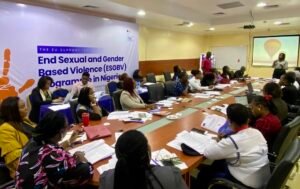
The EU-funded Support to End Sexual and Gender-Based Violence (ESGBV) programme on Tuesday equipped trainers with skills to strengthen the implementation of procedures on school-related gender-based violence (SR-GBV).
NAN reports that the two-day workshop in Abuja was organised under the ESGBV Programme and implemented by the International Institute for Democracy and Electoral Assistance (International IDEA) in collaboration with the Federal Ministry of Justice.
The training focused on the Standard Operating Procedure (SOP) for the legal pathway to prosecuting perpetrators of SR-GBV in Nigeria.
Mrs Melissa Omene GBV Policy and Strategy Development Specialist with the ESGBV Programme, International IDEA, said that SR-GBV remains a major threat to children’s safety and education.
“SR-GBV remains a deeply concerning reality within Nigeria’s education system, affecting children at both basic and secondary levels through sexual harassment, abuse, exploitation, bullying, corporal punishment and technology-facilitated violence,” she said.
Omene noted that recent studies show that 18 per cent of sexual violence incidents occur in schools, while 25 per cent of children report experiencing corporal punishment by teachers.
“Beyond statistics, these are lived experiences that disrupt safety, dignity, learning and long-term wellbeing,” she added.
She also added that although the 2024 SOP developed by the Federal Ministries of Justice and Education provides a framework for coordinated reporting and accountability, gaps in awareness and implementation continue to limit its effectiveness.
Omene noted that the ESGBV Programme, running from 2025 to 2029, aims to strengthen institutional systems, improve access to services for survivors and promote positive social norms across Nigeria, including the Federal Capital Territory, Benue, Kaduna, and Oyo States.
“The ESGBV Programme recognises that addressing SGBV requires more than isolated interventions.
“It requires coordinated action across legal, institutional and social domains,” she said.
She added that participants were being trained to serve as multipliers who would cascade knowledge within their institutions.
Also speaking, Mrs Yewande Gbola-Awopetu, Head of the Sexual and Gender-Based Violence Response Unit at the Federal Ministry of Justice, said delays in the prosecution of cases often undermine justice outcomes.
“One of the gaps we noticed in the treatment of SR-GBV cases was the legal aspect. From reporting to investigation and prosecution, sometimes it could take a year, and by then, the evidence is lost,” she said.
She said the SOP was designed to standardise procedures and ensure a timely and effective response to cases across schools.
Executive Director of Protect the Child Foundation, Mrs Elizabeth Achimugu, said the training was designed to bridge the gap between policy and implementation.
“What most times, when SR-GBV is mentioned, there is a gap between knowledge and implementation. This training is to bridge that gap,” she said.
Achimugu added that participants would step down the training within their institutions to improve coordination and survivors’ access to justice.
Earlier in her remarks, Mrs Apakasa Augustina, Assistant Director at the Federal Ministry of Education, commended the initiative and reaffirmed the ministry’s commitment.
“There is no effective way to end gender-based violence without training school personnel, because schools are among the primary places where such cases are experienced and reported,” she said.
She added that the ministry had already distributed the SOP document to all 115 Unity Schools nationwide. (NAN)(www.nannews.ng)


Comments