


By Folasade Akpan
Health experts have called for stronger collaboration among scientists, policymakers and communities to translate health innovations into practical solutions that save lives and improve healthcare delivery.
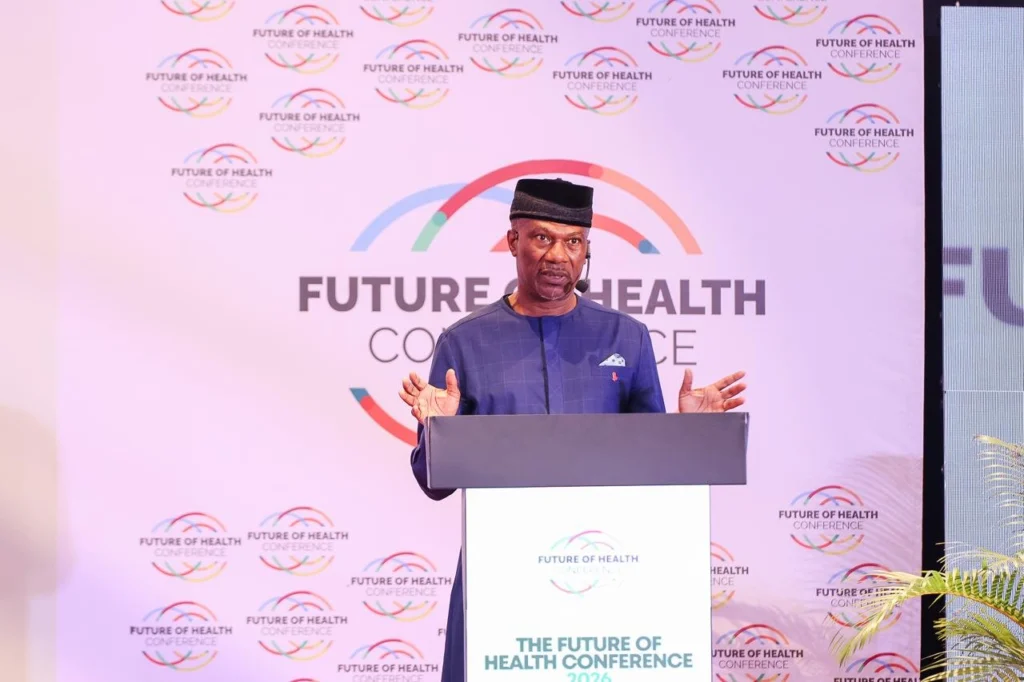
They made the call at a panel session titled “Innovations That Save Lives Now” at the Future of Health Conference organised by Nigeria Health Watch in Abuja on Thursday.
Dr Erasmus Morah, Senior Adviser to the Director-General on Global HIV, Strategic Partnerships and Health Security at the Africa Centres for Disease Control and Prevention (Africa CDC), said scientific discoveries alone could not guarantee improvements.
He emphasised the need for supportive policies and community participation to translate scientific innovations into better healthcare outcomes.
Drawing on his experience in Nigeria’s HIV response, Morah said correcting inaccurate data had helped change the country’s understanding of its treatment coverage.
He said Nigeria’s HIV treatment coverage stood at about 33 per cent in 2017, but a Nigeria AIDS Indicator Survey (NAIS) revised the estimated number of people living with HIV from 3.2 million to 1.8 million.
According to him, the revised estimate raised the reported treatment coverage to 65 per cent, while current coverage was approximately 85 to 86 per cent.
“Overnight, I became popular because I was in Nigeria when the survey results were released. Treatment coverage, which had remained at 33 per cent, rose to 65 per cent simply because we had more accurate data,” he said.
He said the experience demonstrated the importance of evidence and the willingness of health-sector leaders to challenge established assumptions when available data did not reflect reality.
Morah also cited Malawi’s HIV response, where he said the number of people receiving treatment increased from fewer than 1,000 in 2002 to 36,000 in 2006, and approximately one million currently.
He attributed the progress partly to a change from voluntary testing and counselling to generalised provider-initiated testing and counselling, which helped identify more people requiring treatment.
He urged health-sector stakeholders to establish locally accountable implementation coalitions involving leaders and affected communities to ensure that innovations translated into better health outcomes.
“Innovation by itself will not move the needle. We need science, we need politics, and we need the community in between.
“Science without politics is powerless. Politics without science is dangerous.”
Similarly, molecular geneticist Dr Ify Aniebo said locally generated malaria research data could help policymakers develop targeted interventions against drug resistance.
Aniebo said a pilot study using data from 20 local government areas in Nigeria showed differences in malaria parasite resistance patterns and genetic profiles.
She said the research involved collecting more than 60,000 malaria parasite samples, conducting laboratory tests and applying machine learning to support analysis and decision-making.
According to her, the cost of sequencing a parasite’s DNA had been reduced from about 150 dollars to 20 dollars per sample in Nigeria through improvements in the research process.
She said the team also used artificial intelligence, machine learning and CRISPR technology to investigate genetic variations and understand their potential implications for malaria drug resistance.
Aniebo said a dashboard had been developed to present information on drug-resistance mutations across Nigeria, while an artificial intelligence model trained on Nigerian malaria genetics was designed to make the findings more accessible to policymakers.
“We do not want to create a separate programme that will be difficult to sustain. Instead, we want to integrate our work into existing systems and strengthen the health system,” she said.
She said the goal was to ensure that research findings informed decisions by policymakers and National Malaria Elimination Programmes.
Also, Ikechukwu Anoke of Zuri Health said technology could improve access to healthcare by connecting people, particularly those in underserved communities, with health services.
He said innovation also involved using technology to make healthcare more accessible and affordable, including exploring services that could be accessed through mobile phones.
“Our goal is to provide services at a cost of about N1,000, bringing healthcare closer to people through their mobile phones. It is about putting a hospital in the palm of your hand,” he said.
Anoke said screening remained a major challenge, as people could die from treatable diseases when conditions were not detected early enough.
He said Zuri Health had taken screening services to underserved communities through outreach programmes and medical camps, screening hundreds of thousands of people and connecting those requiring care with doctors and other health services.
He added that artificial intelligence could help predict health outcomes and identify disease risks to support decisions on patient care.
Dr Chidinma Anyanwu of Project HOPE highlighted the importance of locally adapted healthcare solutions, saying point-of-care ultrasound and improved skills among frontline health workers could help identify pregnancy complications early and improve maternal outcomes.
Anyanwu said Project HOPE was working with relevant authorities and health facilities to strengthen frontline healthcare workers’ capacity to use point-of-care ultrasound in Kwali Area Council of the Federal Capital Territory.
She said the initiative involved 10 health facilities, five of which served as hubs with point-of-care ultrasound services, while the other facilities referred patients to them.
“The target is, at the minimum, every woman coming for antenatal would have a minimum one point-of-care scan,” she said.
Anyanwu said the initiative also supported task-shifting and task-sharing by equipping health workers with the skills to provide ultrasound services at the primary healthcare level.
She explained that training began with virtual instruction through the Global Ultrasound Institute before moving to practical sessions using models and pregnant women.
Each trainee conducted at least six scans daily during the practical training period, she said, adding that mentors continued to provide support after the training.
“We didn’t just go to the facilities and tell these healthcare workers. We started with the fundamentals.”
She said health workers could also seek guidance through WhatsApp and a digital platform that allowed them to upload scans for review when they needed clarification.
Anyanwu urged other health-sector organisations to support continuous training and mentorship, emphasising that providing equipment alone would not guarantee effective use or sustainable results.
“For us, impact is one step at a time. If we can build the capacity of the healthcare workforce, strengthening that for the purpose, we obviously will win.”
The News Agency of Nigeria (NAN) reports that the Future of Health Conference provides a platform for stakeholders to examine how health innovations, partnerships, research and sustainable financing can improve healthcare delivery in Nigeria.
The 2026 edition, themed “From Innovation to Impact: The Future of Health is Now”, focuses on practical solutions, scaling effective interventions and strengthening health systems to achieve measurable health outcomes.(NAN)
Edited by Abiemwense Moru


Comments