


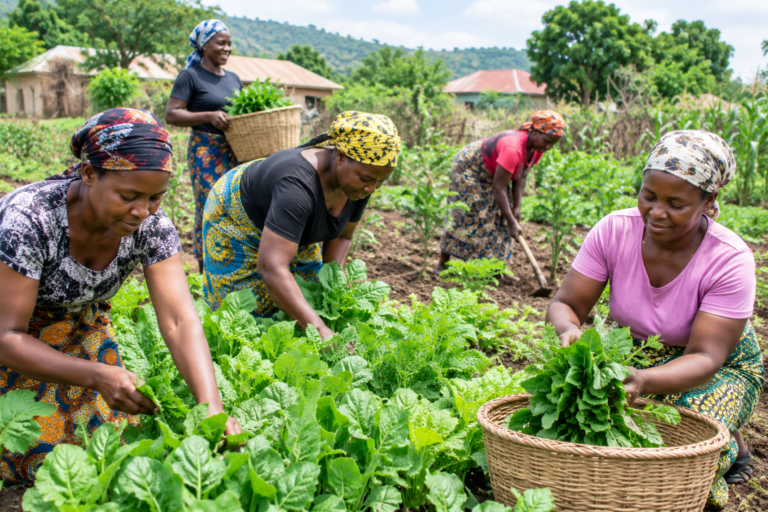
FCT women farmers seek improved access to finance, markets
By Veronica Dariya
Women farmers and petty traders in Bwari Area Council, FCT, have urged the government and stakeholders to provide affordable finance, storage facilities and market linkages to boost their businesses.
The women, who spoke in separate interviews with the News Agency of Nigeria (NAN) on Sunday in Abuja, said an improved support mechanism would also boost their household incomes.
They said inadequate capital, rising cost of farm inputs, poor storage facilities, transportation challenges and unstable prices of farm produce remained major challenges to their livelihoods.
Mrs Theresa Elias, a vegetable farmer, said women farmers often invested heavily in production but struggled to make reasonable profits due to inadequate access to markets and post-harvest losses.
She noted that the absence of affordable storage facilities forced many farmers to sell their produce immediately after harvest, sometimes at prices below the cost of production.
“Some of us produce and sell these greens and tomatoes you see in the market and we transport them from interior communities far from the town where we live and farm.
“Farming is profitable but its major challenges are storage and transportation and sometimes, we bear the burden of losses if we do not sell off everything immediately,” she said.
Elias, who said she used the business to support her husband who is also a farmer, added that selling the farm produce after harvest helped sustain her family and meet other needs.
She appealed to relevant agricultural agencies to establish community-based storage facilities and strengthen linkages between farmers and bulk buyers to reduce waste and improve their bargaining power.
Another farmer, Mrs Grace Awoyi, said the rising prices of fertiliser, seeds, pesticides and other farm inputs had made farming increasingly difficult for women operating on a small scale.
According to her, access to low-interest loans and grants will enable women farmers to expand their farms, acquire improved inputs and increase food production.
She said: “Sometimes we have good harvests, but the challenge is where and how to sell them at a good price.
“Middlemen here often dictate prices because we have limited access to bigger markets and we can’t process or store the produce for future use, except for local drying.”
Awoyi called for measures to ensure fair and transparent pricing of farm produce, saying stronger farmer cooperatives and access to reliable market information would help women negotiate better prices and reduce exploitation by middlemen.
She further urged the council, private and government-related agricultural development organisations to prioritise and initiate programmes that support women farmers in rural communities.
Similarly, Mrs Shekwoyemi Daniel, a petty trader who sells food items at Zamayi Market in Bwari, said inadequate working capital and fluctuating prices had made it difficult to maintain sufficient stock.
According to Daniel, traders are also affected by transportation costs, low purchasing power among consumers and competition from larger businesses.
She, however, said women-friendly credit schemes, training in financial management and stronger connections between traders, producers and established markets would help many women grow their businesses.
She said: “In spite of all these challenges, some of us have recorded progress through personal savings, cooperative societies, skills acquisition programmes and support from community-based organisations.
“The cooperative group I belong to has helped some of us access small loans, purchase farm inputs collectively and support one another during periods of financial difficulty.
“This is why I believe that if we get bigger and stronger support from government or other development organisations, we can do better in business and support our families at the same time.”
Daniel added that supporting women farmers and petty traders would not only improve livelihoods but also contribute to food security, employment creation and economic development in Bwari.
She, therefore, urged the government to move beyond occasional empowerment programmes and establish sustainable interventions that would enable women to build businesses capable of surviving economic challenges.
Mrs Anna Yonah, a women leader in Baran-goni community, also said improved access to mobile banking and social media platforms had enabled some women to advertise their products and reach customers beyond their immediate communities.
She, however, stressed that such progress remained limited as many women still lacked sufficient capital, business facilities and access to larger markets.
She appealed for regular capacity-building programmes on improved farming methods, food processing, packaging, bookkeeping and digital marketing to enable the women to compete more effectively. (NAN)(www.nannews.ng)
Edited by Dorcas Jonah




Comments