


By Philip Yatai
The Federal Capital Territory Administration (FCTA) says its authority to enforce traffic regulations remains fully intact and warned traffic offenders and touts of dire consequences.
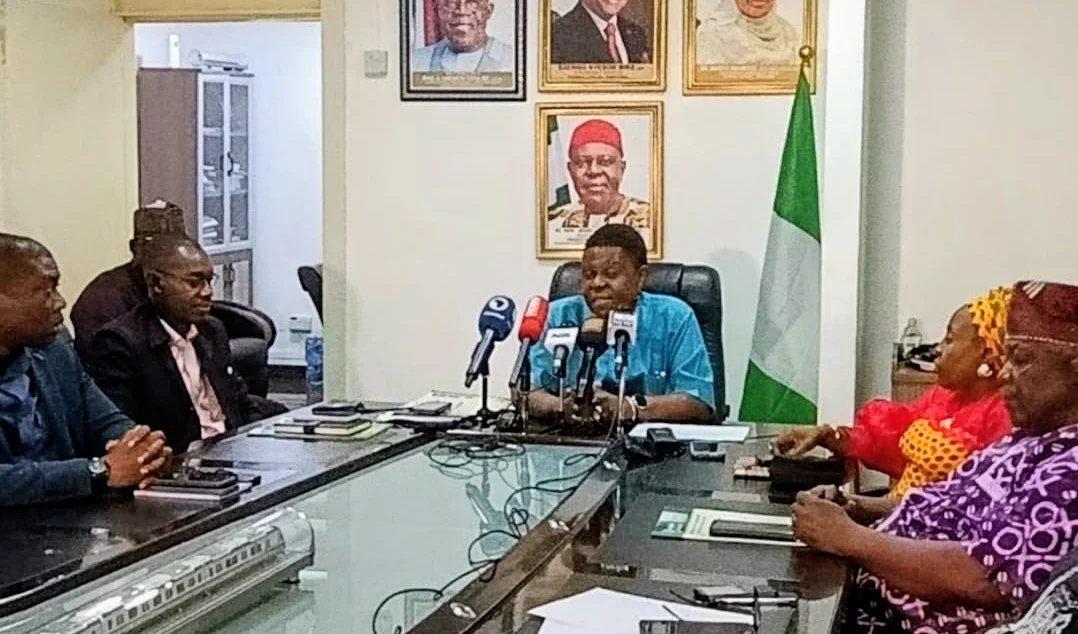
The Mandate Secretary, FCTA Transportation Secretariat, Mr Chinedum Elechi, gave the warning at a news conference in Abuja on Thursday.
Elechi dismissed claims that a recent court judgment stripped the administration’s Department of Road Transport Services (DRTS) of its power to impound vehicles or penalise traffic offenders.
He issued a stern warning to motorists attempting to take advantage of legal misconceptions surrounding the status of the DRTS.
He clarified that the court evaluated the DRTS as a single department lacking a specific enabling statute akin to Lagos State Traffic Management Authority.
The mandate secretary added that the broader legal mandate to enforce transportation laws rested directly with the FCTA as a corporate entity under the leadership of FCT Minister, Nyesom Wike.
“People will say, ‘Oh, there’s no DRTS, so we can do anything we like.’ False, it is not true. The enforcement capacity for transportation infractions does not rest solely with DRTS; it rests with the FCTA,” he said.
He emphasised that traffic management in the nation’s capital was an integrated, multi-agency effort executed through the city’s joint “Command and Control” task force.
He explained that the combined enforcement structure brought together the DRTS, the FCT Security Department, the Nigeria Police Force, the Nigerian Security and Civil Defence Corps, the Department of State Services, the Abuja Environmental Protection Board and other security agencies.
“When we move into the street, it is not just DRTS. You will see us there as a complete executive body. I am issuing a warning: don’t do anything you think you like, because we will come after you,” he said.
Reiterating the administration’s commitment, Elechi noted that safe and orderly public transportation was central to Wike’s vision of maintaining a clean, secure, and functional capital city.
He declared a full-scale crackdown on touts, unregistered transport operators, and illegal motor parks across the nation’s capital, warning that the era of appeals and soft enforcement was over.
Elechi announced that the administration would deploy mobile courts to prosecute offenders, impound vehicles, seal illegal premises, and even crush seized automobiles were mandated by judicial verdicts.
He noted that previous soft-touch approaches and gentle appeals by the administration had been mistaken for weakness by illegal operators.
“We have held several meetings; we have made appeals. So, we’re tired. When you appeal to people, they think that you are weak.
“The appeal we made in the past was not because of weakness. Now, we’re coming out with strength. We’re not appealing; we’re going to clean out the streets,” he said.
The mandate secretary dismissed claims that some of the transport groups operating along major corridors were recognised, emphasising that even those categorised as “organised” lacked valid operational licenses from the FCTA.
“Even the ones you call organised are not organised! They don’t have licences. You ask them to come and get licence, they don’t,” he stated.
“With the development of formal bus terminals across the FCT, operators will no longer be allowed to convert unauthorised locations in areas like Wuse or Utako into illegal loading points.
Highlighting previous enforcement efforts, Elechi revealed that the Secretariat had previously impounded over 100 vehicles but released them on compassionate grounds.
He warned, however, that operators should “take it to the bank” that no such leniency would be extended moving forward.
Backing the incoming enforcement exercise with legal instruments, the mandate secretary cited the Federal Capital Territory Establishment Law Dissolution Order No. 1 of 2004, signed by former President Olusegun Obasanjo.
He said that the order established the Transportation Secretariat, as well as the FCT Road Transport Regulations 2023.
“The existing laws give powers to seal premises, impound vehicles, set up mobile courts, and get people convicted and sent to prison.
“If you operate without a licence, the law prescribes three months imprisonment in some sections. If we get hold of your vehicle, you will face the mobile court.
“If we are given a verdict to seize and crush your vehicle, we will do it,” he said.
Elechi said that the transportation secretariat was fully committed to carrying out the mandate strictly according to the law to restore order to Abuja’s transportation network. (NAN)
Edited by Funmilayo Adeyemi

Comments