


By Justina Auta
The Federal Government, in collaboration with UN Women and development partners, has intensified efforts to institutionalise gender-responsive planning and budgeting across Ministries, Departments and Agencies (MDAs) to promote inclusive national development.
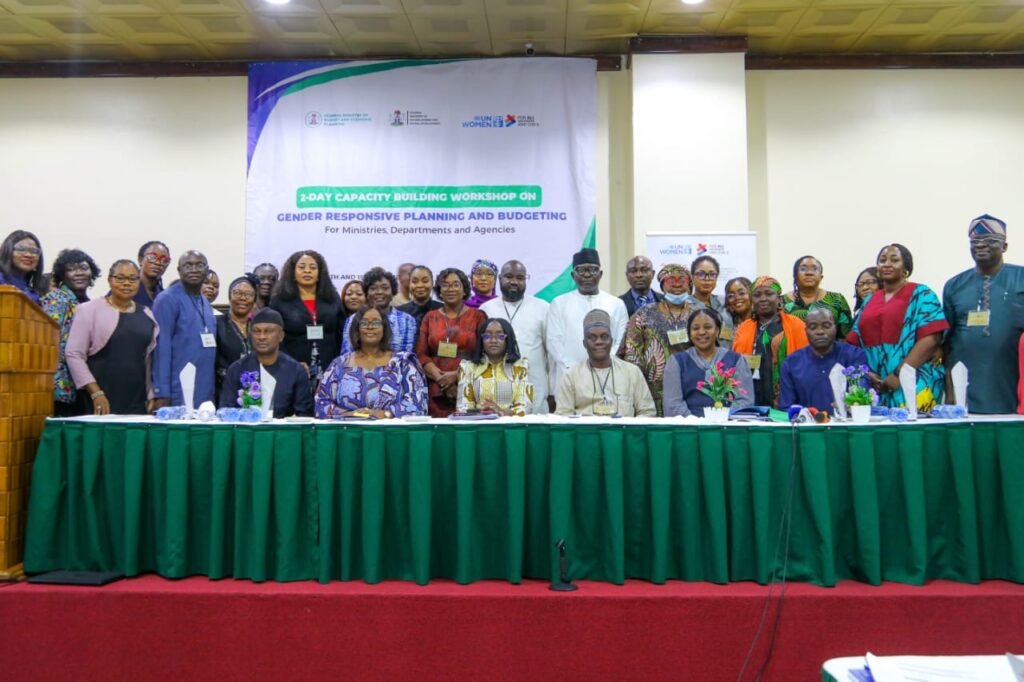
The renewed commitment was reiterated at a capacity-building programme on Gender-Responsive Planning and Budgeting organised by the Federal Ministry of Budget and Economic Planning on Monday in Abuja for senior officials.
Mrs Esuabana Nko-Asanye, Permanent Secretary, Federal Ministry of Women Affairs and Social Development, said the training would strengthen government officials’ capacity to implement equitable planning, budgeting and development nationwide more effectively.
Nko-Asanye, represented by Director of Gender Affairs, Mr Samaila Adamu, explained that gender-responsive planning and budgeting involved mainstreaming gender considerations into decision-making throughout the annual budget cycle and key economic processes.
According to her, the approach promotes awareness of gender inequalities, analyses their causes, and supports programmes addressing the different needs of women, children and other vulnerable groups across society and communities.
Nko-Asanye said, “Gender Planning and Budgeting simply means mainstreaming gender considerations into decision-making within the annual budget cycle and other key economic decision processes.” emphasising relevance to government planning and budgeting.
“By this, we promote awareness of gender inequalities, its causes, run policy analysis, review and appraise policies, and design gender-responsive programmes to deal with existing inequalities, especially for women, children and other persons with special needs,” she added.
She therefore urged Gender Focal Persons across MDAs to apply knowledge gained during the training to advance government’s Roadmap to Equality by 2030 and strengthen implementation nationwide.
The Permanent Secretary said strong families were foundations of prosperous societies, emphasising that investing in family wellbeing was a high-return economic policy essential to tackling poverty, insecurity, inequality and unemployment.
Also, Dr Deborah Odoh, Permanent Secretary, Federal Ministry of Budget and Economic Planning, said gender-responsive budgeting was being integrated into national planning and budgeting, with the 2027 budget expected to reflect reforms.
Odoh said gender-responsive budgeting should not be treated as a standalone initiative but embedded across policy formulation, resource allocation, implementation, monitoring, evaluation and reporting within government operations and programmes.
According to her, the ministry, supported by UN Women and partners, developed a gender-responsive planning and budgeting framework to guide MDAs in identifying gaps, integrating interventions into plans and tracking results.
She said that although the Budget Office of the Federation had incorporated gender-responsive planning and budgeting into budget circulars, responses from MDAs remained low in spite of ongoing sensitisation and technical support initiatives.
“As we plan for our 2027 budget, with all the training that is being done at top level and middle level that will cascade down, we expect that the 2027 budget will be a reflection of all the things that we have done,” she said.
She also said the Renewed Hope Ward Development Survey, conducted across Nigeria’s 8,809 wards, had generated critical data on community needs to support evidence-based and inclusive development planning nationwide and locally.
Dr Abdul Kamara, Acting Vice-President, Regional Development, Integration and Business Delivery, and Director-General, African Development Bank Nigeria Country Department, described gender-responsive budgeting as a strategic tool for promoting inclusive growth.
Kamara, represented by Dr Patience Ekechukwu, Gender Equality and Women’s Empowerment Specialist, AfDB, said governments must ensure public expenditure addressed barriers limiting women’s and girls’ access to opportunities and decision-making.
He reaffirmed AfDB’s commitment to supporting the institutionalisation of Nigeria’s gender-responsive planning and budgeting framework through technical assistance, capacity development and sustained institutional support across relevant government agencies nationwide.
On her part, Ms Beatrice Eyong, UN Women Country Representative to Nigeria and ECOWAS, said the organisation had moved beyond advocacy to a structured process of institutionalising gender-responsive planning and budgeting within Nigeria’s public service.
Eyong said UN Women had signed a Memorandum of Understanding with the Civil Service of Nigeria to support the initiative and promote inclusive workplaces across public institutions nationwide and sustainably.
She said that Permanent Secretaries, directors and senior government officials had undergone training, while a five-year implementation plan would monitor how MDAs integrate gender-responsive planning and budgeting into their operations.
“Institutionalisation cannot be achieved through a two-day workshop alone.
Sustained monitoring, technical support and implementation will be required,” Eyong said.
She added that success would ultimately be measured by tangible improvements in the lives of women and girls through more equitable allocation and utilisation of public resources across Nigeria’s communities(NAN)
Edited by Abiemwense Moru
Comments