







By Ijeoma Olorunfemi
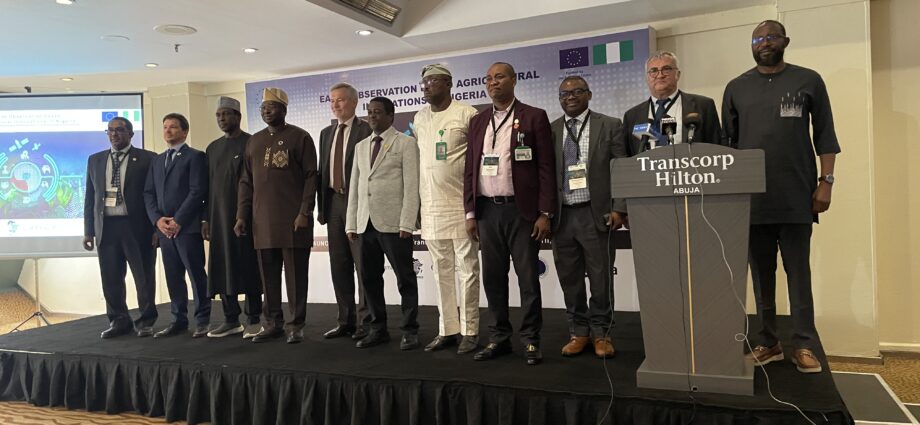
The Federal Government, in partnership with the European Union (EU), inaugurated a £2.7 million Earth Observation (EO)-based Agricultural Innovation Project aimed at transforming Nigeria’s agriculture sector through space technology and data-driven solutions.
The project, jointly implemented by the National Space Research and Development Agency (NASRDA) and the European Space Agency (ESA), was designed to enhance climate-smart agriculture, improve productivity and strengthen food security across the country.
Dr Kingsley Udeh, Minister of Science, Technology and Innovation, at the inuauguration on Thursday in Abuja described the initiative as a defining moment for Nigeria’s agricultural transformation.
Represented by Dr Mukhtar Yawale, Permanent Secretary of the ministry, Udeh said that agriculture remained central to Nigeria’s economy and livelihoods.
However, he said, it faced increasing challenges such as climate change, land degradation, environmental stress, and population growth.
He said addressing these challenges required a paradigm shift driven by innovation, data and technology.
“This vision aligns with the Renewed Hope Agenda of President Bola Tinubu, which places agriculture at the core of national economic revitalisation.
“The administration is committed to achieving food security, reducing import dependence, enhancing value chains and promoting modern, technology-driven agricultural practices,” he said.
According to him, EO technologies provide accurate, timely and scalable data that can improve crop monitoring, environmental risk assessment, land use planning and evidence-based decision-making.
Dr Matthew Adepoju, Director-General of NASRDA, said the agency had made significant investments in satellite infrastructure, data systems and human capacity over the years.
Adepoju said that the true value of space technology was in translating data into practical solutions with measurable impact.
“This initiative aligns with all the Sustainable Development Goals (SDGs), demonstrating strong global partnerships involving African and European institutions,” he said.
Mr Gautier Mignot, EU Ambassador to Nigeria, said the project, funded under the EU Global Gateway strategy, would run for three years and support farmers and herders with space-based information.
Mignot explained that the initiative would deploy modern technologies to promote climate-smart practices, improve livestock management and modernise farming systems.
He further said that EU chose to work with Nigeria because the country was advancing in technology.
According to him, the project will help position Nigeria as a hub for agricultural innovation on the continent.
Minister of Agriculture and Food Security, Sen. Abubakar Kyari, represented by Mr Olanipekun Oshadiya, Director of Agriculture, Land and Climate Change Management Services, highlighted the importance of satellite imagery in modern agriculture.
He said the technology would enable accurate soil mapping, crop yield forecasting and efficient land-use optimisation.
Dr Godstime James, Director of Strategic Space Applications, NASRDA, earlier said seven states which included Kano, Bauchi, Plateau, Oyo, Enugu, Cross River, and the FCT had been selected for demonstration farms across Nigeria’s agro-ecological zones.
James added that farmers in those states would be equipped with Internet of Things (IoT) devices and supported with Artificial Intelligence (AI)-based tools for data collection and analysis.
In his presentation, Dr Christopher Sannier, an expert on the project, outlined that the project would develop a sustainable, open-source agricultural information system, co-developed with NASRDA.
Sannier said the system would integrate satellite data with ground sensors and include features such as voice-based AI advisory services, SMS alerts, a mobile application and a web dashboard, among others. (NAN)http://www.nannews.ng
Edited by Uche Anunne