


By Mark Longyen
Antalya (Türkiye) Global leaders and senior government officials have converged on Antalya, Türkiye, for this year’s Antalya Diplomacy Forum (ADF2026) an annual multilateral conference aimed at managing current global uncertainty.
The three-day annual conference, which kicks off on Friday in the serene southern Mediterranean city, is hosted by the Turkish Ministry of Foreign Affairs under the auspices of President Recep Erdogan.
The News Agency of Nigeria (NAN) reports that the forum, themed: “Mapping Tomorrow, Managing Uncertainties,” focuses on “Navigating Uncertainty in a Changing World.”
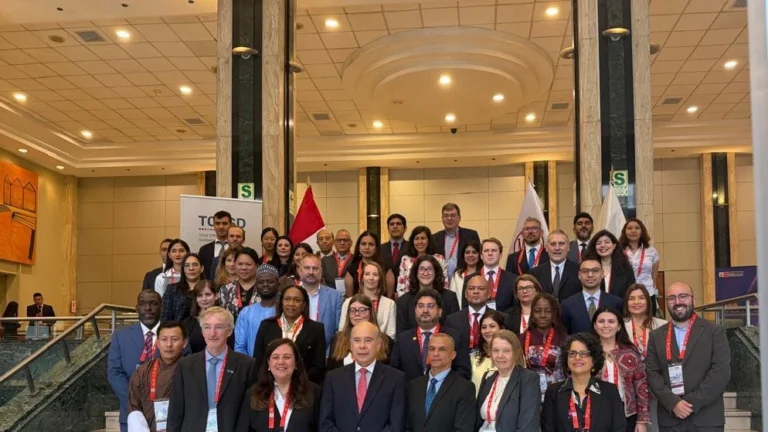
Participants include 20 heads of state and government, 40 foreign ministers, 60 invited foreign media, over 5,000 decision-makers, academics, experts and diplomats, among others from about 150 countries.
Prominent dignitaries in attendance include Russian Foreign Minister Sergey Lavrov; Secretary-General of the League of Arab States; Ahmed Gheit; Egyptian Foreign Minister, Dr Badr Abdel-Aty; and Director-General of UNESCO, Dr Khaled El-Enany.
The multilateral diplomatic conference, initiated by Erdogan in 2021, opens this year in an international environment that is currently characterised by the erosion of traditional alliance and security norms.
The event kicks off amid several globally sensitive issues, such as the U.S.-Israel-Iran war, and its attendant energy security and maritime routes crisis, the Russian-Ukrainian war, and other international conflicts.
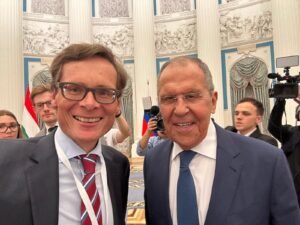
Russian Foreign Minister Sergey Lavrov (right) arrives in Türkiye alongside other top dignitaries for ADF2026.
The ADF is Türkiye’s multilateral engagement strategy to bolster strategic ties, reshape global governance narratives, and position itself as a diplomatic counterweight to Western institutions while promoting multipolar cooperation frameworks.
Participants say ADF2026 significantly provides a pivotal platform for international dialogue on myriad issues, as the world currently witnesses rapid geopolitical transformations, characterised by international tensions and increasing uncertainty.
They say the forum aims to interrogate and address the genuine concerns of nation-states, who no longer just seek to gain influence, but to define their position within an ill-defined international system.
“It is a platform for discussion, a tool of Turkish diplomacy, and a direct reflection of Turkey’s foreign policy strategy, based on balancing international powers, engaging with competing parties simultaneously, and combining mediation with active diplomacy.
“The forum differs from other international gatherings, such as the World Economic Forum and the Munich Security Conference in several ways, especially its flexibility in discussions and not being bound by pre-established scenarios.
“The forum allows space for multiple viewpoints without imposing a single vision, encourages informal meetings between rival parties, and has previously proven effective in creating channels of communication between conflicting parties,” Dr Mohamed Tharwat, a journalist and diplomatic analyst, said.
He said that, as it happened in important past diplomatic meetings between Russia and Ukraine, and Azerbaijan and Armenia, ADF does not seek to resolve conflicts directly, but focuses on managing international differences.
This, according to him, creates spaces for ongoing dialogue, promotes understanding between different parties, and reflects the reality of the current international system, where interaction continues, in spite of complete consensus absence.
Tharwat further explained that the forum reflects several important shifts, including the rising role of regional powers in shaping the international order, and represents a leading model for international dialogue platforms in an era of complexity and uncertainty.
“Instead of seeking immediate solutions, the forum focuses on managing international interactions and creating an environment for sustainable dialogue, making it one of the most prominent diplomatic gatherings in the world today,” he added.
NAN reports that the forum also features more than 40 panels, discussions and sessions covering a wide range of topics shaped by contemporary political, economic, environmental, and technological dynamics.(NAN)(www.nannews.ng)
Edited by Sadiya Hamza
Comments