


By Hafsah Tilde
UN Women has described Gender-Based Violence (GBV) as a major threat to Nigeria’s development, calling for collective action to end harmful practices and strengthen enforcement of laws protecting women and girls.
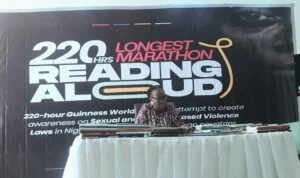
The UN Women Representative in Nigeria, Ms Beatrice Eyong, said this at the commencement of a 220-hour continuous reading marathon by Olubumi Oluba, on Monday, in Abuja.
Eyong said GBV was not limited to physical violence between spouses but included child marriage and other practices that denied girls access to education and economic opportunities.
“Many people think that GBV is essentially when somebody slapped the wife or somebody slapped the husband, and many people don’t relate it to our day-to-day life.
“Gender-based violence is not only a women’s issue. It is not only for gender advocates or activists. It is something that is actually limiting our development, seriously limiting our development.
“What of early marriages, what of child marriages, those children who are out of school, who cannot learn a marketable skill, cannot have a job because they were sent out of school or were taken out of school for marriage? That’s perpetration of poverty,” she said.
Eyong identified lack of public knowledge of existing laws as a major challenge in addressing Sexual and Gender-Based Violence (SGBV).
“Sometimes the duty bearers don’t know about these laws and sometimes the right owners don’t know about this law. You cannot assert any law that you actually don’t know about.
“Too many women and girls do not know their rights or where to seek help. That is why today’s initiative is particularly significant,” she said.
She described the reading marathon as an innovative approach to public enlightenment.
“Through this 220-hour reading marathon, Oluba will bring attention to legal frameworks, human rights instruments and survivor protection laws from 15 African countries.
“She is turning legal text into an instrument of public education, making important information accessible and bringing the law closer to the people it is meant to protect,” she said.
Eyong urged government institutions, traditional and religious leaders, civil society organisations, the media, families, men and boys to work together to end SGBV.
“We all have to come together to play a major part, to challenge harmful norms, promote accountability and build communities where violence is neither tolerated nor normalised.
“The most important thing is not just getting a Guinness World Records milestone. The most important thing is the millions of people that will be reached with this initiative,” Eyong said.
Also speaking, Yewande Gbola-Awopetu, Head of the SGBV Response Unit, Federal Ministry of Justice, said the fight against SGBV required more than the enactment of laws.
She said the ministry remained committed to strengthening access to justice, improving institutional response and promoting effective implementation of laws addressing SGBV.
“Sexual and gender-based violence remains a grave concern that threatens the dignity, safety, fundamental rights and well-being of individuals, families and communities.
“Its eradication requires more than the enactment of laws. It requires sustained public education, effective institutional response, access to justice, accountability and collective determination to challenge the attitudes, practices and structures that enable violence,” she said.
Gbola-Awopetu commended Oluba for dedicating the marathon to public awareness and legal education.
In her remarks, the Founder, Network of Women with Disabilities, Lois Auta, said women and girls with disabilities faced additional barriers in reporting sexual violence and accessing justice.
“For too many women, especially women and girls with disabilities, the law exists on paper, but it has not spoken to us and today, we will make it speak.
“When a woman with a disability is raped, what happens? Too often, nothing.
“The police station has steps she cannot climb. The officer does not know sign language. The medical form is not in Braille.
“The court says she cannot be a credible witness because she cannot speak the way they expect her to speak. So she goes home, and the perpetrator goes free,” she said.
Auta called for accessible information and facilities, including Braille materials, sign language interpreters and accessible buildings.
She also urged government to domesticate and enforce relevant laws, while calling on the police and judiciary to train their personnel and make police stations, hospitals and courts accessible.
“To civil society organisations, do not hold your workshops about us without us.
“Nothing about us without us. Anything about us without us is against us,” she said.
The News Agency of Nigeria (NAN) reports that Oluba, a staff member of the Federal Ministry of Justice, is undertaking the marathon to raise awareness of SGBV through the public reading of relevant laws from Nigeria and 14 other African countries.
The 220-hour exercise, which has commenced, is equivalent to nine days and four hours. (NAN)
TIL/OBA/FOF
Edited by Bukola Adetoye/Folasade Akpan
Comments