


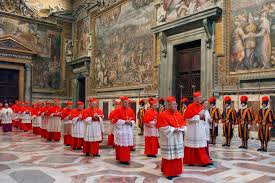
Shaped by centuries-old rituals, the conclave to choose a successor to the late Pope Francis is set to begin on Wednesday.
A ringing of bells will accompany puffs of white smoke announcing that a new pontiff has been chosen to lead the world’s Roman Catholics.
However, before that can happen, the conclave must be held.
The name of the election procedure derives from the Latin “cum clave” (with a key) and refers to the tradition of locking cardinals in a room until they agree upon a new pope.
As usual, voting will take place in the Michelangelo-frescoed Sistine Chapel at the Vatican.
Cardinals will swear an oath of secrecy about the proceedings and seal themselves off from the world.
To prevent any outside influence from affecting the election, the men will not be allowed to read newspapers, watch television, listen to the radio, exchange mail or use telephones and computers.
During the conclave, cardinals will be housed in Saint Martha House, a residence inside the Vatican built in the 1990s also used for the previous conclave.
Before 2005, cardinals had to sleep in cramped conditions in the Apostolic Palace, the pope’s official residence.
Theoretically, any baptized male Catholic is eligible to become pope. In practice, however, the conclave will elect one of the members of the College of Cardinals.
There is no official list of candidates for the papacy. Each cardinal simply writes the name of the person he favours on a slip headed with the words “Eligo in summum pontificem… ” (I vote for … as pope).
Cardinals are encouraged to disguise their handwriting to prevent anyone from knowing where their sympathies lie.
One ballot is held on the first day, followed by four on each successive day.
From ballot to ballot, support builds for various figures, making the outcome clearer until the needed two-thirds majority is reached.
Should no pope have been elected after three days, there must be an interruption of no more than a day to retire for prayer and “informal conversation among the electors,” as John Paul II directed in his 1996 document “Universi Dominici Gregis” (The Lord’s Whole Flock).
The most senior cardinal addresses the conclave.
Three urns will be used for voting. One is used to collect the cardinal’s ballot papers; another one to hold them after they have been counted; and a third may be brought to cardinals confined to Saint Martha House owing to illness or frailty.
Ballot papers are strung together and burned after each vote. When dark smoke rises from the Sistine chimney, this is a signal that no pope has been elected.
Though conclaves have in the past lasted months, and even years, in recent history they have never taken more than a week.
Once the necessary majority is achieved, the would-be pope is asked if he accepts the post. If he says yes, he assumes office from that moment and is asked to state the name he has chosen to use as pope – generally that of a former pontiff or of a beloved saint.
White smoke then rises from the Sistine Chapel, in a sign to the outside world that a pope has at last been elected.
At this point, the cardinal protodeacon, who at the time of Francis’ death was French Cardinal Dominique Mamberti, will appear from the central balcony of St. Peter’s Basilica to announce to the world: “Habemus papam” (We have a pope). (dpa/NAN) (www.nannews.ng)
Edited by Emmanuel Yashim


Comments