


By Felicia Imohimi
The Federal Government says the Special Agro-Industrial Processing Zones (SAPZ) policy will unlock agro-industrial growth, attract private investment, boost agricultural value addition and improve food and nutrition security.
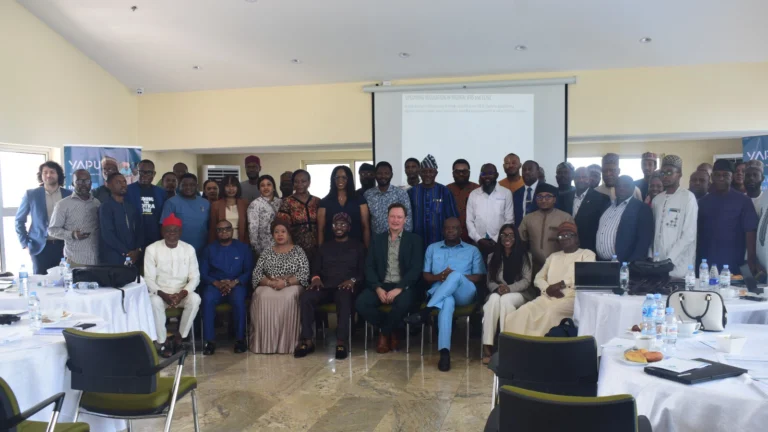
The Minister of Agriculture and Food Security, Sen. Abubakar Kyari, stated this at the stakeholders’ validation workshop on the draft SAPZ policy document on Monday in Abuja.
The workshop had the theme: “Facilitating Seamless Investment Entry and Operations in Nigeria’s Special Agro-Industrial Processing Zones.”
Kyari said Nigeria’s agricultural transformation would be driven through strategic partnerships, policy coherence and increased private sector investment.
He said food security was a key pillar of President Bola Tinubu’s Renewed Hope Agenda and was being treated as both a national security and economic priority.
“The President understands that food sovereignty cannot be achieved without investment in productive agriculture. Investment, in turn, depends on favourable policies, strong institutions and a predictable business environment.
“That is why the SAPZ national policy before us is both timely and strategic,” he said.
Kyari described the validation workshop as a defining engagement on Nigeria’s economic future.
He said the draft policy was designed to remove investment barriers, strengthen institutional coordination and position SAPZ as a globally competitive destination for agro-industrial investment.
According to him, Nigeria possesses the key ingredients for global agro-industrial leadership.
He said the country has more than 70 million hectares of cultivable land, over 3.1 million hectares of irrigation potential, diverse agro-ecological zones and preferential access to the 1.3 billion-person African Continental Free Trade Area market.
“These advantages position Nigeria as a natural destination for agricultural investment and regional value chain development.
“The SAPZ concept was visionary for its time, but today, priority commodities and markets have changed. Climate realities and investor expectations have also evolved.
“This expanded vision requires a modern policy framework, which informed the development of the current SAPZ draft policy.
“It is a policy committed to building stronger institutions alongside world-class agro-industrial environments,” he said.
Kyari said the draft policy provides a coherent framework for planning, regulating and promoting SAPZ while improving the ease of doing agribusiness.
He said the programme would integrate smallholder farmers into modern agricultural value chains through organised out-grower schemes, aggregation systems and guaranteed market access.
“Our smallholder farmers account for nearly 80 per cent of agricultural producers and produce about 85 per cent of Nigeria’s food.
“SAPZ is one of the strategic platforms that will put smiles on the faces of those at the first mile of agricultural production,” he said.
The minister said the programme would also create opportunities for youths and women in agribusiness, mechanisation, digital agriculture, climate-smart farming, logistics, food innovation and agricultural technology.
He added that the policy would strengthen governance, improve the ease of doing agribusiness and encourage sustained private sector participation.
According to him, the vision is to make SAPZ a compelling investment destination, a catalyst for industrial growth and a centre of excellence where productivity is rewarded and prosperity is shared.
“Nigeria is open for responsible agricultural investment. Our land is fertile, our market is vast, and our reforms and partnerships are credible.
“Let this national SAPZ policy become the bridge between production and prosperity, and between our farmers and global markets.
“With more SAPZs, Nigeria will feed itself on its own terms, control its food future and trade with the world from a position of strength.
“When our farmers prosper, food becomes secure. When our women are empowered, communities flourish. When our young people innovate, nations compete,” Kyari said. (NAN)(www.nannews.ng)
FUA/OIF/TAK
Edited by Ifeyinwa Okonkwo/Tosin Kolade
Comments