


By Martha Agas
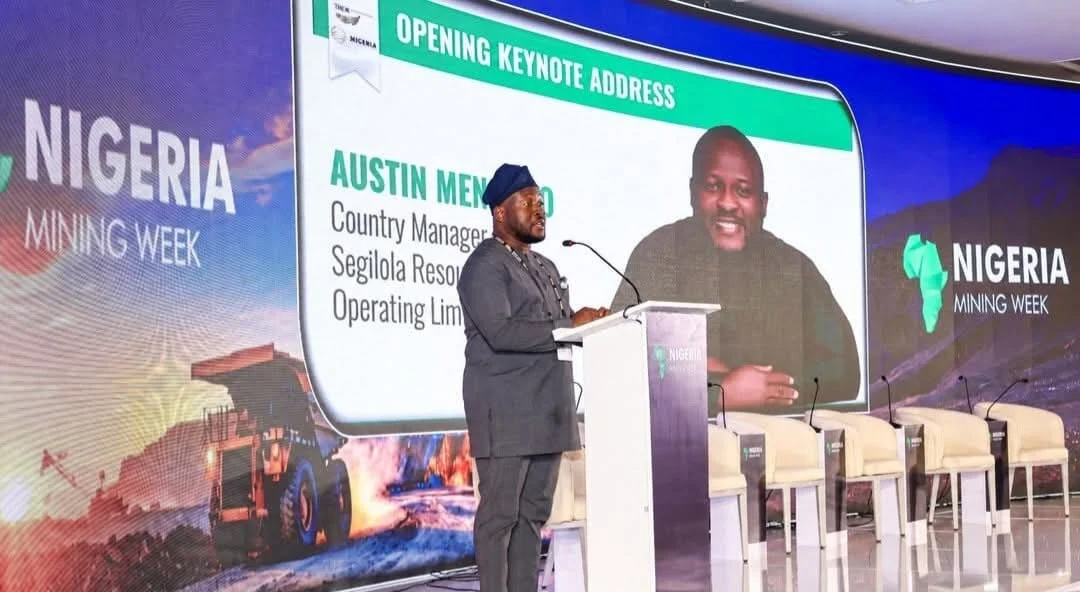
The Country Manager, Segilola Resources Operating Ltd., Austin Menegbo, on Tuesday in Abuja called for a comprehensive approach to tackling illegal mining in Nigeria.
Menegbo in his remarks at the opening of the 11th Nigeria Mining Week said combining law enforcement with formalisation, safety training, access to finance and alternative livelihoods was critical in combating illegal mining.
He said that illegal mining required coordinated responses to its economic, security, environmental and safety dimensions.
“Illegal mining cannot be treated as a single problem with a single solution. It is, at once, an enforcement challenge, an economic challenge, a safety challenge, an environmental challenge and in some locations, a security challenge,” he said.
According to him, enforcement remains necessary, particularly against criminal networks and individuals financing or benefiting from illegal mining operations.
He, however, said enforcement alone would not adequately address the problem without providing accessible pathways for miners to operate legally and responsibly.
“We also need accessible pathways into compliance,” he said.
According to him, technical and safety training, geological and market support, cooperative structures, responsible access to finance and alternative livelihoods are measures needed to address illegal mining.
He said alternative livelihoods were particularly important in locations where mining could not be conducted safely or legally.
The country manager also called for stronger coordination among government ministries, departments and agencies to address overlapping regulatory requirements and conflicting directives that could create uncertainty for mining operators.
He said clearer approval processes, transparent service timelines and effective mechanisms for resolving inter-agency challenges would improve the operating environment for legitimate mining businesses.
“A more coordinated system would not mean weaker regulation. It would mean regulation that is clearer, faster and more effective,” he said.
He also advocated sustained dialogue among government, industry operators, investors, host communities, service providers and civil society to identify emerging challenges and improve policy implementation.
He said communities and civil society should have meaningful roles in discussions on mining governance, adding that regular engagement could help resolve problems before they escalated into crises.
Speaking at the event, Dele Ayankale, National President of the Miners Association of Nigeria (MAN), said insecurity was one of the major barriers requiring urgent and decisive action.
“We are having a lot of insecurity issues around our mining corridors. This is one of the major barriers we need to address,” he said.
Ayankale acknowledged the efforts of the government in addressing the situation while also calling for appropriate regulation of the mining sector.
He decried that despite the inclusion of the solid minerals in the Federal list, state governments still regulate mining operators and increasing financial burden on them
He decried the continued involvement of state governments in regulating mining operations despite mineral resources being under the Federal Government’s jurisdiction.
Addressing the challenges, he said, would improve the investment climate, enhance returns and enable the sector to contribute more significantly to Nigeria’s economic diversification.
He said the gathering of local and international stakeholders would promote the exchange of ideas, technology and investment needed to accelerate the industry’s development.
“The coming together of different stakeholders, not only within Nigeria but from outside, will bring a convergence of ideas, technologies and investment that will make the industry grow very well in Nigeria,” he said.
The News Agency of Nigeria (NAN) reports that the two-day event themed ‘Unlocking Investment and Growth through Partnerships’ is organised by MAN, in partnership with PricewaterhouseCoopers (PwC) Nigeria and the Nigeria Extractive Industries Transparency Initiative (NEITI).(NAN)
Edited by Yakubu Uba


Comments