


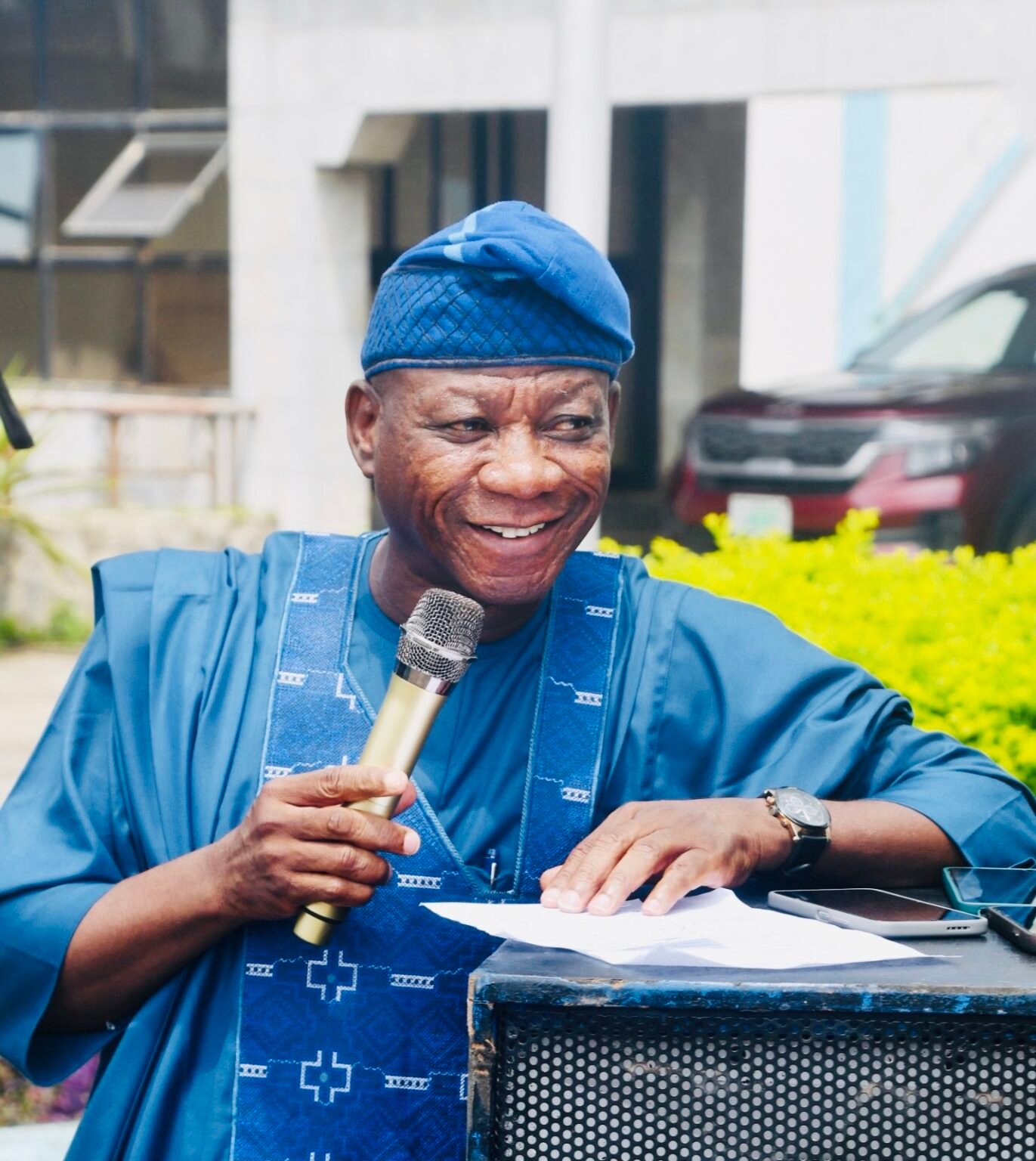
By Francis Onyeukwu, News Agency of Nigeria (NAN)
The tributes that followed the week-long retirement activities for Mufutau Ojo, former Editor-in-Chief of the News Agency of Nigeria (NAN), were remarkable by the agency’s standards.
Again and again, colleagues spoke not only about his professional accomplishments, but also about a man whose stern exterior often concealed a generous and compassionate heart.
Dr Adewale Sadeeq, Head of NAN’s Politics Desk, perhaps captured that contradiction most vividly.
“When you look at the face of Ojo, you won’t dare to meet him for any problem, but beneath the face lies a golden heart,” Sadeeq said.
According to him, Ojo could initially appear intimidating when approached with a problem and might even raise his voice.
“However, at the end, he will certainly solve the problem, leaving you happier than when you met him,” he said.
For many of Ojo’s colleagues, that discovery of the man behind the stern face became a defining feature of their working relationship with him.
Indeed, the scale of the tributes during his retirement suggested that his influence extended well beyond the newsroom.
NAN, established by military decree No. 19 of 1976, began editorial operations on Oct. 2, 1978.
The agency, which prides itself as a leading wire service in Africa, has produced nine Chief Executive Officers, beginning with its pioneer Director-General, Mr Onuora Nzekwu.
Others included Dr Nwabu Mgbemena, Malam Wada Maida, Akin Osuntokun, Mrs Oluremi Oyo, Ima Niboro, Bayo Onanuga, Buki Ponle and the current Managing Director, Malam Ali M. Ali.
Similarly, more than 20 editors-in-chief have served the agency, beginning with Prof. Victor Olufemi Adefela, the pioneer EIC, and including Ojo, who handed over to Hajiya Hadiza Mohammed-Aliyu, the agency’s first female Editor-in-Chief.
While retirement ceremonies are customary in public institutions, colleagues said Ojo’s farewell stood out for the depth and breadth of the tributes.
His retirement activities began on Aug. 10 with a valedictory session organised by NAN’s Editorial Management.
Senior editors took turns to recall his leadership style, professional discipline and ability to combine newsroom demands with concern for staff welfare.
Two days later, the wider editorial department again celebrated him during its weekly meeting, with staff members recounting their experiences under his leadership.
However, the most personal celebration came on Aug. 14, when Ojo turned 60.
The NAN Chapel had arranged what Ojo later called an “ambush”, complete with a trumpeter and a specially prepared birthday cake.
As the vehicle conveying him drove into the NAN complex in Abuja, a waiting trumpeter and scores of staff members surrounded the vehicle.
Amid music and dancing, colleagues ushered the surprised celebrator into the newsroom, where a specially designed birthday cake awaited him.
The celebration continued with staff members dancing and presenting gifts to the visibly delighted retiree.
The grand finale came on Aug. 17, when colleagues, friends and associates gathered for a farewell celebration that many regarded as exceptional in NAN’s history.
Beyond the food, music and celebration, however, the event offered something more enduring; an opportunity for people to recount the ways Ojo had affected their lives.
Mrs Augusta Nwaozuzu, Secretary to the Office of the EIC in Abuja, became emotional while delivering her valedictory remarks.
Having served as secretary to more than 12 EICs, from Mr Dipo Ogbede to Ojo, she said her relationship with Ojo was exceptional.
“He is a kind and very generous man and also a mentor. He will always give us a token every weekend,” she said.
More significantly, Nwaozuzu recalled a near-fatal accident she suffered in August 2025, after work.
She said she was knocked down by a hit-and-run motorcycle and rushed to the trauma and emergency section of the National Hospital, Abuja.
According to her, Ojo was the first person to arrive at the hospital and paid her preliminary medical expenses, enabling doctors to commence treatment.
“He called daily, sympathising and giving me hope until I was discharged,” she said.
Even after her discharge, she added, Ojo visited her at home.
For Nwaozuzu, that gesture remained one of the clearest demonstrations of the man behind the stern professional exterior.
Similarly, Ojo’s kindness extended beyond the newsroom and senior members of staff.
Mr Manasseh Yavenga, one of NAN’s cleaners and gardeners, presented Ojo with a portrait on behalf of his colleagues.
Yavenga said Ojo had consistently remembered them during festive periods.
“From the year 2021 when Oga Ojo was appointed the Special Adviser to date, he gave us Christmas rice and money for us and our families to celebrate with others,” he said.
For the workers, therefore, the portrait was more than a gift; it was a token of appreciation for someone they believed had treated them with dignity.
Meanwhile, Mr Collins Yakubu-Hammer, Chairman of the NAN NUJ Chapel in Abuja, focused on Ojo’s leadership in the newsroom.
Although Ojo served as EIC for about one year and nine months, Yakubu-Hammer said his impact was significant.
“I was employed in 2012 and elected chairman of the chapel in 2022. In my 14 years in the agency, Ojo is one of the best EICs we have had,” he said.
According to him, Ojo brought sanity to the newsroom, remained firm in official decisions and treated staff fairly.
“He is a thorough-bred journalist who achieved results,” he said, urging both senior and younger staff members to emulate his example.
The Managing Director of NAN, Ali M. Ali, also reflected on Ojo’s contribution to the agency.
Ali said that in his almost three years at NAN, he had not witnessed such an outpouring of affection for a retiring official.
He commended Ojo for his diligence and commitment to journalism, saying his leadership helped advance the agency without making himself the centre of attention.
“My reading of him was that he never sought to be in the limelight, but somehow put the agency in the limelight,” Ali said.
For Ali, working with Ojo offered lessons in commitment, diligence and professionalism.
He noted that editorial leadership was especially demanding because editors worked under enormous pressure and were responsible for ensuring that stories were accurate, factual and properly presented.
“Editors work under enormous pressure and editors cannot afford to make mistakes, grammatical, typographical or even factual,” he said.
He also cited Ojo’s willingness to respond to calls and messages at odd hours as evidence of his commitment to the agency.
At the same event, Ali unveiled Mohammed-Aliyu as Ojo’s successor and NAN’s first female Editor-in-Chief.
He said she was thorough, committed and hardworking, urging staff members to give her the same support they had extended to Ojo.
Mohammed-Aliyu, in turn, thanked the Managing Director for entrusting her with the responsibility.
She recalled Ojo as supportive and patient, saying his advice and encouragement had left a lasting impression on her.
The tributes also reflected Ojo’s journey through journalism and public service.
Born on Aug. 14, 1966, in Offa, Kwara, Ojo obtained his West African School Certificate before proceeding to the Intermediate Joint Matriculation Board programme.
He attended Ahmadu Bello University, Zaria, from 1985 to 1988, where he obtained a Bachelor’s degree in English.
He later earned a Postgraduate Diploma in Mass Communication from the University of Lagos in 1990, an MBA from the University of Ado-Ekiti in 1999 and an M.Sc. in Communication Studies from Lagos State University in 2007.
Ojo began his journalism career with The Herald and was involved in the production of Harmony, a public relations magazine for the Kwara State Government.
He joined NAN in 2007 and served as Zonal Manager of the Ibadan Zonal Office before becoming Special Adviser to the Managing Director on Special Duties under Buki Ponle.
In December 2024, he was appointed Editor-in-Chief.
From that position, he led NAN’s editorial operations involving more than 500 editors and reporters across the headquarters in Abuja, the Lagos Directorate, 35 state offices and 18 district offices.
Thus, although his tenure as EIC lasted less than two years, colleagues argue that the brevity of the period does not diminish the significance of his impact.
Ojo urged staff members to extend the same cooperation to his successor.
“She is a very strong-willed woman. Allow her to do her job and extend the same kind of support you gave me to her,” he said.
He also encouraged younger journalists to learn from their senior colleagues and take their professional development seriously.
“To our young recruits, I leave you in the hands of your seniors, who I believe will mentor you in love,” he said.
Ojo reminded them that securing employment was different from mastering the responsibilities that came with it.
“My people say you can help somebody to get a job; you can’t help the person to do it. A word is enough for the wise,” he said.
He also acknowledged the role of his wife of more than 30 years in supporting his career.
Responding to the tributes, Ojo expressed appreciation to NAN management and staff across the country for their support, gifts, kind words and goodwill throughout his tenure and retirement.
Yet, perhaps the most revealing verdict on his legacy came not from his official citation or professional record, but from the ordinary people who interacted with him.
From senior editors and reporters to administrative staff, cleaners and gardeners, the testimonies pointed to a common thread; behind the stern face was a man many considered kind, generous and dependable.
Certainly, as a human being, Ojo must have had his shortcomings, none of which featured prominently during the retirement celebrations.
Nevertheless, the remarkable outpouring of affection suggested that, over almost two decades at NAN, he left an imprint on people that went beyond official responsibilities.
His story therefore offers a simple lesson in leadership; authority may command respect, but kindness earns remembrance.
And when the professional record is eventually measured against the lives touched along the way, Ojo’s retirement tributes suggest that his legacy at NAN may be remembered as much for the people he helped.
It may also be remembered for the newsroom he led and the values he brought to his work.
As one colleague’s testimony aptly captured it, beneath the stern face was a golden heart. (NANFeatures)
Edited by Tosin Kolade

Comments