

By Jessica Dogo
The Nigerian Communications Commission (NCC) and the Office of the National Security Adviser (ONSA) have called for stronger collaboration to protect fibre optic infrastructure during road construction and excavation activities.
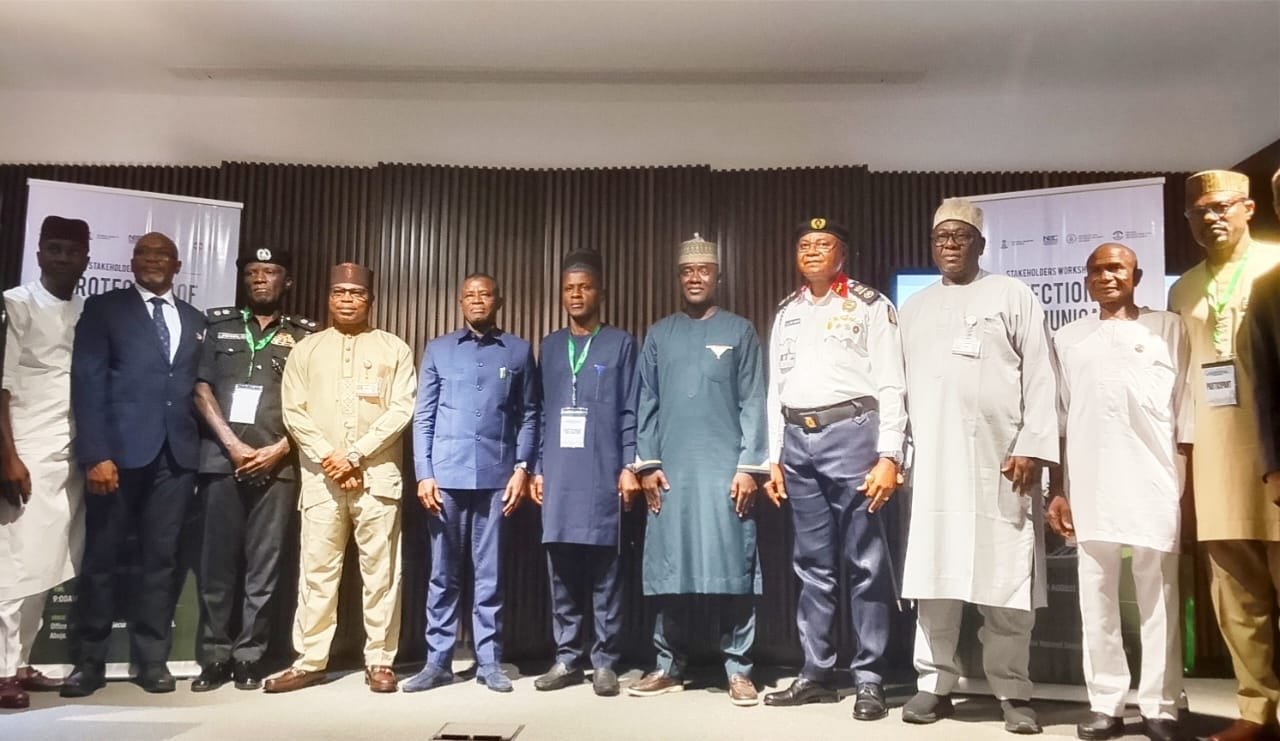
They made the call at a stakeholders’ workshop on the protection of fibre optic infrastructure during road construction activities in Nigeria on Tuesday in Abuja.
Speaking at the event, Air Vice-Marshal Effiom Ewa, Director, Critical National Standards and Infrastructure Protection, ONSA, said the protection of fibre optic infrastructure was a shared national responsibility.
Ewa, who represented the National Security Adviser, Nuhu Ribadu, said this involved government institutions, private organisations, contractors, telecommunications operators and citizens.
He said that damage to fibre infrastructure was more than a disruption to telecommunications network as it could affect governance, economic productivity, public services and the daily lives of Nigerians.
“Every fibre cable damage is more than a disruption to a network or simply a cable cut.
“It is indeed a disruption to governance, economic productivity, public services and daily lives of millions of Nigerians,” he said.
The director said that fibre optic infrastructure had been designated as Critical National Information Infrastructure.
He said that damage caused by negligence, interference or acts that predisposed the assets to damage constituted an offence under Nigeria’s legal framework.
According to him, there is the need for strict adherence to established protocols, guidelines and procedures during construction and maintenance activities.
Ewa said as Nigeria continued to invest in transportation, utility and digital infrastructure, it was important for the sectors to develop in a coordinated and mutually reinforcing manner.
According to him, the stakeholders’ engagement will foster collaboration and develop an enduring framework for protecting critical infrastructure.
The Executive Vice-Chairman and Chief Executive Officer of NCC, Dr Aminu Maida, said there was the need to reconcile the country’s road construction drive with the protection of digital infrastructure.
Maida said that road and fibre infrastructure complemented each other.
According to him, while roads physically connect communities, fibre networks connect them digitally to information, services, markets and opportunities.
He said communications infrastructure had become a lifeline underpinning banking, government services, education, healthcare, commerce, security and emergency communications.
The NCC boss said a fibre cut could have consequences far beyond the telecommunications operator whose cable was damaged.
Maida recalled that fibre cuts, including those caused by road construction, contributed to a nationwide disruption experienced by one of the major telecommunication operators in February 2024.
According to him, millions of Nigerians were unable to make calls, send messages or access the internet during the incident, while increased traffic on alternative networks resulted in congestion.
The director said more than 5,000 fibre cut incidents had been reported in the first six months of 2026 from road excavation, construction and related civil works.
He attributed many of the incidents to inadequate coordination among stakeholders before construction or excavation commenced.
“No road contractor sets out to disconnect a community. No telecommunications operator wants to obstruct the building of a road.
“No public agency wants one vital national project to undermine another. Our interests are aligned. What has often been missing is a dependable system of early coordination,” he said.
He said the Permanent Secretaries of the Ministry of Works and Ministry of Communications, Innovation and Digital Economy had inaugurated a standing committee on the protection of Fibre Optic Cables.
“This is to develop practical coordination mechanisms before, during and after road construction, ” he said.
Maida said the committee’s membership had recently been expanded to include officials from ONSA and the National Security Council, adding that the move would provide additional strategic oversight.
He said the workshop was a direct outcome of the committee’s work and would help construction companies, engineers, contractors and site supervisors understand their responsibilities when working around critical telecommunications infrastructure.
Maida said telecommunication operators also had responsibilities, including laying fibre according to standards, responding promptly when notified of construction works and relocating infrastructure within stipulated timelines.
He urged operators to provide accurate information; contractors to check for underground infrastructure before excavation; and government agencies to facilitate timely information exchange.
“Every fibre cut we prevent is more than an engineering success.
“It is a call that connects; a payment that goes through; a lesson that continues; a public service that remains available,” Maida said.
He urged participants to engage actively and develop practical steps that could be implemented at construction sites across the country.
The News Agency of Nigeria (NAN) reports that stakeholders from government Ministries, Departments and Agencies (MDAs); telecommunication operators, construction companies, regulators, security agencies, engineers and other relevant organisations attended the workshop. (NAN)(www.nannews.ng)
Edited by Benson Ezugwu/Isaac Aregbesola



Comments