


By Felicia Imohimi
The Federal Government and the International Fund for Agricultural Development (IFAD) have commenced capacity building for stakeholders to scale up climate finance mobilisation under the Value Chain Development Programme in Northern Nigeria (VCN).
The initiative is aimed at strengthening the ability of federal and state actors to access and deploy climate finance for resilient agri-food systems.
The VCN, co-financed by the Federal Government, IFAD and the French Development Agency (AFD), seeks to promote nutrition-sensitive, socially inclusive and sustainable agricultural value chain development across participating northern states, with a strong focus on climate resilience.
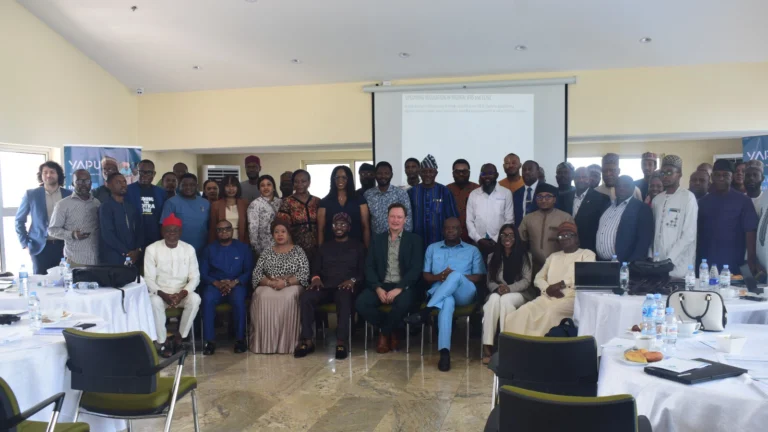
Speaking at a workshop titled “Capacity Building on Climate Resilience for Agri-food Systems Transformation in Northern Nigeria” in Abuja, IFAD Country Director, Ms Dede Ekoue, said the training would enhance participants’ capacity to identify and leverage climate finance opportunities.
The workshop was organised by the Federal Ministry of Agriculture and Food Security (FMAFS) in collaboration with IFAD, the Global Centre on Adaptation (GCA) and the Joint SDG Fund.
Ekoue said the goal was to build a shared and practical understanding among stakeholders on climate risks, adaptation strategies; including digital climate services and climate finance.
According to her, the initiative is also designed to foster coordinated implementation of climate-resilient interventions and strengthen climate finance mobilisation under the VCN.
“It is to build a solid foundation for climate resilience and transform current momentum into a community of practice.
“It ensures that every actor is empowered to turn VCN planned investments into opportunities for sustainable resilience of agri-food systems to climate shocks,” she said.
She said Northern Nigeria’s agricultural value chains remain vital to the economy but face growing pressure from climate shocks and environmental degradation.
Ekoue stressed the importance of grounding interventions in Climate Risk and Vulnerability Assessment (CRAVA).
“Our interventions cannot be based on guesswork. They must be anchored in CRAVA.
“CRAVA identifies the most fragile landscapes and vulnerable crops, ensuring that every naira spent under the VCN goes into climate-proofed interventions,” she said.
She added that VCN investments would provide initial funding for climate-resilient interventions, while climate finance would be key to sustaining and scaling impact.
“By integrating CRAVA-led adaptation, we are de-risking Northern Nigeria for future large-scale climate financing and demonstrating that our value chains are sustainable and economically viable,” she said.
Also speaking, Mrs Olubunmi Iluromi, Director, Federal Department of Development Partners Projects, FMAFS, said the workshop followed a recent high-level engagement on the VCN joint roadmap for accelerated implementation.
She said the training was a practical step to ensure institutions and technical teams are equipped to deliver climate-resilient outcomes.
“The VCN programme is being implemented at a time when climate change is no longer a distant risk, but a present reality, manifesting through droughts, floods, heat stress and land degradation,” she said.
Iluromi noted that CRAVA provides an opportunity to move from general awareness to actionable, value chain-specific adaptation measures.
“Mobilising climate finance is not only about accessing resources, but also about strengthening institutional readiness, improving investment planning and demonstrating results that attract further support,” she said.
She emphasised the need for strong coordination among federal and state governments, as well as across ministries, departments and agencies.
Dr Oluyede Ajayi, Global Lead, Food Security Programme at the Global Centre on Adaptation (GCA), said the organisation supports governments and international financing institutions to integrate climate adaptation into large-scale agricultural investments.
According to him, GCA provides technical assistance, climate risk analytics and co-designed adaptation solutions across projects.
He said the support includes climate-resilient livestock systems, improved crop production, agroforestry development, and digital climate advisory services.
The News Agency of Nigeria (NAN) reports that the initiative is part of broader efforts to strengthen resilience, boost productivity and attract sustainable climate financing into Nigeria’s agricultural sector.(NAN)(www.nannews.ng)
Edited by Dorcas Jonah/Tosin Kolade
Comments