



By Folasade Akpan
The Federal Government says it is spending about 280 million dollars on immunisation and plans another 539 million dollars for tuberculosis, malaria and HIV programmes nationwide.
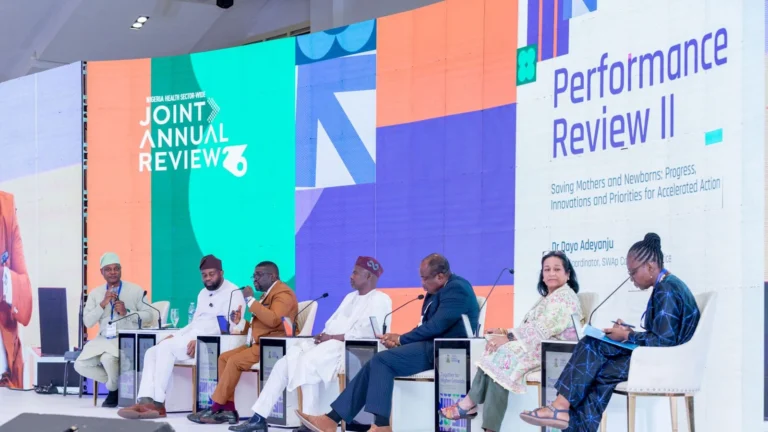
Dr Ado Muhammad, Special Assistant to the Director-General of the Budget Office of the Federation, said this during a health financing panel at the 2026 Joint Annual Review in Abuja.
Muhammad said the scale of the financial commitments made it necessary for state governments to share responsibility for funding major health interventions and sustaining essential programmes across the country.
“Now, those two vaccinations itself, we’re spending about 280 million dollars on immunisation.
“Now, we are just taking on ATM, which is tuberculosis, malaria and HIV and that is going to cost the Federal Government of Nigeria 539 million dollars,” he said.
He said the Federal Government was exploring ways to encourage states to contribute financially towards the programmes, ensuring sustainable funding and shared responsibility across different levels of government.
“So, ultimately, if we have to sustain funding for the sector, I think it’s right time that the subnational level also pick some of the bills.
“We are making a proposal, making a submission to the National Economic Council, because we need to sustain it. It is not just enough to allocate without release,” he said.
Muhammad said health financing should consider budget releases, expenditure and accountability, rather than focusing solely on approved allocations, emphasising the importance of translating appropriations into actual services and outcomes.
He urged state governments to ensure that appropriated health funds were released and spent appropriately, with measurable outcomes and accountability mechanisms to strengthen healthcare delivery and public confidence.
“Health is an investment. Health is not an expenditure, and health contributes to human capital development,” he said.
He said the Federal Government had recorded its highest health sector budget allocations in three years, partly through alignment with the Nigeria Health Sector Renewal Investment Initiative and Sector-Wide Approach.
Earlier, Dr Francis Ayomoh, Head of Health Financing Division, Federal Ministry of Health and Social Welfare, said government health expenditure had improved, although domestic financing remained inadequate.
Presenting National Health Accounts data, Ayomoh said government health expenditure as a share of total health expenditure increased from 13.3 per cent in 2015 to 26.4 per cent in 2024.
He said government health expenditure per capita also increased from approximately N3,000 in 2015 to N12,000 in 2024, reflecting growth in public spending on healthcare services nationwide.
According to him, out-of-pocket expenditure declined from 71.7 per cent of current health expenditure in 2022 to 65.7 per cent in 2023 and 62.2 per cent in 2024.
“In spite of this progress, it is clear that we are still not where we want to be as a country, because we are aiming to see that out-of-pocket expenditure is between 30 per cent or 20 per cent, or even less,” he said.
Ayomoh said development partners had committed 1.7 billion dollars to Nigeria’s health sector in 2026, compared with 1.6 billion dollars mapped in 2024 and 1.3 billion dollars in 2025.
He, however, said fluctuations in donor funding made it necessary for Nigeria to strengthen domestic resource mobilisation and develop sustainable financing mechanisms for essential healthcare programmes.
He also said that the Federal Government accounted for 67 per cent of government health expenditure in 2024, while states contributed 27 per cent and local governments seven per cent.
Ayomoh called for increased subnational funding, improved budget execution and a review of the 2017 National Health Financing Policy and Strategy to reflect current economic realities and reforms.
Speaking on Kogi’s experience, the state’s Commissioner for Health, Dr Abdul-Aziz Adams, said the government was aligning its health budget with people-centred interventions and measurable outcomes.
Adams said Kogi’s proposed 32-year development plan prioritised healthcare, with its current implementation phase focusing on building stronger foundations for sustainable development and improved service delivery.
He said that a bill was before the State House of Assembly to establish a health trust fund, proposing two to five per cent of allocations and internally generated revenue.
“This creates a pool of funds for us in the health sector to be able to carry out our projects in health,” he said.
Also speaking, Dr Mohammed Safana, Director-General of the Katsina State Contributory Healthcare Management Agency, said the state had increased its health budget allocation to meet the international 15 per cent benchmark.
He said Katsina allocated N43.3 billion to health in the previous year and increased funding for nutrition programmes from N500 million to N1.2 billion.
He said the state also invested N750 million in expanding its drug supply agency to strengthen medicine availability and support the delivery of free healthcare services.
According to him, Katsina automated its financial processes to ensure approved funds reached relevant accounts within 24 hours, improving efficiency and accountability in public health financing.
He said the state had also adopted a system domiciling 50 per cent of capitation funds with its drug supply agency to ensure medicines remained available in healthcare facilities.
Mr Owen Smith, Lead Economist at the World Bank, said Nigeria needed to increase health spending while improving efficiency in the utilisation of available financial resources.
Smith said government health expenditure and the priority assigned to healthcare in national budgets remained low compared with spending patterns in other countries.
He identified primary healthcare staffing, timely fund releases, reduced fragmentation among development partners and appropriate investment sequencing as priorities for improving healthcare financing and service delivery.
Smith said investments in facility financing would produce better results when primary healthcare facilities had adequate personnel, infrastructure and essential resources to deliver quality services.
Similarly, Ms Juliet Whitley, Head of Health and Demography at the Foreign, Commonwealth and Development Office, said states would play critical roles in sustaining domestic financing for vaccines.
Whitley urged development partners to improve efficiency through pooled and coordinated resources, aligning their support with national priorities under the Sector-Wide Approach framework.
She said coordinated support would reduce fragmentation and ensure development partners’ assistance remained aligned with national health priorities and the country’s broader healthcare objectives.
The 2026 JAR, themed “Together to Higher Grounds: Make the Data Count”, is a three-day engagement bringing together federal and state governments, development partners, civil society organisations and stakeholders to review health sector performance.(NAN)
Edited by Abiemwense Moru


Comments