


By Victor Okoye
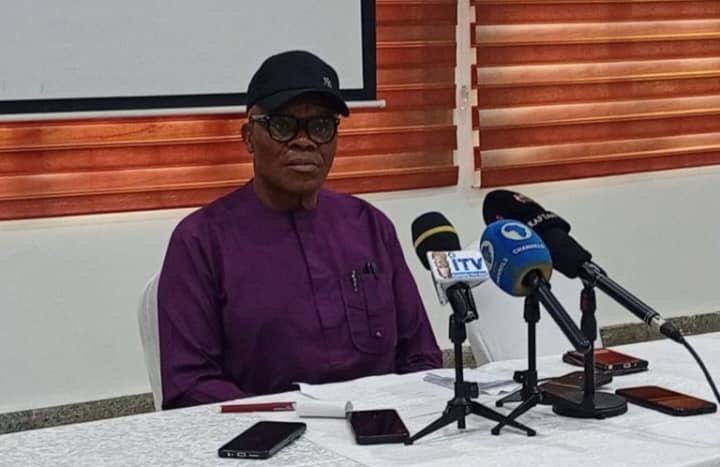
Former Nigeria Football Federation (NFF) Secretary-General, Fanny Amun, has called for fundamental reforms to rescue Nigerian football.
Amun, also a former member of the NFF Ethics Committee, made the call on Monday in Abuja while adresssing newsmen after submitting the fact-finding committee’s report.
The six-member committee, chaired by Amun, was constituted to examine Nigeria’s recent poor performances in international football.
The committee’s assignment followed the Super Falcons’ disappointing campaign at the 2026 Women’s Africa Cup of Nations (WAFCON) in Morocco.
Nigeria subsequently failed to qualify for the 2027 FIFA Women’s World Cup scheduled for Brazil.
Amun said the setback should compel stakeholders to examine the structural challenges affecting football administration and development in the country.
“We must stop treating our challenges as isolated incidents. There are systemic issues that require urgent and fundamental reforms,” Amun said.
The committee examined governance, finance, technical development, grassroots football, player management and league administration, among other areas.
It identified challenges involving player release and communication, team preparation, medical and injury management, camp administration, technical coordination and player development.
The committee recommended better use of technology, improved data management and age verification, stronger regulations and closer monitoring of national teams.
It also called for deliberate development plans for both male and female football and regular training for technical and administrative personnel.
Amun said the development of Nigerian football required a system that encouraged competent and experienced stakeholders to participate in decision-making.
“The NFF statute must be opened up to genuine stakeholders who have the experience, knowledge and commitment to move Nigerian football forward,” he said.
He said the NFF Congress should comprise credible and experienced personalities capable of providing effective oversight and constructive contributions.
According to Amun, Congress members should serve a maximum of two terms to promote accountability, fresh ideas and responsible leadership.
“Nobody should see football administration as a permanent occupation. There must be room for fresh ideas and new people to contribute,” he said.
The former Golden Eaglets coach said football administrators should place the interests of the game above personal or sectional considerations.
“Our primary responsibility should be to Nigerian football. When personal interests come first, the development of the game suffers,” Amun said.
The committee also recommended improved league structures and better preparation for national team competitions.
It highlighted allegations of undue influence in national team invitations, financial inducements and unequal remuneration of players and officials.
The report also raised concerns over the prolonged retention of some federation officials in lucrative positions.
Amun urged the NFF to investigate all allegations thoroughly and strengthen its internal mechanisms to promote transparency and accountability.
“Every allegation must be properly investigated. Where there are weaknesses, we must correct them and ensure that the system becomes stronger,” he said.
Amun stressed that implementing the committee’s recommendations would require genuine political will from football administrators and other stakeholders.
“The value of this report will be measured by what happens after today. We need implementation, not another report that ends up gathering dust,” he said.
The committee further urged the NFF to adopt reforms capable of repositioning Nigerian football and restoring confidence among stakeholders.
It commended the Super Falcons for their efforts and urged stakeholders to unite in rebuilding the country’s football structures.
Amun said the current challenges provided an opportunity to create a stronger, more transparent and sustainable football system.
“This is not about blaming individuals. It is about identifying what is wrong, fixing it and building a football system that Nigerians can be proud of,” he said.
Edited by Joseph Edeh


Comments