


By Adebayo Gbeja
The Prisoners Rehabilitation and Welfare Action (PRAWA), says effective parole implementation will reduce custodial congestion and promote rehabilitation.
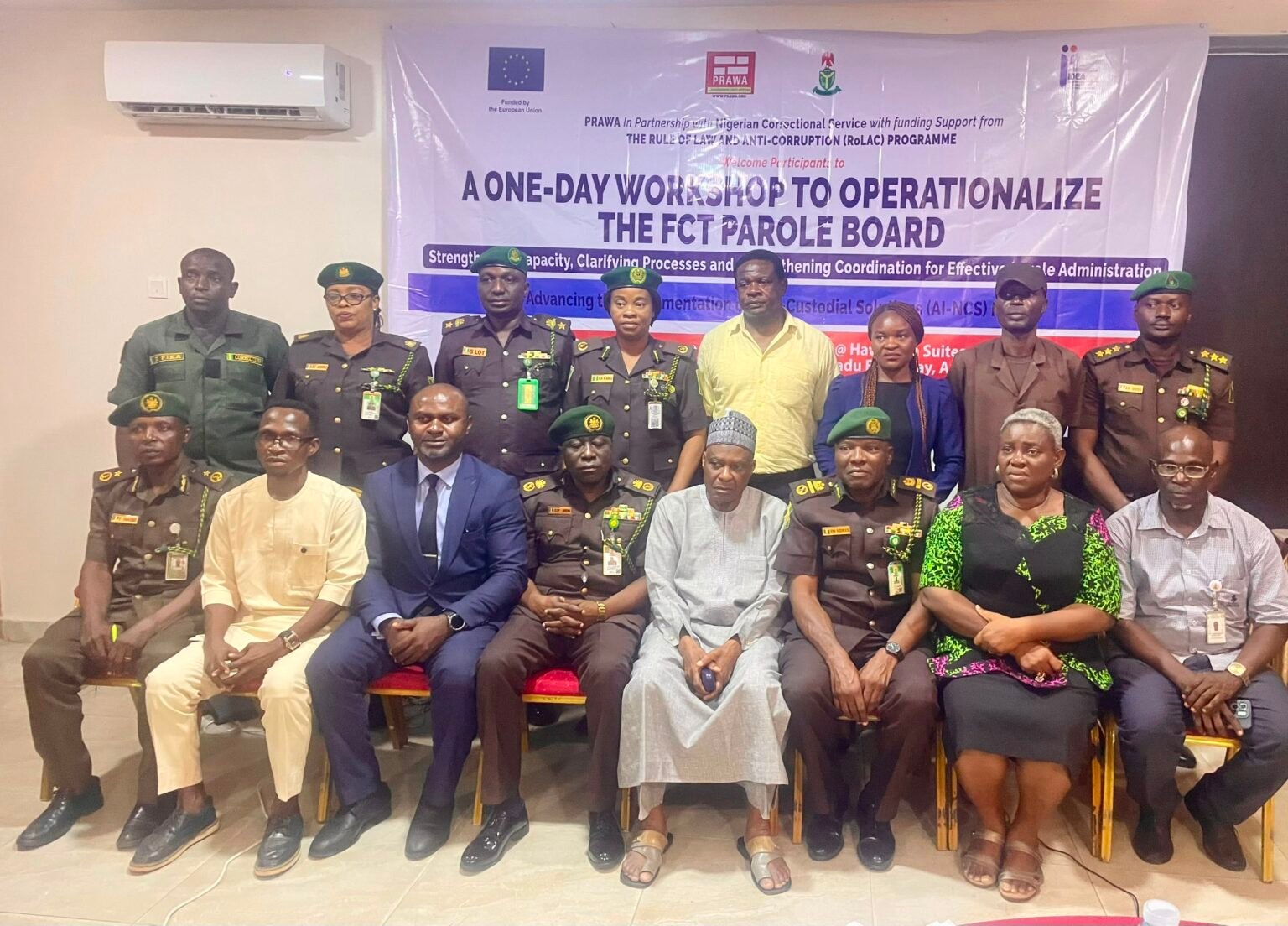
The President of PRAWA, Dr Uju Agomoh, said this on Monday in Abuja at a one-day workshop to operationalise the Federal Capital Territory (FCT) Parole Board.
The workshop was organised under the Advancing the Implementation of Non-Custodial Solutions (AI-NCS) project to strengthen the capacity of stakeholders and improve parole administration.
Agomoh described parole as a structured and supervised release of eligible offenders into the community to complete their sentences.
She explained that parole was a conditional release from custody into the community to complete the sentence under supervision.
She noted that parole would reduce pressure on custodial centres and enable the Nigerian Correctional Service (NCoS) to focus its resources on inmates who needed to remain in custody.
She also said that it would encourage good behaviour and participation in rehabilitation programmes.
The PRAWA president added that structured reintegration was preferable to an abrupt return to society after completion of a sentence.
“Everybody who is in custody today will, unless the person dies there, come out someday.
“I prefer a situation where people come out through the parole process than they do normally after the completion of their sentence,” she said.
Agomoh further said that public safety would be prioritised through risk assessments before parole was granted, including determining the support available to offenders in their communities.
She therefore called for clear procedures for applications, assessment and decision-making, as well as collaboration among correctional authorities, the judiciary, prosecuting agencies and health and social welfare professionals.
She emphasised the need for post-release support, including starter packs, to facilitate successful reintegration.
Similarly, the Chairman of the FCT Parole Board, retired Justice Abbazih Saddeeq, said the board would ensure that parole was implemented fairly, transparently and effectively.
Saddeeq said the board would balance rehabilitation and reintegration with public safety, urging members to develop practical approaches for effective implementation.
In the same vein, the DCG of Corrections covering Non-Custodial Service, ACG Ibrahim Idris, said parole was one of the non-custodial measures provided under the Nigerian Correctional Service Act, 2019.
Idris said parole was technically demanding because it involved releasing an offender already serving a custodial sentence, thereby making accountability and multi-agency participation essential.
He revealed that previous efforts to operationalise parole in the FCT had not resulted in any inmate being granted parole.
Idris said the NCoS and its partners had therefore reconstituted the board and commenced capacity building, expressing hope that the territory would soon have its first parolees.
The representative of the International Institute for Democracy and Electoral Assistance (IDEA), Joshua Dada, said the organisation was supporting PRAWA under the AI-NCS project to advance non-custodial measures.
Dada noted that though parole was provided for under Nigerian law, stakeholders needed to move from having it as a legal provision to making it operational.
NAN reports that the workshop brought together representatives of the NCoS, judiciary, justice sector institutions, civil society organisations and other stakeholders involved in correctional administration.(NAN)
Edited by Deborah Coker/Sadiya Hamza
Comments