


A major afrofeminist consultation on the protection of Women Human Rights Defenders (WHRDs) in West Africa took place on 16 June 2026 at the Dakar Office of the Réseau des Femmes Leaders pour le Développement (RFLD).
It brought into a single room the continental institutional voice of the African Commission on Human and Peoples’ Rights, the bilateral diplomatic missions active in Senegal, senior Government of Senegal representatives, RFLD’s two principal institutional donors GIZ and Sida, senior journalists covering the human rights beat, and the women defenders whose work the architecture is meant to protect.
The convening responded to one of the most urgent and least adequately addressed protection challenges in the region.
The Réseau des Femmes Leaders pour le Développement (RFLD) convened on 16 June 2026 a high-level afrofeminist consultation on the protection of Women Human Rights Defenders (WHRDs) in West Africa.
The convening, titled Solidarity, Protection and Lineage of Resistance, was held in the RFLD Dakar Office Hall, located on the 5th and 6th floors of Résidence “AW 06”, Cité Keur Gorgui, in the Senegalese capital.
It gathered approximately thirty representatives whose articulated engagement shapes the protection environment available to women defenders across the West African region.
Women Human Rights Defenders invited from across the West African region, including from the Sahelian and transitional governance contexts of Mali, Burkina Faso, Niger and Guinea, were present alongside leading Senegalese feminist civil society organisations.
The consultation took as its analytical starting point a direct recognition of the structural reality. Women human rights defenders across West Africa face the threats common to all defenders, namely surveillance, harassment, criminalisation, physical violence, judicial persecution, to which is added the specific arsenal that patriarchy reserves for women who refuse to be silent: sexual violence as a tool of silencing, the organised destruction of their reputation, attacks on their children and families, and the systematic delegitimisation of their work as too political, too feminist, too foreign, contrary to our culture.
The contraction of civic space across the Sahel, particularly in the transitional governance contexts of Mali, Burkina Faso, Niger and Guinea, has increased the exposure of defenders at precisely the moment when their work has never been more urgent.
The protection architecture available to them combines several layers, each carrying its own limits and its own possibilities: continental mechanisms anchored in the African Commission, regional instruments under ECOWAS, the African Peace and Security Architecture, bilateral diplomatic protection, accompaniment by feminist intermediaries, peer to peer solidarity networks, and the witnessing work of journalists.
The cumulative effect of the gaps between these layers means that the protection available remains structurally insufficient.
Strengthening this architecture, the consultation affirmed, is not a technical question but a political one, and the women who carry the work must also be the women who carry the analysis.
The consultation gathered a deliberate cross section of actors whose engagement most decisively shapes the protection environment for women defenders in West Africa. Continental institutional weight was represented by Hon. Prof. Remy Ngoy Lumbu, ACHPR Special Rapporteur on Human Rights Defenders and Focal Point on Reprisals in Africa, and former Chair of the African Commission on Human and Peoples’ Rights.
Mr Naji Moulay Lahsen, CIDH Sahel and North Africa Director, contributed the additional cross regional perspective bridging the Sahel and the North African human rights context.
Independent senior expertise came from Mme Hannah Forster, former Executive Director of the African Centre for Democracy and Human Rights Studies (ACDHRS, Banjul); from Pr. Mabassa Fall, jurist and senior expert of the African human rights system; and from M. Sadikh Niass, senior Senegalese human rights leader. Bilateral diplomatic missions active in Senegal participated alongside the consultation.
Two of RFLD’s institutional donors, GIZ and Sida (Swedish International Development Cooperation), attended the convening as cooperation partners.
From GIZ Senegal, Mme Katja Roeckel, Country Director, joined the consultation. H.E. Catharina Cappelin, Ambassador of the Kingdom of Sweden to Senegal, was present on behalf of the Swedish diplomatic mission, accompanied by Mme Khady Touré, Programme and Political Officer at the Embassy of Sweden in Dakar.
Senior representatives of the Government of the Republic of Senegal also participated in the consultation. Senegalese feminist civil society organisations participated at senior level.
Senior journalists covering the African human rights and civil society beats were present in the room, contributing the media witnessing layer of the protection architecture available to defenders.
RFLD was represented at senior level by M. John GBENAGNON, Regional Strategy and Development Director, while the main discussions on behalf of RFLD were led by M. Bathor Seck, RFLD Country Representative for Senegal.
RFLD is an African feminist intermediary, conceived, governed and led by African women, and its institutional architecture is the product of the analytical and political work of African feminism.
The partnership between RFLD and European donors is best understood as accompaniment to that work, not as its origin.
Within this relationship of peers, European bilateral cooperation has accompanied the network with the multi year, flexible and trust based modalities that feminist movement infrastructure actually requires, in a manner that respects the network’s autonomy of analysis and decision.
The institutional architecture that RFLD has built and continues to lead, namely the four offices in Porto Novo, Accra, Banjul and Dakar; the 670 member organisations across more than 35 African countries; the WAFFF Fund and the Africa Portfolio Grant as continental re granting facilities that reach grassroots feminist organisations directly; the DƆNÙESÈ Data Center as a public good comprising twelve open bilingual policy tools for African civil society; the rapid response capacity for women human rights defenders facing acute threat; the State of African Francophone Feminist Movements report as a continental analytical reference; and the strategic guidance positions such as the co-chairmanship of the SEA-T Programme Advisory Council, has all been built by RFLD itself.
The impact of European donor support, in this sense, is the accompaniment that allows this African feminist work to be done at scale, and the protection environment around women human rights defenders to be addressed with the institutional weight the moment requires.
The continuing presence of GIZ and Sida in the Dakar room reflected this sustained partnership of peers, and the two flagship engagements described below demonstrate how it is operationalised in practice.
Two of RFLD’s institutional donors were present at the Dakar consultation. Germany was represented through the Deutsche Gesellschaft für Internationale Zusammenarbeit (GIZ), the implementing partner of the Federal Ministry for Economic Cooperation and Development (BMZ), by Mme Katja Roeckel, Country Director GIZ Senegal, and M. Mathias Muehlhans, Programme Director GIZ Senegal.
Sweden was represented through the Embassy of Sweden in Dakar by H.E. Catharina Cappelin, Ambassador of the Kingdom of Sweden to Senegal, accompanied by Mme Khady Touré, Programme and Political Officer; Sweden’s institutional support to RFLD is channelled through Sida, the Swedish International Development Cooperation Agency.
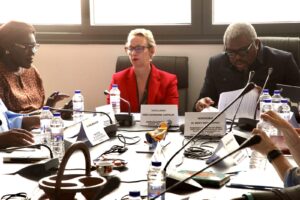
The presence of both donors in the room reflected the sustained partnership of peers that Germany and Sweden have built with RFLD over multiple cycles of institutional cooperation.
RFLD, Réseau des Femmes Leaders pour le Développement, is a pan African afrofeminist intermediary with four offices in Porto Novo, Accra, Banjul and Dakar.
The network holds ACHPR Observer Status N°553 and is a sitting Member of the Working Group of the ACHPR Special Rapporteur on Human Rights Defenders. RFLD currently serves as co-chair of the SEA-T Programme Advisory Council, the strategic guidance body for the Society. Equality.
Africa – the Transformation (SEA-T) programme, also funded by Germany’s BMZ and implemented by GIZ.
The mandate of the Advisory Council is to provide strategic guidance to ensure that SEA-T’s direction, priorities and resources are meaningfully aligned with the visions of afrofeminist civil society.
The Dakar consultation was anchored in RFLD’s BRAVE programme, which holds bodily autonomy, the Maputo Protocol, sexual and reproductive health and rights, and the protection of women human rights defenders as inseparable struggles within a long afrofeminist tradition.
Spaces such as this consultation produce impact that exceeds the day they are held. They restore the dignity of being heard to defenders whose work is too often silenced.
They give visibility to the operational realities that shape protection in the region. They create relationships that translate into mutual aid in moments of acute threat.
They place institutional actors and grassroots defenders in the same room, and the resulting accountability persists long after the room has emptied.
They strengthen the continental conversation by anchoring it in country level testimony, and they strengthen country level work by connecting it to continental support.
Most consequentially, they signal to defenders themselves that they are not alone, that the architecture surrounding their work is alive and engaged, and that the lineage of resistance they carry is recognised by those who hold institutional power.
The closing line of the convening, drawn from the long lineage of African women’s resistance, framed the entire afternoon: Celle qui arrive est liée à celles qui sont venues avant. Nous avançons en nous souvenant d’elles.
She who arrives is bound to those who came before. We move forward by remembering them.
Article by RFLD
Comments