


By Felicia Imohimi
Obafemi Awolowo University (OAU), Ile-Ife, Osun, and the Institute of Agricultural Research and Training (IAR&T) have called for sustainable soil management and responsible nutrient stewardship to address Nigeria’s declining soil fertility.
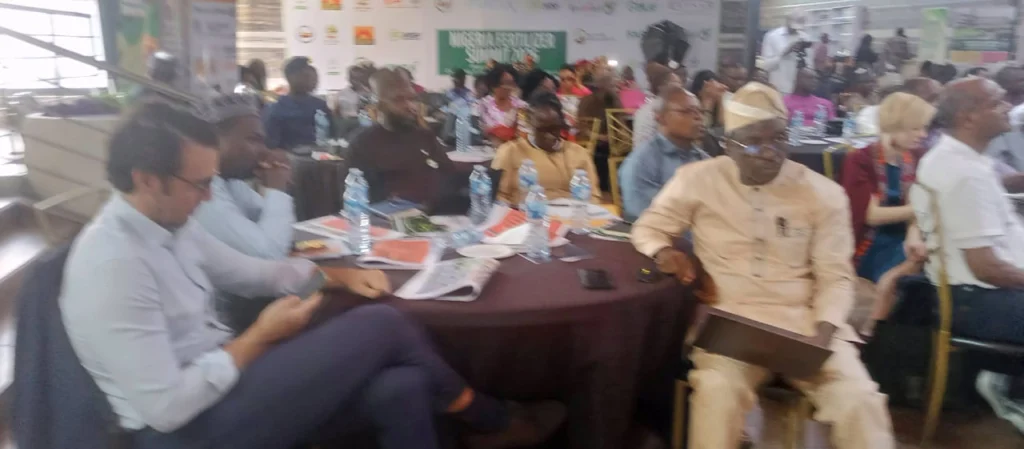
The institutions made the call on Monday in Abuja at the Nigeria Fertiliser Summit 2026, which was themed “Phosphorus and Food Security: Challenges in Food Production in Nigeria.”
Prof. Adebayo Bamire, Vice-Chancellor of OAU, who delivered a keynote address, emphasised that securing the country’s food future required sustainable soil fertility management, with strategic attention to phosphorus.
The keynote address is tagged “Securing Nigeria’s Food Future through Sustainable Soil Fertility Management: The Strategic Importance of Phosphorus for Agricultural Transformation.’’
Bamire said that sustainable agricultural production was not merely a concern for farmers but a national priority that affects economic growth, job creation, poverty reduction and well-being of citizens.
He emphasised that while attention was often given to improved seeds, mechanisation, irrigation and market access, agricultural productivity ultimately depended on nutrients available in the soil.
“Every successful agricultural system begins with healthy and productive soils. One of the most important of these nutrients is phosphorus. Without adequate phosphorus, crops cannot attain their full potential.
“Many agricultural lands across Nigeria face declining soil fertility due to continuous cultivation, nutrient mining, soil degradation, deforestation and limited replenishment, leading to reduced yields and lower profitability.
“Addressing the challenge requires more than increased fertiliser use, but a comprehensive commitment to sustainable soil management and responsible nutrient stewardship.
“Responsibility must be shared by government, research institutions, fertiliser industry, extension services, private sector and development partners,” he said.
Bamire noted that universities had a responsibility to contribute through research, innovation and capacity building to transform scientific discoveries into practical solutions for farmers.
He said the summit provided a platform for dialogue and collaboration to improve nutrient use efficiency, strengthen fertiliser systems and promote sustainable growth.
According to him, the future of Nigerian agriculture will not be determined solely by the resources, but they are effectively managed.
On his part, Prof. Gabriel Oluwatosin, Executive Director, IAR&T, identified phosphorus as the bottleneck no one talked about in food security.
“Without nitrogen, we can make fertiliser from air. Without phosphorus, there is no workaround.
“It is an element; you cannot synthesise. Every plant needs phosphorus for DNA, ATP and root development.
“About half of global food production depends on phosphorus fertiliser and about 63 per cent of it comes from mined phosphate rock.
“Food security trap is too little and too much at the same time – too little in Sub-Saharan Africa where soils have been mined for decades, and too much in Europe, North America and parts of Asia where excess run-off causes eutrophication and algal blooms,’’ he said.
According to Oluwatosin, phosphate rock is finite, with peak production of high-grade rock projected around 2030 to 2033, while geopolitics makes it riskier as Morocco controls about 70 per cent of world reserves.
He said Africa held 60 per cent of world arable land but had some of the lowest fertiliser use, adding that many Nigerian farmers applied urea alone, which further undermined the soil.(NAN)
FUA/CJ/
=======
Edited by Chijioke Okoronkwo


Comments