


Governance
By Halima Muhammad
Mr Aigboje Aig-Imoukhuedea, a Non-Executive Chairman of Access Holdings Plc, has urged the National Salaries, Incomes and Wages Commission (NSIWC) to adopt proactive wage governance.
This according to him, has become necessary ahead of the next minimum wage review scheduled for 2027.
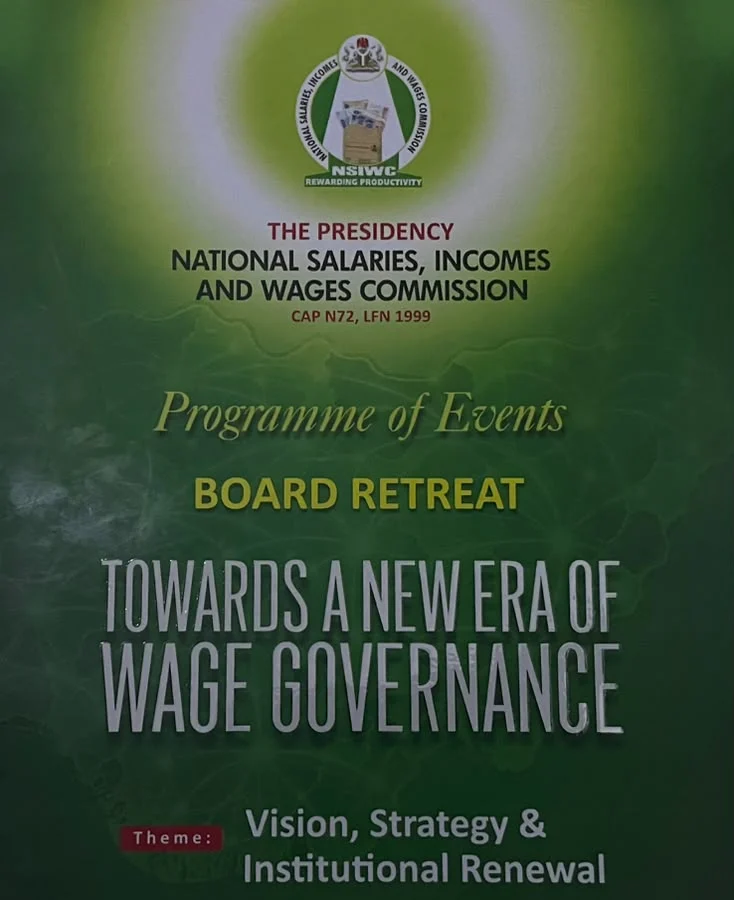
Aig-Imoukhuede, who was represented by Chioma Njoku, made the call at the Commission’s Board and Management Retreat held on Monday in Abuja.
Aig-Imoukhuedea said evidence-based reforms would promote fairness, fiscal sustainability and predictability in wage determination, while strengthening public confidence in the country’s wage-setting system.
He identified fragmented salary structures, inadequate data, differences in states’ revenue capacities and weak enforcement as challenges affecting effective wage governance.
He stressed the need for reliable labour-market information and fiscal assessments to guide wage decisions and reduce prolonged disputes.
Aig-Imoukhuedea recommended strengthening the Commission’s database and preparing an annual State of Wage Governance Report to guide policy decisions.
According to him, the proposed report would track wage compliance, workers’ purchasing power and productivity indicators, with its first edition targeted for 2027.
He also called for early and transparent preparations for the 2027 minimum wage review to promote informed negotiations among government, organised labour and employers.
The non-executive chairman said continuous stakeholders engagement would encourage information sharing, scenario planning and consensus-building before wage-related disagreements escalated.
He proposed that the Commission use its first 100 days to establish its vision, performance indicators and an inter-agency forum.
He also recommended reviewing the Commission’s wage-setting methodology by the end of 2027 and developing a national scorecard by 2030.
Associate Prof. Marvelous Isibor Aigbedion, another resource person, called for a shift from crisis-driven wage negotiations to proactive, evidence-based incomes governance.
Aigbedion identified inflation, declining purchasing power, industrial conflicts and uneven implementation of wage policies as major challenges facing Nigeria’s wage system.
He said the Commission needed stronger analytical capacity, reliable labour-market data and fiscal-impact assessments to guide wage decisions.
According to him, wage governance should extend beyond minimum-wage determination to address productivity, income distribution, policy enforcement and broader economic policies.
He recommended strengthening compliance mechanisms, improving payroll monitoring and accelerating dispute resolution to ensure effective implementation of wage policies.
Aigbedion also proposed a technical working group to share data, assess policy options and build consensus before wage-related disagreements arose.
He recommended a transparent cost-of-living assessment method to support informed wage reviews and policy decisions.
Aigbedion said sustainable wage increases required stronger compliance systems, improved productivity and policies aligned with Nigeria’s development and fiscal strategies.
Ibrahim Kana, the Permanent Secretary, General Services Office, urged the Commission to strengthen board-management collaboration to improve accountability and service delivery.
Kana said effective collaboration was fundamental to translating institutional mandates into measurable results and ensuring that public institutions served Nigerians.
“In simple language, the board governs while management manages,” he said.
He said the Commission’s structure was peculiar because its chairman served as chief executive officer, while its secretary served as accounting officer.
Kana said the arrangement required cooperation among the chairman, board members, secretary and other members of staff to ensure effective institutional performance.
He identified five pillars of effective collaboration as clarity of roles, trust and mutual respect, evidence-based decisions, structured communication and accountability, and shared commitment to results.
Kana said clearly defined responsibilities would prevent duplication, interference and gaps in accountability.
He recommended a clear board charter, delegation framework, committee structure and approved scheme of service to define responsibilities.
He stressed that decisions on salaries, wages, incomes and productivity should be guided by reliable data, clear analysis and measurable indicators.
“A board that hears only good news is not exercising effective oversight,” Kana said.
He urged the Commission to establish regular reporting on financial performance, strategic-plan implementation, major risks, audit findings, human-resource issues and projects requiring board decisions.
Kana warned that board resolutions without proper implementation and follow-up could undermine institutional effectiveness.
He urged the chairman to promote balanced participation, constructive engagement and unity among board members and management.
The permanent Secretary also emphasised transparency, ethical conduct, effective internal controls and accountability in managing public resources.
“Every naira entrusted to a public institution belongs ultimately to the Nigerian people,” he said.
Kana called for stronger documentation, knowledge management and succession planning to preserve institutional memory despite changes in leadership.
He said effective board-management collaboration would strengthen remuneration policies, promote fairness, improve productivity and support sustainable government expenditure.
The recommendations align with the broader objectives of President Bola Tinubu’s Renewed Hope Agenda, particularly efforts to strengthen public institutions, improve governance and promote economic growth.
The retreat provided an opportunity for the Commission’s board and management to consider strategies for strengthening institutional effectiveness and improving Nigeria’s wage governance framework.(NAN)
Edited by Ese E. Ekama-Williams



Comments