


By Kayode Adebiyi
Each year, billions of dollars leave African economies through corruption and illicit financial flows.
Experts note that these funds could build hospitals, equip schools, pave roads, and support livelihoods across the 55 member states of the African Union.
Tracing, freezing, seizing, and returning stolen assets across different legal systems has long strained national laws and international cooperation.
In Abuja, however, Africa’s top anti-corruption officials, investigators, and financial intelligence experts met to change that reality for good.
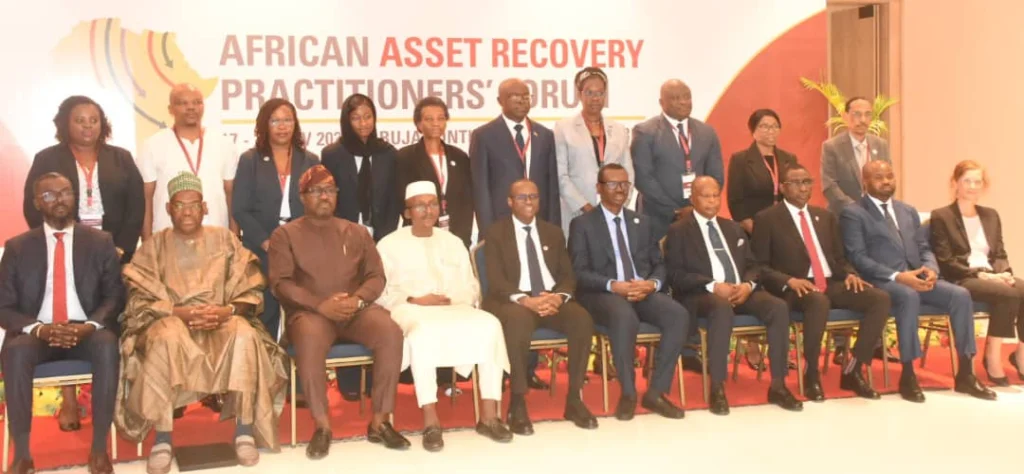
Hosted by Nigeria’s Independent Corrupt Practices and Other Related Offences Commission (ICPC) from November 17 to 20, the gathering marks the first General Assembly of the African Asset Recovery Practitioners’ Forum (AARP-F).
The event was convened under the auspices of the African Union Commission’s Department of Political Affairs, Peace and Security (AUC-PAPS) and the African Union Advisory Board Against Corruption (AUABC).
Participants said the theme of the assembly, “From Commitment to Action: Enhancing Africa’s Asset Recovery Architecture through Effective Implementation of the Common African Position on Asset Recovery (CAPAR)” was apt.
The gathering also transitioned AARP-F from an interim body into a permanent, practitioner-led continental institution armed with a substantive leadership council, four specialised working groups, a validated work plan and an operational budget.
Organisers said the four-day assembly marked a decisive institutional turning point for the continent.
At the opening event, Nigeria’s Attorney-General of the Federation and Minister of Justice, Chief Lateef Fagbemi, framed the mission not merely as a legal or technical exercise, but as a vital step toward national reform.
He said it was importantly as a fundamental question of justice and economic survival.
“Today, we gather not merely to discuss the recovery of stolen assets, but to confront a question of justice…
“How can a continent so richly endowed continue to be deprived of resources that should educate its children, equip its hospitals, build its infrastructure and secure its future?”
Drawing on an African proverb, the Fagbemi warned that “when the roots of a tree are being eaten away, its leaves cannot remain green for long”.
He noted that illicit financial flows eat directly at the roots of Africa’s development.
“Asset recovery is therefore not simply a technical exercise in tracing bank accounts or securing forfeiture orders. It is a struggle for accountability, economic sovereignty and the restoration of public trust.”
Fagbemi also underscored the same operational truth.
“Policies do not trace hidden assets; skilled practitioners do; declarations do not prepare mutual legal assistance requests; committed professionals do.
“And political will, however strong, must be translated into lawful investigation, effective prosecution, enforceable confiscation orders and accountable asset management,” he said.
That urgency was echoed by Dr Musa Aliyu, Chairman of the ICPC and Chair of the Forum’s Interim Steering Council, who emphasised the direct human cost of financial crimes.
“Every resource lost through corruption represents more than a financial loss; it is an opportunity denied to our people; resources that could otherwise support education, healthcare, infrastructure, security, employment and other essential public services.
“Behind every successfully recovered asset lies an opportunity to restore public value, strengthen institutions, advance justice and rebuild confidence in governance,” he said.
The Head of Development Cooperation at the German Embassy, Dr Karen Jansen, expressed concern over the enormous resources Africa continues to lose through illicit financial flows.
She said recovering these resources was imperative for financing development, improving citizens’ welfare and restoring public confidence in governance.
Jansen offered recommendations to strengthen Africa’s capacity to trace, freeze and recover stolen assets, highlighting the importance of international partnerships and sustained cooperation.
It is worth noting that the Abuja Assembly is the culmination of a deliberate, six-year continental effort anchored in the African Union’s Agenda 2063 and its broader governance and development financing priorities.
On Feb. 10, 2020, AU Heads of State and Government unanimously adopted the Common African Position on Asset Recovery (CAPAR) at their 33rd Ordinary Session in Addis Ababa.
The adoption, stakeholders acknowledged, built on the momentum of the 2018 African Anti-Corruption Year championed by Nigeria.
Rooted in the African Union Convention on Preventing and Combating Corruption, CAPAR established a unified continental policy framework built on four strategic pillars.
These are: detecting and identifying illicit assets; recovering and returning them to their countries of origin; transparently managing recovered assets; and strengthening international cooperation and partnerships.
Yet, as Kwami Senanu, Chairperson of the AUABC, reminded delegates in Abuja, policy declarations alone could not repatriate a single stolen dollar.
“Neither convictions, nor concept or position papers can by themselves stem illicit financial flows or help us to recover a single asset.
“What was clearly needed was an institution with the skill sets and experience to proactively follow through on our conviction.
“We need a group to constantly speak up on illicit financial flows and to actively pursue the return of assets.
“We need sustained action was needed and this required practitioners,” he said.
The journey to build that practitioner-led mechanism moved steadily over four years.
First mooted in Dakar, Senegal, in Sept. 2022 when the AUABC and AUC-PAPS convened asset recovery experts and prosecutors, the concept gained structural shape in Jan. 2024 in Dar es Salaam, Tanzania.
By May 2024 in Addis Ababa, Member States, Asset Recovery Inter-Agency Networks (ARINs), and prosecutors agreed upon and adopted the Forum Charter.
Three years after the initial vision, in April 2025, the AARP-F was unveiled in Nairobi, Kenya, with the signing of the Nairobi Declaration.
“This is Africa rising! Africa in action!” Senanu declared.
He praised Nigeria’s consistent leadership across the 55-member Union since proposing and sponsoring CAPAR in 2020.
“Today, this assembly turns an interim arrangement into a permanent platform, and it is a big win for us all,” he said.
However, some stakeholders, including Dr Abdullahi Yibaikwal, warn that, while African nations have steadily upgraded their domestic anti-corruption statutes, practitioners still confront formidable hurdles.
They say that criminal networks routinely exploit differences in national legal systems and opaque corporate structures that conceal beneficial ownership.
According to stakeholders, criminals also exploit delays in Mutual Legal Assistance, limited technical capacity and the prohibitive financial cost of litigating across multiple foreign jurisdictions.
Moreover, Aliyu provided further insights
“Assets stolen from one country can be concealed, transferred or invested across several jurisdictions through complex financial arrangements designed to frustrate investigation and recovery.
“No country or institution can effectively confront these challenges in isolation.”
To ensure the newly institutionalised forum delivers measurable impact, he outlined six strategic priorities to guide the AARP-F’s work, including institutional development and governance to establish a credible, transparent leadership structure.
He also mentioned capacity building and professional development through specialised training and peer-to-peer knowledge exchange; and operational cooperation and information sharing to accelerate cross-border investigations and Mutual Legal Assistance.
“Strategic partnerships and international engagement with the AU, regional economic communities, and development partners such as GIZ and UNODC were also highlighted.
“Policy and legal development to harmonise domestic frameworks with regional and international standards; and sustainability and resource mobilisation to secure durable human, technical, and financial backing complete the list,” the ICPC chairman said.
Over the past year, the AUABC and its partners conducted targeted CAPAR capacity-building trainings across four African nations: Liberia, Eswatini, Chad, and Mauritius.
The Abuja sessions highlight this peer-to-peer approach, featuring practical cross-border asset-tracing lessons from Mauritius alongside case studies on recovering and managing confiscated wealth from Kenya and South Africa.
“These are African practitioners teaching African practitioners! This is the way to go; an African forum and model that focuses on practical experiences at the core,” Senanu noted.
At the assembly, Fagbemi admonished the practitioners that history would not judge them by the beauty of their declarations, but by the assets they recovered, the obstacles they removed and the difference they made.
Aliyu reinforced this demand for accountability, stating that real success would not be judged by the volume of meetings held or resolutions passed.
Instead, he emphasised that it depends on building strong partnerships, fostering meaningful cooperation, and delivering tangible results together.

Comments