


By Adesewa George
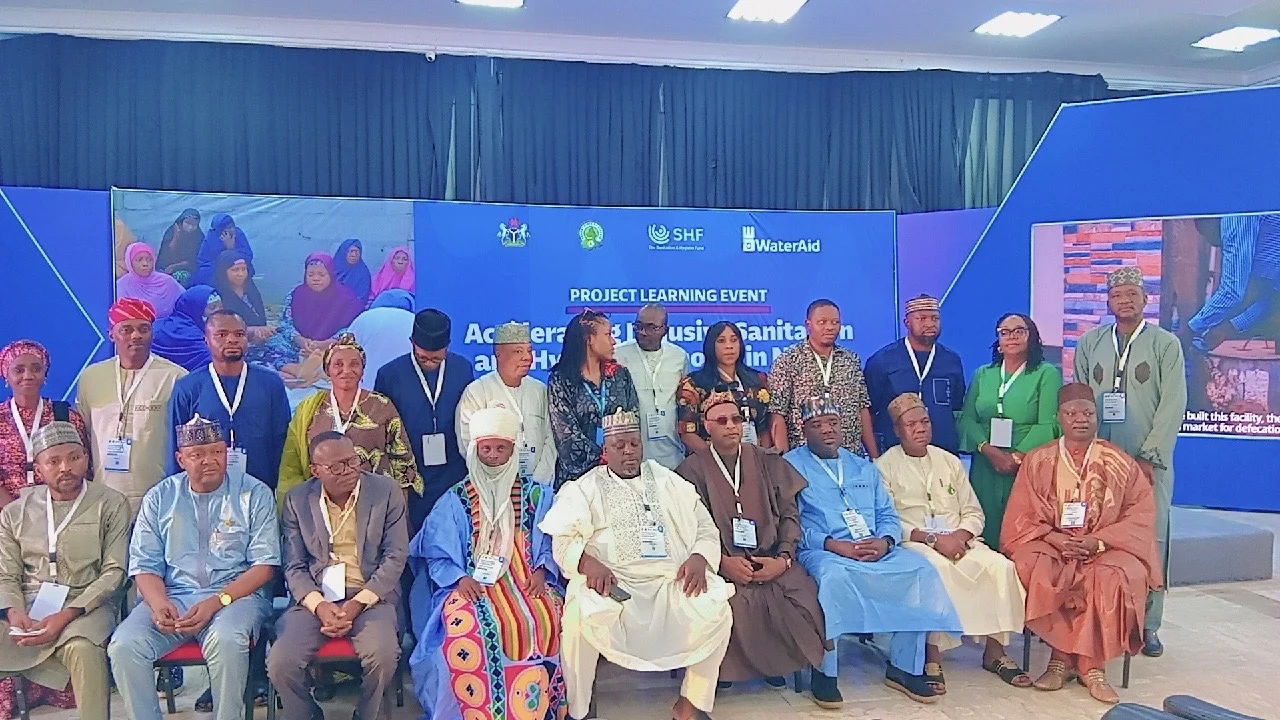
More than 480,000 Nigerians in 1,283 communities gained improved sanitation access through a 24-month Sanitation and Hygiene Fund-supported intervention implemented by WaterAid.
Mr Nanpet Chuktu, Head of Programmes, WaterAid, disclosed this at the close-out event of the project on accelerating access to safely managed sanitation and strengthening systems in Abuja on Tuesday.
Chuktu said more than 16,000 basic household toilets were constructed during the intervention, while more than 4,600 were completed as safely managed sanitation facilities.
He said 1,283 communities attained open-defecation-free status through house-to-house engagements, mass media campaigns, radio programmes and digital communication.
Chuktu said WaterAid’s digital communication platforms also reached more than 900,000 people with hygiene behaviour messages aimed at preventing disease and protecting families.
He said the intervention was designed to address recurring cholera outbreaks, open defecation, inadequate sanitation services and limited access to safe hygiene facilities.
The organisation also supported sanitation entrepreneurs through training, mentoring and access to financing, enabling businesses to expand, generate income, create jobs and improve access to sanitation services.
It said women and young people emerged as sanitation entrepreneurs and community leaders through the programme.
Earlier, Mr Abu Jamilu, Director, Department of Water Quality Control and Sanitation, Federal Ministry of Water Resources and Sanitation, called for stronger collaboration among governments, development partners, private sector and other stakeholders.
He said the collaboration was needed to accelerate progress towards Sustainable Development Goal Six (SDG 6) on water and sanitation by 2030.
Jamilu said government could not achieve the country’s sanitation targets alone, urging coordinated action by Federal and State Governments, local authorities and relevant MDAs.
“The government should know that we cannot be doing things alone.
“We need to collaborate with partners and stakeholders so that we can achieve our target on sanitation in Nigeria and meet the 2030 mandate of the SDGs,” he said.
Jamilu said uncoordinated interventions could hinder progress and urged states to strengthen ownership and commitment to closing sanitation gaps.
He disclosed that 179 Local Government Areas (LGAs) in Nigeria had attained open-defecation-free status.
He said SDG 6 was central to achieving targets on poverty, hunger, health, education and gender equality.
Jamilu identified opportunities for private-sector participation in the sanitation value chain, including faecal sludge emptying, transportation, treatment and reuse.
Similarly, Mr Mahmud Bose, Director-General, Bauchi State Environmental Protection Agency, said the intervention had strengthened sanitation services, especially the capacity of pit-emptying and faecal sludge management operators.
Bose said sanitation operators had been organised into associations and supported through capacity-building programmes, while Bauchi had adopted Gulper technology for faecal sludge evacuation.
He said operators were also exploring the conversion of faecal sludge into organic compost and other useful products.
Bose said the intervention initially covered four of the state’s 20 LGAs but had been extended to additional areas.
He said local governments were establishing final disposal sites to strengthen faecal sludge management and ensure safe disposal. (NAN)
Edited by Tosin Kolade
Comments