


By Itohan Abara-Laserian
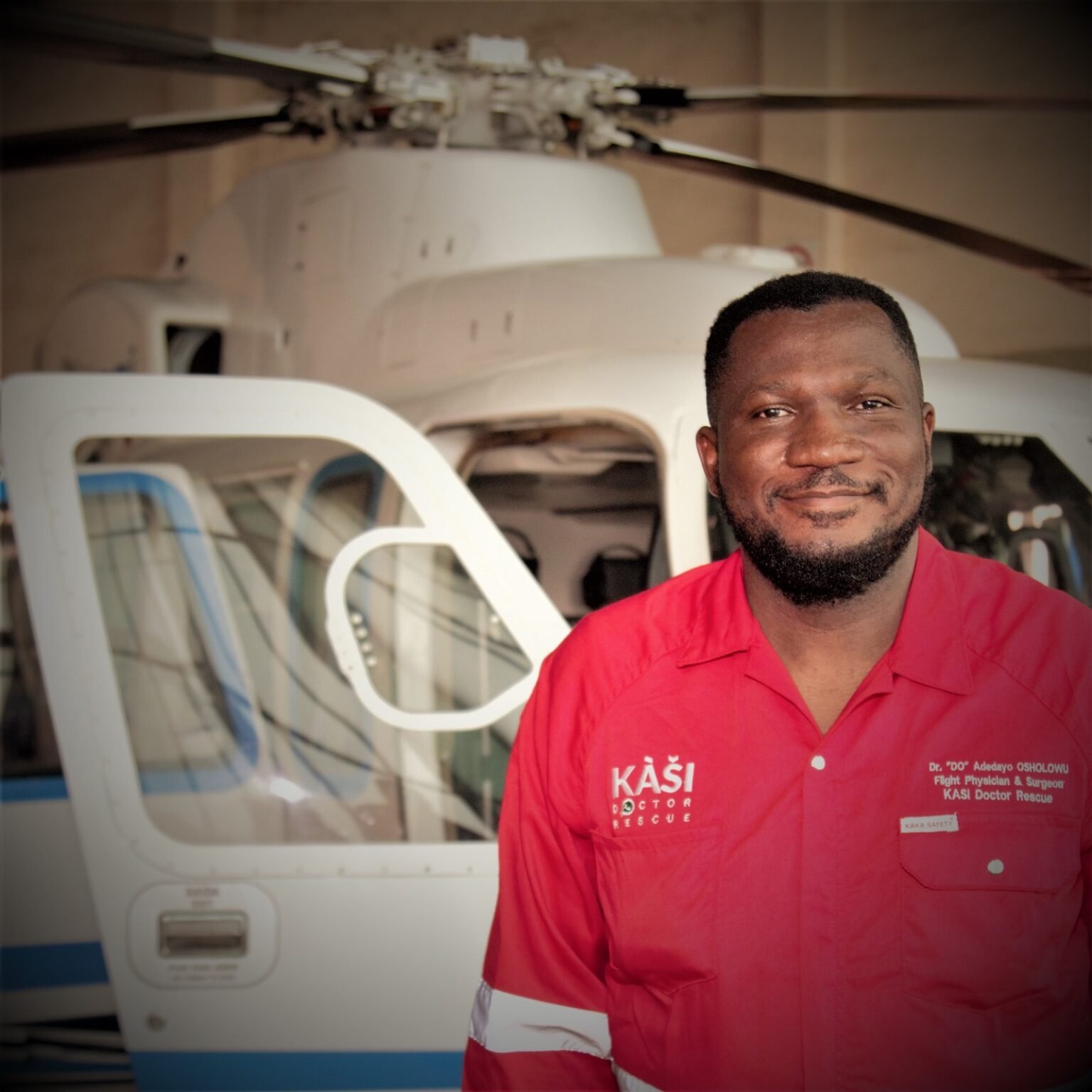
The Medical Director of Kasi Healthcare, Dr Dayo Osholowu, says there is need for Nigeria to operate dedicated, purpose-built domestic ambulance helicopters to enhance air medical emergency response.
Osholowu told the News Agency of Nigeria (NAN) on Sunday in Lagos that Nigeria not operating a single of such aircraft was not good.
“Air medical transport is not a luxury asset for a privileged few; it is fundamental survival infrastructure,” he said.
Osholowu said that as Nigeria was moving toward becoming one of the world’s most populous nation, relying solely on hospital beds and road medical emergency response was no longer sustainable.
The emergency medical expert said that Nigeria needed a ‘ready to launch at a moment’s notice’ for emergency care across its 924,000 square kilometres.
Osholowu noted that response times for air medical evacuations at remote areas and offshore rigs often stretched from one hour to 48 hours.
He described the stretch as a tragedy compared to the global benchmark of 10 minutes to 15 minutes.
“In emergency medicine, we measure human survival against an unforgiving clock: the golden hour.
“Across Nigeria, that hour is routinely erased by distance.”
He said that critical evacuation requests from Nigeria often required aircraft to come from Nairobi, Casablanca or Cape Verde.
“By the time cross-border flight clearances are secured, crews assembled and fuel uploaded, four to six hours have slipped away under optimal conditions.
“Often, bureaucratic delays stretch that waiting into two agonising days. In medicine, a two-day delay is not a response time; it is a tragedy,” he said.
Osholowu said that air medical operations in Nigeria had historically functioned as secondary, pre-scheduled inter-facility transfers rather than a primary life-saving effort.
He said that delays in air medical operations were rarely clinical but systemic, stemming from slow aviation clearances, rigid slot allocations, and non-24-hour operational limits at regional airfields.
He also identified lack of certified hospital helipads as a major challenge, saying that this would force an aircraft to land at a commercial airport, requiring a second ground ambulance transfer that ‘burns up critical time’.
He noted that the Lagos State Emergency Medical Services (LASAMBUS) operated more than 30 decentralised ambulance points linked to 112 dispatch network and trauma centres.
Osholowu said that the state-level model was being tied into a national blueprint under the Federal Ministry of Health’s Sector-Wide Approach Office and National Emergency Medical Services and Ambulance System.
“We are actively building an Integrated National Ground-to-Air System by connecting pioneer ground operators such as LASAMBUS with regional Helicopter Emergency Medical Services fleets and guaranteeing 48-hour emergency funding through the Basic Health Care Provision Fund.
“We are ensuring that when an aircraft lands, a pre-notified, fully-funded and equipped medical chain is waiting on the tarmac to save a life,” he said.
On the cost of air ambulance, Osholowu said it was huge.
He said that mobilisation fees, specialised intensive care unit equipment, aviation fuel, and overseas maintenance pushed its costs into thousands of dollars per hour.
He said that with out-of-pocket spending dominating Nigeria’s healthcare system and low insurance penetration, air ambulances had historically been accessible only to major energy corporations and wealthy individuals.
“Just as our nation leapfrogged telecommunication landlines by adopting GSM, an integrated aeromedical network allows us to leapfrog physical infrastructure deficits,” he said.
“Aeromedical capability is sovereign mobile infrastructure, and the time to build it is before tragedy strikes,” he said.
NAN recalls that Kasi Healthcare and Airbus Helicopters and Kasi recently signed an agreement for procurement of up to two Airbus H135 helicopters for emergency medical services.
The aircraft will be delivered to Kasi Healthcare in 2028.
Kasi Healthcare is a pioneering Nigerian medical services and aeromedical organisation based in Lagos. (NAN)
Edited by Ijeoma Popoola
Comments