









By Philomina Attah
A coalition of civil society organisations has decried the low representation of women in the 2027 general elections.
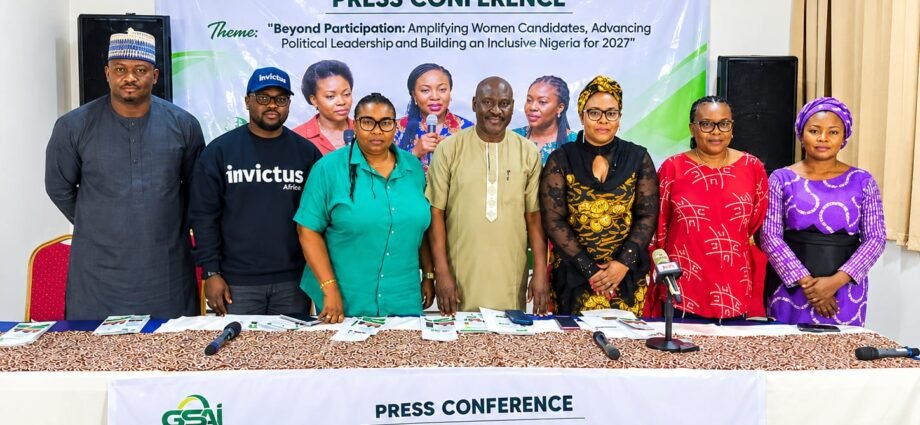
The coalition led by Gender Strategy Advancement International (GSAI) made their position known while briefing newsmen in Abuja on Thursday.
The coalition noted that only 10.1 per cent of candidates vying for National Assembly seats were women.
The Executive Director of GSAI, Adaora Sydney-Jack, said that democracy can not thrive without women in decision-making spaces.
Sydney-Jack said that the final of candidates recently published by the Independent National Electoral Commission (lNEC) shows that 443 women among 4,408 candidates cleared for 469 Senate and House seats.
She explained that the list also revealed that 115 women are contesting 109 Senate seats, representing 9.6 per cent, while 328 seek House seats.
Sydney-Jack noted the figure though represented an increase from 380 in 2023, the progress remains slow and uneven across states.
She added that Jigawa, Nasarawa, Niger and Yobe had no female senatorial candidates, while Akwa Ibom had the highest.
She identified rising cost of politics as a major barrier limiting women’s competitiveness and inclusion in the process.
“Nomination fees, campaign logistics and media visibility now determine competitiveness,” she said, stressing that capacity is not lacking.
“The question is whether our systems create equitable pathways for women to compete, be visible and succeed,” she said.
Sydney-Jack called for deliberate mechanisms, including reserved seats for women, as part of broader electoral reforms.
She also urged the media to provide equitable, policy-focused coverage for women candidates ahead of the 2027 elections.
“Political inclusion is achieved when women are visible, competitive, elected and empowered to contribute meaningfully,” Sydney-Jack said.
In her contribution, Kemi Okenyodo, Executive Director of Partners West Africa Nigeria, said that systemic barriers and party gatekeepers continue to disenfranchise women candidates at both state and national levels.
Okenyodo revealed instances where party leadership pressured female aspirants to step down, having purchased nomination forms and satisfied all participation requirements.
The Executive Director of the Peering Advocacy and Advancement Centre in Africa (PAACA), Mr Ezenwa Nwagwu, urged women advocates to view the struggle for gender inclusion in governance as an enduring democratic movement rather than a short-term project.
Nwagwu criticised political parties for acting as major barriers to female representation, calling on advocates to challenge party executives and demand accountability during political primaries.
He also tasked women in politics active participation and self-driven engagement, saying “Nobody carries anybody along in the power business.
“Women must be out there and invest in the political process in a way that forces the system to take them seriously,” Nwagwu said.
Also, the Executive Director of the Civil Society Legislative Advocacy Centre (CISLAC), Auwal Rafsanjani, warned that state-sponsored political violence and the influx of `dirty money’ were driving credible candidates, specially women away from politics.
Rafsanjani also faulted the actions of some state governors and public officials who consciously deprive opposition political parties and female candidates of the space to conduct election campaigns.
Vice-President, Nigeria Association of Women Journalists (NAWOJ), Mrs Chizoba Ogbeche, advised female politicians to leverage on the power of media, especially social media platforms for visibility.
“While traditional media can be expensive, social media and strategic relationships offer effective avenues. We must also socialize our children both boys and girls from the home to participate in politics,’’ she said.
Also, the Executive Director, Hallowmace Africa, Mr Anderson Osiebe, urged women to be deliberate in fighting for their representation in politics.
Osiebe noting that the bill seeking special seats for women will be represented to the National Assembly in October, urged stakeholders, especially women to be strategic in lobbing for the passage.
The Data and Research officer, Invictus Africa, Adewusi Oluwasesan, revealed that 64 percent of Nigerian voters expressed willingness to vote for female candidates, provided they run on merit and competence.
Special Assistant on Women Affairs to the AMAC Chairman, Hon. Loveth Izekor, shared her personal experiences contesting local elections, urged political parties to amend their constitutions to provide a level playing field for female flagbearers.(NAN)
Edited by Abdulfatai Beki/Sadiya Hamza