


By Folasade Akpan
Some stakeholders in the health sector have urged political leaders to treat investment in healthcare as a political and economic priority.
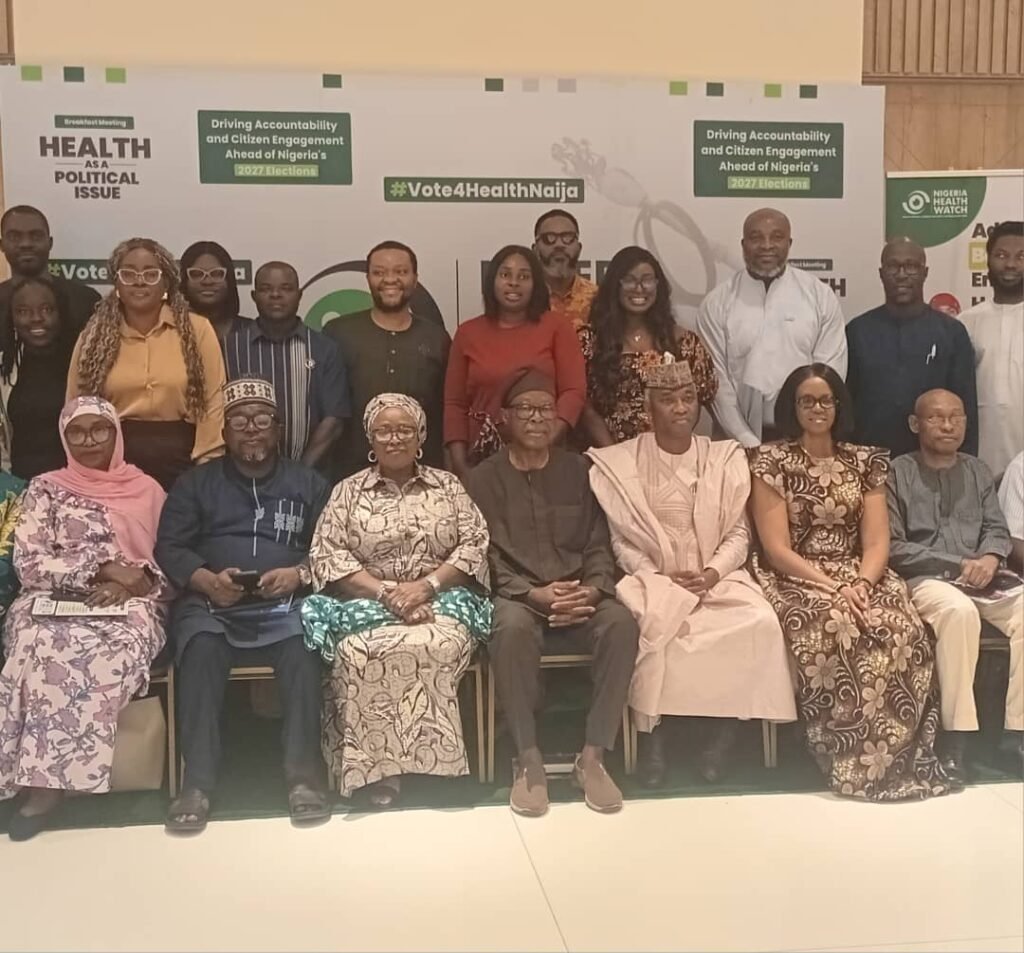
They made the call at a high-level breakfast meeting, convened by Nigeria Health Watch on Tuesday in Abuja, to drive accountability and citizen engagement ahead of the 2027 general elections.
The meeting had the theme, “Health as a Political Issue: Driving Accountability and Citizen Engagement Ahead of Nigeria’s 2027 Elections”.
It brought together political leaders, policymakers, civil society organisations, private sector stakeholders and the media.
The stakeholders said political leaders must move beyond broad promises of free healthcare.
The called on the leaders to rather identify specific interventions that would improve access to essential services, protect Nigerians from catastrophic health spending and strengthen the quality of care.
One of them, the Chief Executive Officer of DGI Consult, Dr Gafar Alawode, said access to basic healthcare remained a major challenge.
This, he said, was particularly for women and children requiring antenatal care, safe delivery and immunisation services.
“We want Nigerian government to put it on the political front burner, but it is not only about getting access to care.
“We do not want people to be thrown into poverty because they are accessing healthcare.
“Financial protection is very important, having access to health insurance and improving the quality of care,” he said.
Alawode said health reforms should be treated as a political process, particularly during election periods.
According to him, the process should be when citizens and stakeholders have an opportunity to influence the priorities political parties place before the electorate.
‘’Previous efforts to engage political parties on health priorities had produced some gains, with parts of a citizen-led health agenda reflected in political manifestos, ‘’ he said.
He said the lessons from previous election cycles showed the need for sustained engagement beyond elections to ensure that health commitments became government priorities and were reflected in implementation.
Alawode also called for greater financial accountability.
He said, ‘’Evidence shows that, while revenues have increased in some states, health expenditure has not risen proportionately and has even declined in others.’’
Also, the Commissioner for Health in Niger, Dr Murtala Bagana, said politicians needed to better understand health as a political dividend, rather than merely another sector requiring public expenditure.
Bagana said political leaders often focused on highly visible infrastructure projects without considering the returns that could come from investments in preventive and essential health services.
“For every one dollar you invest in the healthcare workforce, you have 10 dollars in full returns.
“If you take it down to the community health workforce, you are almost getting closer to 20 dollars,” he said.
He said investment decisions must be evidence-based, with better data on returns from health interventions like immunisation and maternal care.
Bagana said the focus should also shift from merely constructing new health facilities to ensuring that existing facilities were adequately equipped and capable of delivering a full range of services.
“Not all primary health centres are as we know them.
“We have over 1,500 in Niger, but are they Level Two, with the full complement of services, perimeter fencing, accommodation and solar power?
“Those are the commitments,” he said.
The commissioner said the state was working with the Federal Government, United Nations Children’s Fund and World Bank to upgrade 100 existing primary health centres.
He said political commitments should, therefore, be specific enough for citizens and stakeholders to assess whether governments had fulfilled them.
Bagana said promises to provide free healthcare, without stating the services to be covered, target population, funding arrangement and level of government responsible, would be difficult to implement and measure.
He said the involvement of the right people in designing political commitments was critical to ensuring that governments prioritised interventions capable of delivering measurable results.
The Managing Director, Nigeria Health Watch, Vivianne Ihekweazu, said the approach to the 2027 elections provided citizens with an opportunity to demand clear plans from political aspirants on improving healthcare.
According to her, citizens should demand answers on how political leaders intend to improve primary healthcare, make medicines more affordable and ensure that health facilities have adequate health workers.
“We need to make sure that our citizens are also asking the right questions from political aspirants in terms of how they are going to improve and deliver on health.
“If we do not have a healthy population, how can we also have a healthy and productive population? The two must go together,” she said.
Ihekweazu said health affected every Nigerian regardless of political affiliation, location or income, and should receive greater attention as political parties and aspirants began preparations for the 2027 elections.
Highlight of the meeting was the unveiling of the third edition of the ‘Vote4Health Naija’ campaign.
It also unveiled the Health Manifesto Tracking and Accountability Tool to monitor political commitments on health ahead of and after the 2027 general elections.(NAN)(www.nannews.ng)
Edited by Esenvosa Izah


Comments