


By Grace Abe
Mr Folorunso Aluko, the Director-General of the Progressive Governors Forum (PGF) has called on state governments and local government chairmen across the country to embrace cooperative autonomy to drive meaningful development.
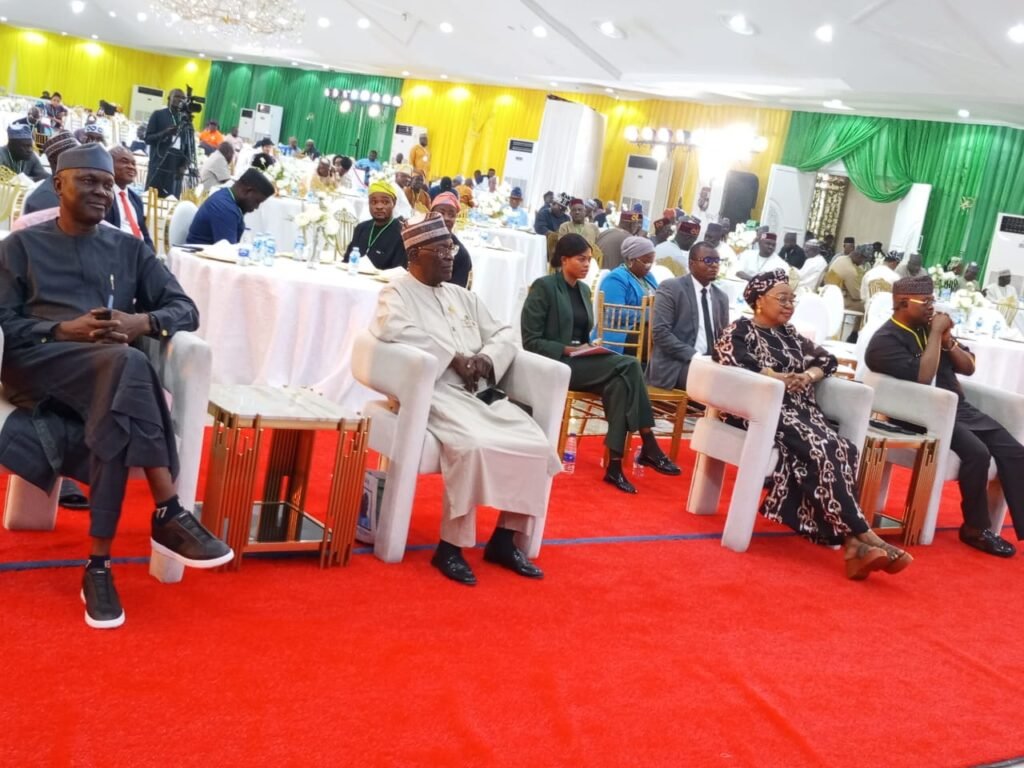
Aluko made the call on Tuesday in Abuja, during the second day of a two-day national workshop organised by the Federal Character Commission (FCC) in partnership with the PGF.
The workshop was themed “Deepening National Unity through Grassroots Implementation of the Federal Character Principle.”
Delivering a paper titled “Autonomy that Delivers: Responsibility, Accountability, and State-Local Government Partnership in Nigeria,” Aluko described cooperative autonomy as “independence that promotes cooperation, unity, collaboration between local governments and state governments”.
Aluko emphasised that citizens care more about visible governance and development than about which tier of government delivers it.
He noted that government must meet citizens at their point of need, asserting that “it is only when basic service delivery is achieved that the presence of local, state, or federal authorities becomes truly meaningful to the public.
“Nigeria’s federal architecture divides government powers, but citizens experience government as one reality,” he said.
He explained that the fundamental issue in governance was not about which level of authority holds control, but whether power was close enough to respond to people, disciplined enough to prevent abuse and sufficiently coordinated to serve a common goal.
Highlighting the complementary roles of both tiers, Aluko noted that state governments possess the advantage of scale, while local council chairmen hold the power of proximity to the grassroots.
Effective governance, according to him, requires a bridge built on trust, shared resources, clear information, and mutual responsibility.
He outlined critical components that define productive local governance, noting that true autonomy must be distinguished from isolation or inter-governmental rivalry.
He further stressed the need to connect authority and resources with duty, evidence, and consequences, while translating administrative independence into tangible public services and local economic opportunities.
Aluko advised council chairmen to align local plans with broader state developmental outcomes without surrendering their constitutional discretion, while continuing to cooperate within the framework of the federal character principle.
“The governing idea I am putting forward is what I call cooperative autonomy—an autonomy that promotes cooperation, unity, and collaboration between local and state governments,” he said.
He clarified that local government autonomy protects institutional space for elected councils to make and execute lawful decisions, emphasising that it represents neither total sovereignty nor complete separation.
Conversely, he added that state coordination should never be mistaken for absolute control over council administration.
Touching on institutional discipline, the PGF D-G warned that power without responsibility degenerates into privilege, responsibility without power becomes an excuse, and accountability without transparency remains merely ceremonial.
Earlier, the Vice-Chancellor of the University of Ilorin, Prof. Wahab Egbewole, SAN, noted that the federal character principle exists to promote equity, balance, and fairness, urging local council chairmen to actively foster inclusiveness.
Egbewole advised local leaders to thoroughly understand the demographics of their respective communities, noting that demographic clarity is essential for targeted development, fair political appointments and balanced employment opportunities.
Similarly, Dr Ogbonna Chime, National President of the Nigerian Institute of Town Planners (NITP), called for a fully inclusive governance framework that guarantees every Nigerian equitable access to public infrastructure, healthcare, education, and economic opportunities regardless of their background.
The Executive Chairman, FCC, Mrs Hulayat Omidiran, commended the participants for their engagement and urged them to apply the lessons and insights from the workshop toward building a more unified and equitable nation.(NAN)(www.nannews.ng)
Edited by Philip Yatai

Comments