






By Mark Longyen, News Agency of Nigeria (NAN)
In a world increasingly characterised by divisions, instability, and social tension, the pursuit of peace has become both an urgent necessity and a shared responsibility.
Across communities and nations, the foundations of sustainable peace rest on dialogue, collaboration, mutual understanding, justice, and respect for diversity.
Peaceful coexistence goes beyond the mere absence of conflict.
It embodies a state of harmony in which people live, work, and prosper together, bound by shared values and mutual trust.
Experts say that dialogue, advocacy, and collaboration remain the most effective tools for building such harmony, especially in multi-ethnic and multi-religious societies like those in West Africa.
Indeed, observers argue that deliberate and sustained efforts, such as community dialogue, peace advocacy, and awareness creation, can bridge divides and strengthen social cohesion.
When effectively pursued, these processes can transform conflicts into opportunities for shared growth and sustainable development.
Consequently, promoting regional peace requires a multifaceted approach that not only addresses the root causes of conflict but also builds trust and inclusivity within social and political structures.
For decades, the Economic Community of West African States (ECOWAS) has been at the forefront of peace promotion in the subregion.
Through dialogue and consultation, the regional body has helped prevent conflicts, restore stability, and sustain peace among member states.
To institutionalise this approach, ECOWAS established the Peace Fund (EPF), which became fully operational in 2006 as a key pillar of its peace and security framework.
The fund provides financial support for conflict prevention, management, resolution, and peacebuilding activities.
It also facilitates capacity building in preventive diplomacy, early-warning systems, good governance, and human rights.
Through the EPF, ECOWAS has empowered local actors, including civil society organisations, youth groups, and women’s associations, to strengthen their dialogue and advocacy capacities.
By supporting grassroots initiatives, ECOWAS ensures that peacebuilding efforts are inclusive, community-driven, and reflective of local realities.
Furthermore, the commission leverages the media to amplify positive narratives of peaceful coexistence and to counter hate speech and misinformation.
This strategy shapes public opinion and reinforces a culture of peace across borders.
It is worth noting that informal and formal dialogue platforms remain central to ECOWAS’ peace agenda.
These channels, often involving traditional leaders, religious figures, civil society groups, and citizens, help dismantle stereotypes, rebuild trust, and foster empathy.
By creating safe spaces for discussion, ECOWAS has enabled communities to move beyond cycles of mistrust toward shared visions of stability and mutual growth.
The organisation believes that while dialogue transforms hearts and minds, advocacy turns those outcomes into tangible policies and institutional reforms.
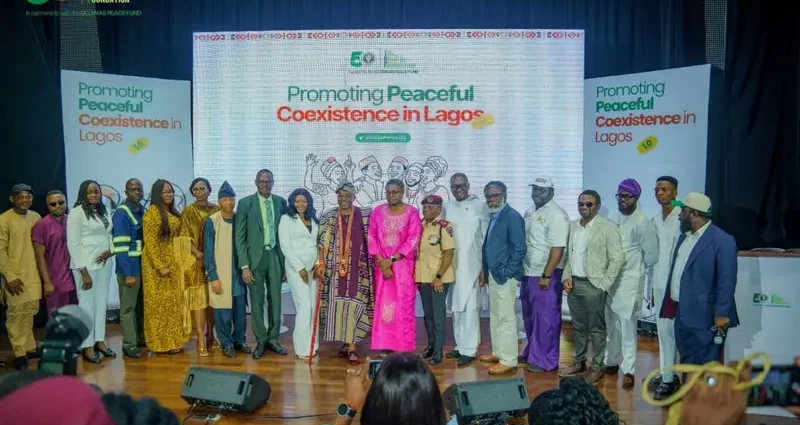
In line with this philosophy, the Adeola Adeyemi Foundation (TAAF), in partnership with ECOWAS, recently organised a three-day peace conference in Lagos.
It was themed “Promoting Peaceful Coexistence: A Conflict Prevention Initiative”.
The event featured sessions dedicated to dialogue, a peace walk, and outreach to schools, each aimed at promoting the culture of peace among young people and communities.

Ms Adeola Adeyemi, Founder and Chief Executive Officer of TAAF, underscored that peaceful coexistence and community harmony are essential foundations for unity and economic growth.
“Diversity is not a weakness but a strength,” she said, urging West African youths to become ambassadors of peace, unity, and understanding.
“Today is not just another event, it is a movement, a movement of peace, for understanding, and for co-existence. Peace begins with me, peace begins with you, and peace begins with us.
“Together, we can build the subregion that we dream of, safe, united, thriving, and at peace with itself,” she said.
Also speaking, Mr Dieudonné Nikiema, ECOWAS Peace Fund Manager, reiterated the commission’s commitment to supporting bold peace initiatives led by NGOs.
He said ECOWAS supported the initiative because the commission prioritised the promotion of peace and security across West Africa, and expressed optimism that the initiative would be sustained and replicated.
According to him, ECOWAS will continue to lend funding support to any organisation that keys into its vision and mission of promoting peace and security to engender regional development.
Nikiema stressed that ECOWAS’ fundamental mission was to promote peace, security and development, hence it was very important for it to identify with initiatives that would promote peace across the subregion.
He noted that no meaningful development would take place in the subregion without peace, security, unity and harmony among community citizens.
“If we in Africa are united, there is nothing we cannot do. So, we are calling on all of you, all of us, to put heads together and see how we can do our best to get this unity, to gather our brothers and sisters, to go beyond,” he said.
For Gov. Babajide Sanwo-Olu of Lagos State, intergovernmental collaboration and community development remain essential instruments for achieving peaceful coexistence.
He noted that peace is never accidental but the outcome of deliberate efforts, structured partnerships, shared responsibility, and sustained community engagement.
According to him, intergovernmental collaboration and community development are most effective when they complement each other.
Government institutions provide structure, policies, and resources, while communities contribute trust, intelligence, and local ownership.
Represented by his Senior Special Assistant on Special Duties, Mr Tobi Oladepo, the governor emphasised that communities with access to justice, education, healthcare, employment, and infrastructure naturally become active partners in maintaining peace.
He added that peace thrives where people from diverse ethnic, religious, and cultural backgrounds collaborate, coexist, share information, align their goals, and build their lives together in unity.
Mr Jude Chukwuka, a renowned Nigerian actor, encouraged speaking out against hate, describing it as a step toward social harmony, as silence is the fertile soil where hate takes root.
He described silence as a “loan” taken from the future, which is usually repaid with interest in division and pain, adding that true social harmony cannot be achieved until silence is broken.
“Keeping silence allows a small, loud minority to define the narrative of exclusion; people should always speak out as the first essential pathway to peaceful coexistence.
“When people speak out against hate, they are not creating disharmony, but actually defining the boundaries of true harmony.
“They are drawing a line in the sand and stating clearly: in our Nigeria, hate is not welcome, and silence will no longer be its ally.
“This is the path to the peaceful, prosperous society we have dreamed of for decades,” he said.
In the same vein, Mrs Adedoyin Kukoyi, a journalist, stressed personal accountability as the pathway to less violence and stronger communities.
“Our words and actions shape others’ lives,” she said, calling for mindfulness in social interactions.

Delivering a keynote address, the Oluwo of Iwo, Oba Abdulrasheed Akanbi, described peaceful coexistence as “sacred and non-negotiable”.
He identified land disputes, hate speech, and intergroup suspicion as triggers of conflict, urging traditional rulers to promote reconciliation and moral leadership at the grassroots.
“When a king speaks the language of reconciliation, it resonates widely, and when a palace becomes a space where wounded hearts find redress, trust is restored.
“The maintenance of peaceful coexistence is cheaper than war; an enduring peaceful coexistence is not in the courts or legal textbooks, but in the lived realities of ordinary people across our societies,” he said.
Observers agree that ECOWAS’ ongoing efforts to build an integrated, peaceful, and democratic West Africa will only succeed through sustained collaboration, dialogue, and advocacy.
Ultimately, regional peace cannot be imposed; it must be nurtured through understanding, inclusion, and shared responsibility.
As ECOWAS and its partners continue to champion this vision, their collective commitment offers hope for a more united, stable, and prosperous subregion. (NANFeatures)