


By Ibironke Ariyo, News Agency of Nigeria (NAN)
On Nigeria’s busy highways, tragedy can unfold in seconds.
Twisted metal, shattered windscreens and injured passengers often become grim reminders of how fragile life can be.
In such moments, emergency response frequently determines whether victims survive or succumb to their injuries.
Across the country’s vast road network, the Federal Road Safety Corps (FRSC) has emerged as the first line of rescue, arriving at crash scenes with sirens cutting through confusion and fear.
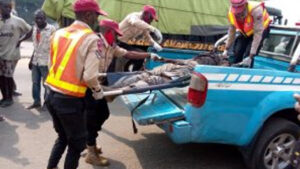
For many survivors, that arrival marks the critical boundary between wreckage and recovery.
An objective review of crash data between Dec. 15, 2025 and Jan. 15, 2026, comparing the 2024/2025 and 2025/2026 festive operations, indicates measurable improvements in rescue outcomes and emergency coordination.
Official statistics show that the number of persons rescued without injury rose from 2,697 to 2,792 nationwide, in spite of the 687 recorded road traffic crashes and 597 fatalities within the same review period.
Similarly, between January and December 2025, the Corps rescued 33,400 injured victims, underscoring the life-saving impact of structured emergency interventions amid persistent road safety challenges.
Survivor testimonies consistently highlight the importance of timely intervention.
Many victims rescued from crushed vehicles or roadside trauma say professional handling prevented further injuries often caused by untrained bystanders attempting rescue.
Mr Musa Abdullahi, a commercial driver who survived a multiple-vehicle collision along the Abuja–Lokoja Highway, recalled regaining consciousness inside an FRSC ambulance.
“I remember voices telling me to stay awake. They kept encouraging me until we reached the hospital. That gave me hope,” he said.
Likewise, Mr Akintunde Akinfenwa in Osogbo narrowly escaped death after losing control of his vehicle before rescue officials arrived.
“I thought that was the end of my life. But the rescue team treated me like family and ensured I received immediate medical attention,” he said.
Emergency management experts note that the Corps’ evolving rescue framework integrates patrol visibility, public enlightenment campaigns and digital reporting platforms to speed up incident detection and response time across highways.
A passenger rescued along the Kaduna–Zaria corridor during the ember-months patrol described how officers secured the crash environment before evacuation.
“They secured the area before moving us. Without that control, more vehicles could have crashed into us,” the survivor said.
Emergency responders say such outcomes depend largely on rapid mobilisation.
FRSC personnel are strategically deployed along highways to shorten response time, stabilise victims and coordinate evacuation to nearby hospitals before complications set in.
“Every second counts after a crash. Our training focuses on quick assessment, safe extraction and immediate transfer because delay can turn survivable injuries into fatalities,” a FRSC rescue officer said.
Medical professionals affirm that early evacuation plays a decisive role in trauma survival.
Dr Timothy Samaila, a Consultant Neurosurgeon at the Federal Medical Centre Jabi, observed that patients brought in by trained responders often arrive stabilised.
“The golden hour after trauma is critical. Patients brought in by FRSC teams often arrive stabilised, which increases survival chances,” he said.
Albeit these successes, road crashes remain a national challenge, with analysis by the corps identifying speeding, dangerous overtaking and reckless driving among leading causes of severe accidents across major corridors.
The Corps Marshal, Malam Shehu Mohammed, attributed improved outcomes partly to specialised patrol exercises conducted during festive periods, when traffic volume spikes.
He explained that psychological reassurance forms part of rescue protocol, as officers are trained not only to administer first aid but also to calm victims experiencing shock and trauma immediately after crashes.
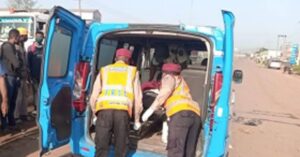
While reaffirming the Corps’ commitment to post-crash response, Mohammed cautioned against complacency, noting that gains already recorded must be protected and deepened.
He said faster response times, refresher training for rescue teams and stronger partnerships with hospitals would be pursued to sustain and further reduce fatalities.
He further declared a zero-tolerance enforcement regime on what he described as the “Big Five” traffic offences responsible for more than 70 per cent of fatal and serious crashes.
These include speed violation, dangerous driving, drunk or drug-impaired driving, wrong-way driving and overloading.
“The rising number of crashes is not an act of fate; it is a failure of compliance. Where discipline collapses, enforcement must rise. Our mandate remains clear: prevent crashes, enforce compliance and save lives,” he said.
Mohammed argued that emergency response alone cannot eliminate fatalities without behavioural change among motorists, while acknowledging that efficient rescue operations significantly reduce mortality rates.
“FRSC’s strategy increasingly combines enforcement with emergency preparedness. Visibility patrols, public awareness campaigns and improved coordination with hospitals are designed to ensure victims receive treatment without delay.
“Emergency response effectiveness is also linked to continuous training. FRSC officials undergo drills on casualty handling, fire risk management and coordination with other security agencies to improve multi-agency rescue operations.
“Data trends suggest gradual improvement. Earlier operational reports showed reductions in fatalities and injuries during periods of intensified enforcement and public education, highlighting the link between prevention and rescue capacity.
“Nevertheless, we admit challenges persist, including traffic congestion, poor road conditions and occasional hostility from crowds at crash scenes. These factors can slow evacuation and complicate rescue logistics,” he said.
Yet many officers say survivor gratitude remains their strongest motivation.
An Assistant Route Commander, who pleaded anonymity, described rescue work as emotionally demanding but rewarding.
“When someone you rescued walks again or calls to say thank you, it reminds you why the uniform matters. We see tragedy, but we also witness miracles,” she said.
For families reunited with loved ones, FRSC intervention represents more than institutional duty; it becomes a story of second chances.
Survivors often describe recovery as a new beginning shaped by the professionalism of responders they had never met before.
Public health advocates argue that strengthening emergency response systems nationwide could further reduce Nigeria’s road crash mortality rate through expanded trauma centres, public first-aid education and increased collaboration between agencies.
As Nigeria continues to grapple with road safety challenges, FRSC’s rescue operations remain a critical safety net, bridging the gap between accident occurrence and medical care.
From mangled vehicles on remote highways to crowded urban expressways, the Corps’ presence has turned countless potential fatalities into survival stories; silent victories measured not only in statistics but in lives restored.
Experts say that combining strict enforcement with behavioural change could save more lives than emergency response alone.
Ultimately, recovery is more than just a physical return.
It represents a second chance to attend family gatherings, celebrate school graduations, and mark birthdays, all made possible by men and women who rush toward danger to protect life. (NANFeatures)
***If used, please credit the writer and the News Agency of Nigeria.

Comments