








By Diana Omueza
Stakeholders at a strategy advocacy meeting on advancing women’s political leadership say the Special Seats Bill will be a major test of Nigeria’s democratic credibility in the 2027 general elections.
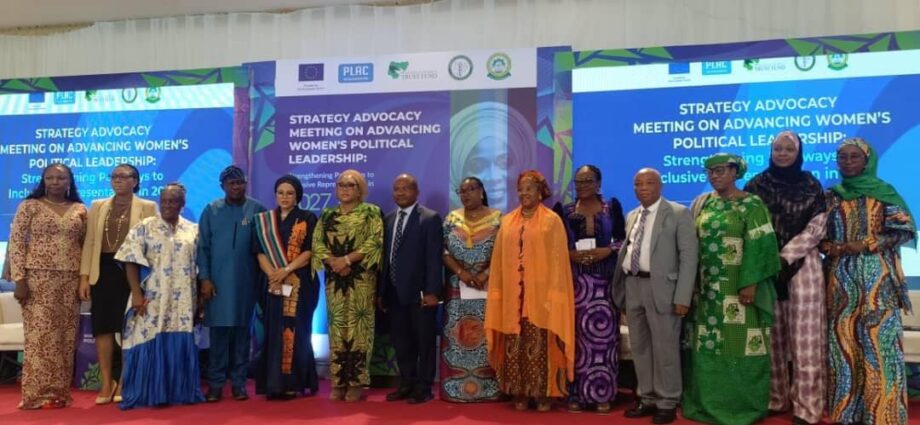
The stakeholders made the assertion during discussions on advancing women’s political leadership and strengthening pathways to inclusive representation in Nigeria’s political system, in Abuja.
The News Agency of Nigeria (NAN) reports that the meeting is themed “Advancing Women’s Political Leadership: Strengthening Pathways to Inclusive Representation in 2027.”
It was co-convened by the Policy and Legal Advocacy Centre (PLAC), Nigeria Women Trust Fund, and NBA-SPIDEL, with support from the European Union.
Mr Clement Nwankwo, Executive Director of PLAC, described the current low representation of women in political participation in the country as embarrassing.
According to him, only a handful of women occupy seats in the National Assembly, while several state assemblies have no female legislators.
“This trend reflects deep systemic exclusion and weakens inclusivity in governance.
“Despite women’s proven competence and achievements, structural barriers continue to hinder their participation in decision-making processes,” he said.
Nwankwo said that the proposed Special Seats Bill was a critical reform needed to guarantee increased representation of women in legislative houses.
He said that if the bill failed to secure assent again, Nigeria would not be able to credibly claim success in its ongoing constitutional reform process.
He said its assent would be a key benchmark for assessing genuine democratic progress.
Nwankwo advised political parties against exclusionary practices, adding that there was need for a deliberate gender balance in candidate selection.
Ms Laolu Olawumi, Programme Manager, Democracy and Rule of Law, EU Delegation to Nigeria and ECOWAS, called for the strengthening of women’s political participation in Nigeria.
She said that the ongoing constitutional reform process presents a critical opportunity to adopt an inclusive legal framework ahead of the 2027 general elections.
She said that women’s participation was essential for democracy, equality and sustainable development.
Olawumi urged political actors to move beyond rhetoric and demonstrate real commitment through action and resources.
“Political will must move beyond rhetoric to real commitment and resources.
“You cannot build a sustainable democracy while excluding half of your population,” she said.
Mrs Uju Agomoh, Chair of Nigeria Bar Association Section on Public Interest and Development Law (NBA-SPIDEL), described women’s underrepresentation as a democratic deficit weakening governance.
Agomoh noted that though women constituted nearly half of Nigeria’s population, their presence in elective and appointive positions remained significantly low.
She called for a stronger legal framework, affirmative action, policies and institutional reforms to address cultural and socio-economic barriers.
Mrs Brenda Anugwom, Chief Executive Officer of Nigeria Women Trust Fund (NWTF), said the exclusion of women was not due to lack of competence but an entrenched systemic barrier.
“Women are present everywhere except where decisions are made and that must change,” she said.
Anugwom observed that while women actively participated as voters and mobilisers, their representation in leadership positions remained disproportionately low.
She highlighted the global successes of Nigerian women and urged stakeholders to translate such excellence into domestic political representation.
On her part, Kafilat Ogbara, Chairperson, House Committee on Women Affairs, called for immediate and practical steps to increase women’s participation in leadership roles.
“The time is now for women to move from participation to leadership,” she said.
Ogbara stressed the importance of retaining women already in office through party support as a strategy to boost representation.
She also advocated cross-party collaboration, grassroots mobilisation and engagement with political gatekeepers to achieve inclusion.
According to her, inclusive governance requires collective responsibility involving men, communities and institutions.(NAN)(www.nannews.ng)
Edited by Chidi Opara