






By Aderogba George
A coalition of non-governmental organisations has called on the Federal Government to implement urgent sodium reduction measures in processed foods.
The organisations are the Network for Health Equity and Development (NHED), Centre for Communication and Social Impact (CCSI), and Corporate Accountability and Public Participation Africa (CAPPA).

The call was contained in a joint statement issued in Abuja by their communication officers, Mrs Tessy Maina of NHED, Mrs Anna White-Agbo of CCSI, and Mr Robert Egbe of CAPPA.
They said the measures were necessary to reduce rising cases of hypertension, stroke, heart disease, kidney failure and other non-communicable diseases linked to excessive salt consumption in Nigeria.
The groups also urged the government to prioritise access to safe, healthy and nutritious foods for Nigerians.
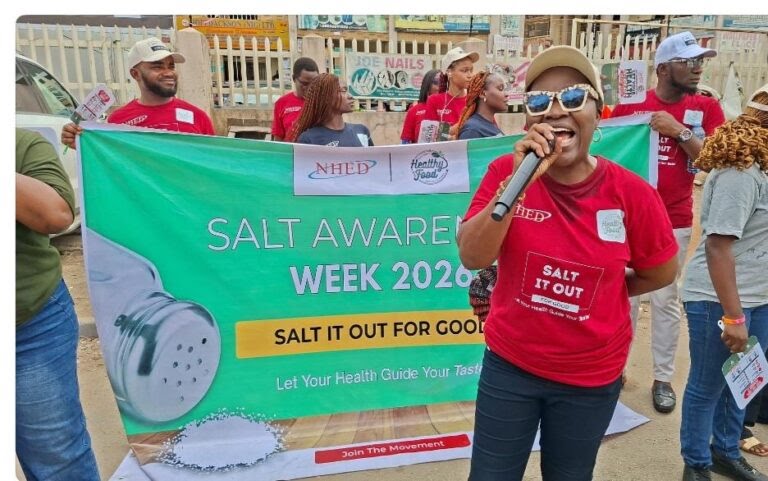
According to the organisations, the theme of the 2026 World Salt Awareness Week, “Salt It Out”, underscores the urgent need to address excessive salt consumption in the country.
They said the campaign encouraged governments, industries, communities and individuals to adopt practical measures aimed at reducing daily salt intake to the recommended limit of five grams or less.
The organisations noted that Nigeria was facing a growing public health crisis linked to unhealthy diets and increasing consumption of ultra-processed foods high in sodium, sugar and unhealthy fats.
Citing publicly available data, the groups said Nigerians consume an estimated 3.8 grams of sodium, equivalent to about 10 grams of salt daily, almost double the World Health Organisation (WHO)’s recommended limit of two grams of sodium or five grams of salt per day.
“Excess salt consumption is no longer a silent issue. It is now a major public health emergency contributing to the alarming rise in hypertension and cardiovascular diseases across the country,” the statement quoted the Executive Director of CCSI, Babafunke Fagbemi, as saying.
Fagbemi stressed that reducing sodium intake must become a national health priority supported by enforceable policies, including mandatory sodium targets, front-of-pack warning labels and stronger public awareness campaigns.
Also quoted in the statement, Dr Jerome Mafeni, Technical Adviser of NHED, warned that Nigeria’s healthcare system was already under pressure from the growing burden of non-communicable diseases.
He said the country might struggle to cope with the long-term social and economic consequences if urgent preventive measures were not implemented.
Speaking on behalf of CAPPA, its Executive Director, Mr Akinbode Oluwafemi, said that while efforts to address micronutrient deficiencies were important, nutrition policies must also align with broader public health goals.
“As Nigeria responds to nutrition challenges, we must also ensure that food policies do not unintentionally encourage increased consumption of ultra-processed foods linked to rising cases of diet-related non-communicable diseases,” he said.
The organisations urged the Federal Ministry of Health and Social Welfare, NAFDAC, the Standards Organisation of Nigeria (SON), and other stakeholders to take proactive steps to protect Nigerians from harmful food environments.
Among other measures, they called for the enforcement of mandatory salt targets for processed foods, front-of-pack warning labels on ultra-processed products, stronger public education campaigns on the dangers of excessive salt consumption, and increased support for healthier food environments.
The groups also urged Nigerians to adopt healthier dietary habits by reducing the use of added salt and seasoning cubes, while incorporating natural spices such as ginger, curry, turmeric and fish powder into meals.
They further encouraged increased consumption of fresh foods, fruits and vegetables, as well as closer attention to food labels when making dietary choices.
“As we mark World Salt Awareness Week, we must recognise that healthy diets are not just a matter of personal choice but also of public policy.
“The government has a responsibility to create food environments that protect health rather than undermine it,” the statement added.
The News Agency of Nigeria (NAN) reports that World Salt Awareness Week 2026 runs from May 11 to May 17, focusing on reducing dietary salt intake to improve public health outcomes.
The campaign encourages the public and the food industry to “Salt It Out” to prevent high blood pressure, heart disease, stroke and kidney damage.(NAN)(www.nannews.ng)
Edited by Tosin Kolade