









By Abujah Racheal, News Agency of Nigeria (NAN)
In July 2014, Nigeria stood at the edge of what could have been a catastrophic public health collapse.
Patrick Sawyer, a Liberian-American diplomat infected with Ebola Virus Disease, arrived at Murtala Muhammed International Airport in Lagos and later collapsed.
Few could have predicted that the incident would become one of the most defining moments in modern African epidemiology.
Within hours, Nigeria activated a response that would later be studied globally.
The system, led by the Nigeria Centre for Disease Control and Prevention (NCDC) and coordinated across federal, state, and local structures, mobilised rapid contact tracing, immediate isolation protocols, and aggressive case surveillance in Africa’s most populous city.
When the World Health Organisation eventually declared Nigeria Ebola-free, it was not just a public health victory, it was a global benchmark.
Behind that success, experts said it was a less visible but decisive factor, institutional trust.
Frontline health workers operated with rare confidence in the system that backed them.
Risk allowances were processed, emergency funds were rapidly deployed, and protective equipment was prioritised for those in direct contact with suspected cases.
That trust functioned as an invisible infrastructure, holding together a response system under extreme biological pressure.
More than 10 years on, that architecture has shifted.
Today, as Ebola outbreaks re-emerge in parts of the Democratic Republic of Congo and Uganda, Nigeria’s preparedness posture appears familiar on paper. Surveillance alerts are issued.
Airport screening is activated; emergency operations centres are mobilised; but beneath this structure lies a widening gap between policy and lived reality.
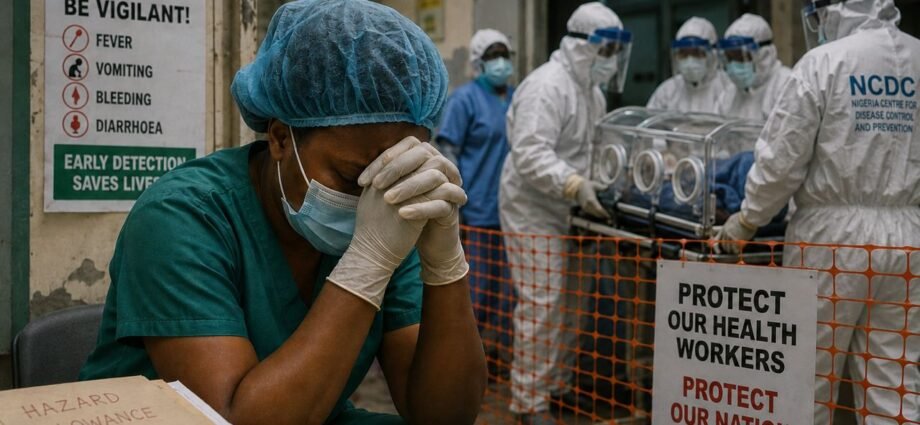
Experts say that instead of the unified medical reserve of 2014, the frontline is increasingly marked by fatigue, welfare disputes, and overstretched facilities.
The result is a system preparing for external threats while absorbing internal stress.
It is worth noting that the Ebola threat is compounding the current Lass fever outbreak.
The NCDC has confirmed that Nigeria’s Lassa fever outbreak has escalated sharply in 2026, with the death toll reaching 191 across 23 states.
The Case Fatality Rate has also surged dangerously to between 24.6 per cent and 25.2 per cent, a significant rise from about 19 per cent recorded in the same period in 2025.
This raises concern that patients are presenting late or that treatment centres are increasingly overstretched and under-resourced.
At the same time, dozens of healthcare workers have been infected with Lassa fever this season alone, shifting the risk from an abstract occupational concern to an active and ongoing hazard within clinical settings.
Across treatment centres, health workers said outbreak response has become a test of endurance.
A doctor at the Irrua Specialist Teaching Hospital, who requested anonymity, said frontline staff members were often forced to work under unsafe conditions.
“When Lassa fever cases come in, we act immediately, but often with inadequate protection and delayed hazard payments.”
He warned that repeated exposure without adequate safeguards was eroding morale and weakening the willingness to respond during future outbreaks.
A nurse at the Abubakar Tafawa Balewa University Teaching Hospital (ATBUTH) described similar fears, stating isolation ward work comes with constant psychological and occupational strain.
“Heroism does not pay the bills; we work in fear of carrying infections home while hazard allowances are delayed,” she said.
She added that emotional fatigue and fear of nosocomial infection were becoming increasingly common among frontline staff.
Observers say at the heart of Nigeria’s outbreak preparedness challenge lies a widening trust deficit between health workers and the system they serve.
The crisis is being driven not only by welfare concerns, but also by prolonged industrial actions and escalating labour disputes.
The Joint Health Sector Unions (JOHESU) embarked on an 84-day nationwide strike that significantly disrupted public health services before it was suspended.
Separately, the Nigerian Association of Resident Doctors (NARD) declared an indefinite nationwide strike over disputes related to the revised Professional Allowance Table and broader welfare concerns.
In response, the Federal Ministry of Health and Social Welfare enforced a strict “no work, no pay” policy, halting salaries for participating professionals.
Health workers said the policy had deepened resentment within the system, worsening mistrust and weakening morale at a time when outbreak readiness depended heavily on voluntary compliance and workforce availability.
Beyond labour tensions, Nigeria’s health system stakeholders said it continued to face critical infrastructure deficits at the facility level.
In several high-burden states including Bauchi, Edo, Ondo, Taraba, and Benue, health workers report erratic electricity supply, inadequate water systems, and shortages of essential personal protective equipment.
Diagnostic delays remain a persistent challenge, with samples often transported across long distances before confirmation, forcing clinicians to manage suspected viral haemorrhagic fever cases without timely laboratory support.
Compounding these challenges is the ongoing “Japa” phenomenon, the sustained migration of highly trained Nigerian medical professionals to the UK, the U.S., and Middle Eastern countries.
Dr Solomon Chollom, a virologist and public health expert, warned that the impact was no longer only numerical but functional, as isolation centres and infectious disease units increasingly struggled with shortages of specialised personnel capable of safely managing high-risk pathogens such as Ebola.
According to Chollom, Nigeria’s preparedness concerns are further heightened by Ebola outbreaks in Central and East Africa linked to the Bundibugyo strain.
He said the strain was particularly concerning due to its high case fatality potential and the absence of licensed vaccines, limiting preventive options in the event of importation.
Authorities, including the Federal Airports Authority of Nigeria, have intensified screening at points of entry.
However, experts warn that border control alone cannot guarantee safety if internal clinical capacity remains weakened.
They argue that Nigeria’s greatest vulnerability lies not at its borders, but within under-resourced hospitals, understaffed isolation centres, and a shrinking workforce of experienced clinicians.
Dr Ishaku Akyala, an Associate Professor of Infectious Diseases at Nasarawa State University, said Nigeria’s 2014 Ebola containment remained a reference point not because of infrastructure alone, but because of trust in the system and its responders.
A renowned virologist, Prof. Oyewale Tomori, said Nigeria’s success was driven by speed, coordination, and public confidence in health authorities.
“We were able to contain Ebola in 2014 because the response was trusted and people complied.”
Tomori warned that the foundation was now under serious strain.
“That trust is fragile. Once it is eroded, even the strongest systems will struggle to function effectively.”
He added that outbreak preparedness must be sustained continuously, not activated only during emergencies.
“Ebola is not just a viral disease; it is a test of systems, leadership, and preparedness discipline,” he cautioned.
For Nigeria, the challenge is no longer only about detection or containment capacity.
It is about whether the health system still has enough protected, motivated, and available personnel to respond when the next outbreak arrives.
Without that trust and workforce stability, experts warn, preparedness remains incomplete—not because systems are absent, but because their foundation is weakening.(NANFeatures)
Edited by Chijioke Okoronkwo
***If used, please credit the writer and the News Agency of Nigeria.