







By Lengnan Tobias, News Agency of Nigeria (NAN)
Uke, a community along the Keffi Expressway- Nasarawa State, is known to travelers as a roadside haven.
Numerous roadside taverns offer fresh fish, palm wine, and other delights, serving as a welcoming sanctuary for weary travelers to rest and rejuvenate.
To most travelers, that is all Uke is known for.
Mike Uja, who plies the route to Jos every weekend, said it had some of the best palm wine around.
“I leave Jos early on Sunday to enjoy the cool breeze and palm wine with fish.
“I have brought a lot of people here, and now they come on their own to relax,” he said.
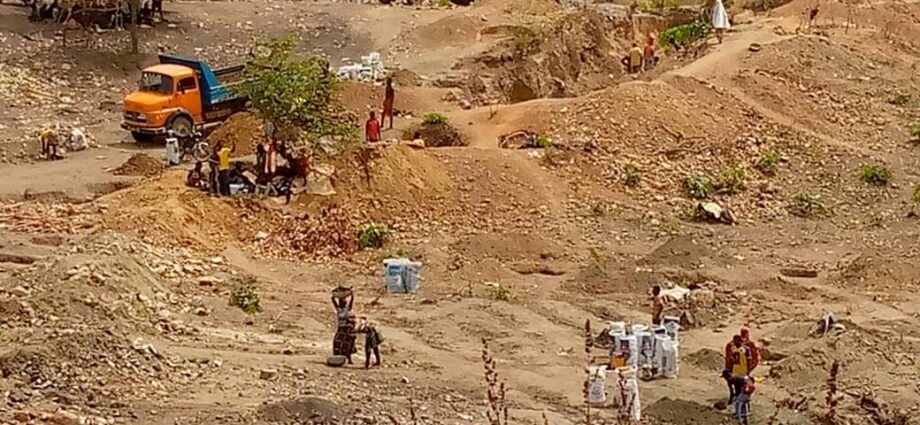
But beyond the roadside stalls, NAN’s investigation reveals a different reality: a booming mining hub attracting both foreign and local miners.
The area is no longer a place for casual visitors; miners grow hostile at the sight of strangers, treating unknown faces with suspicion.
When NAN’s reporter tried to investigate, he was chased out by aggressive-looking miners.
The bike rider familiar with the community rushed him out of the site to escape the miners’ fury.
On a second visit, the reporter was connected to a middleman who advised him to grease palms before linking him to a gold dealer.
Once the conditions were met, the dealer allowed access to the site and even permitted photographs.
Locals say the influx of outsiders may cause insecurity in the district.
Beyond destroying farmlands, miners are accused of luring young girls with mobile phones and cash in exchange for sex.
The trade, they say, has drawn in school-age girls, some as young as 12, who abandon their families to live in camps near the mining sites.
Hassan Aminu, a resident, highlighted some sad realities.
“It is unfortunate that our young girls have abandoned their parents to go after these miners who use them as sex toys for money.
“Every young girl is now using what she has to impress her friends with an iPhone; it has become a serious competition among girls chasing these men,” he said.
Samson Mekiki, another resident, said university students were also being targeted.
“Recently, three girls from Nasarawa State University, Keffi, came with some miners in the evening.
“Their prime time is usually from 8 p.m. It is not easily detected; only those involved know,” he said.
NAN observed that most miners are non-natives and nationals from other West African countries who show little respect for local culture.
Many are hostile and react aggressively when challenged.
Residents fear Uke could end up like Awe, a town considered as a no-go area due to mining-related insecurity.
For Sale Adamu, most of the residents live in fear of the unknown.
“We know what is happening in Awe because of lithium mining; we do not want bandits and other criminal elements to relocate here and displace us.
“Our farmlands have been taken over, and the soil is being destroyed.
“If this continues, we may have no farmland left.
“The government has no strategy to make mining benefit the youths in these communities. They should learn from what is happening in Zamfara, Niger, and Borno States,” he said.
Reacting to the development, Adamu Omadefu, Chairman of the House Committee on Environment in the Nasarawa State House of Assembly, revealed that members of various communities in the state where mining was taking place were treated as slaves.
The lawmaker made the revelation while briefing newsmen and members of Civil Society Organisations (CSOs) on the outcome of his visit to Abuni community in Awe Local Government, where a Chinese company, Multiverse, holds sway.
The oversight visit was in response to a petition by CSOs urging the House to address various challenges faced by mining communities.
The petition was jointly signed by the Renevlyn Development Initiative (RDI), the Environmental Defenders Network (EDEN), and the Citizens Free Service Forum (CFSF).
It urged the lawmakers to embark on a comprehensive environmental audit of Abuni and Uke district and their sources of water, revoke the mining license of any company found wanting, and scrutinise the agreements between mining firms and traditional rulers in the affected communities.
“What we discovered was an eyesore. Everything you raised in your petition was confirmed as the true reflection of what is going on in the communities.
“The mining companies are treating our people as slaves in their own country.
“It is unfortunate what the mining companies are doing in the communities; it is a condition that you cannot wish for your enemy,” the lawmaker said.
On steps taken by the government, the Commissioner for Environment and Natural Resources, Margaret Elayo, said the administration of Gov. Abdullahi Sule had approached the issue of illegal mining with a combination of firm enforcement, community engagement, and structural reforms.
“A very practical example is the intervention in Udege Development Area, which has historically been one of the most active mining corridors in the state.
“Under the directive of the governor, the Ministry of Environment and Natural Resources, led by Elayo, carried out multiple assessment and enforcement visits to mining sites in Udege.
“These engagements were not ceremonial as they resulted in the identification of illegal operators, the shutdown of non-compliant sites, and the immediate escalation of cases to relevant federal authorities.
“In addition, the state has strengthened collaboration with federal institutions such as the Federal Ministry of Solid Minerals Development and security agencies to conduct coordinated crackdowns across illegal mining hotspots in areas like Kokona, Nasarawa Local Government Areas, and many more areas to come,” she said.
NAN reports that illegal and artisanal mining operations have caused more than 200 deaths in the last decade.
In 2024–2025, a surge in incidents, especially in Niger, Plateau, and Zamfara States, killed more than 100 people in single events, often driven by heavy rain and poor safety protocols.
Observers say external interests also fuel illegal and artisanal mining.
A recent report by the Renevlyn Development Initiative (RDI) titled Silent Conquest: The Chinese Infiltration of Nigeria’s Solid Minerals Sector, showed heavy Chinese interests in the nation’s precious mineral belts.
The report connected granular field-level events to broader patterns of national security risk, environmental decline, and governance failures.
Philip Jakpor, Executive Director of RDI, said local communities, especially unemployed youths, were only victims of a system that extracted their wealth and gave them nothing in return.
He said such youths got involved in artisanal mining to also benefit from what God had given them.
“In the process, many get maimed or buried in mining pits while the external forces behind the illegal mining activities escape liability and continue to smile to the banks,” he said.
To sanitise the mining industry in Nasarawa State and stamp out corrupt activities of illegal miners in the Uke, stakeholders are canvassing for synergy among community leaders, security agencies, regulatory authorities, and religious leaders. (NANFeatures)
Edited by Chijioke Okoronkwo
***If used, please, credit the writer and the News Agency of Nigeria.