








By Tosin Kolade
Stakeholders in Nigeria’s water sector have called for stronger policy implementation, sustainable financing, tariff reforms, political commitment and long-term investment to improve urban water supply services across the country.
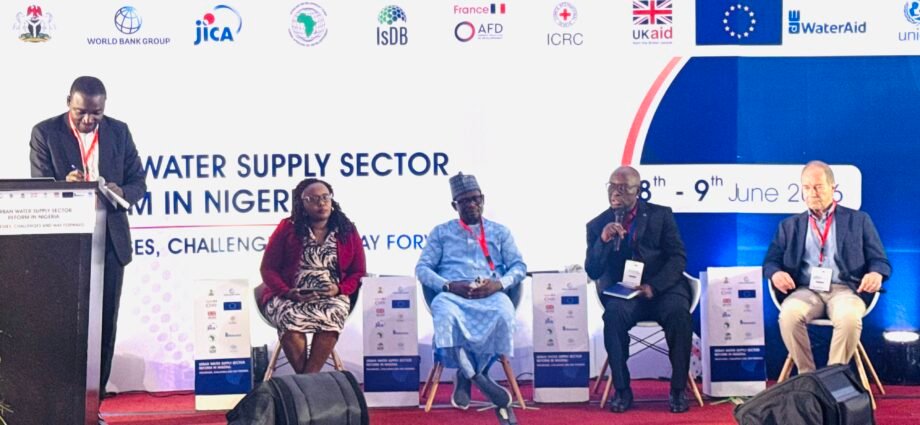
The calls were made during the plenary session of a workshop convened by the Federal Ministry of Water Resources and Sanitation and Development Partners in Abuja on Tuesday.
The News Agency of Nigeria (NAN) reports that the workshop is themed “Urban Water Supply Sector Report in Nigeria: Progress, Challenges and the Way Forward”.
At the event, water sector expert, Mr Sonni Elisha, identified energy costs as one of the most overlooked challenges affecting the sustainability of water utilities.
He said energy accounts for between 30 and 60 per cent of utilities’ operational costs, stressing that sustainable water services cannot be achieved without sustainable energy.
According to him, governments and development partners should design programmes that support and subsidise energy costs for water service providers.
Elisha urged development partners to address the long-standing challenge of inadequate water tariffs, noting that many donor-supported programmes had failed to move states toward cost-reflective pricing despite commitments under project agreements.
He argued that low-income levels should not justify the maintenance of unsustainably low tariffs, adding that many Nigerians already pay far more for water from informal vendors than through public utilities.
He explained that a 20-litre container of water commonly sells for about N100, translating to roughly N5,000 per cubic metre.
This, he said, compared to utility tariffs of between N150 and N350 per cubic metre in many states.
Elisha said tariff reforms would improve utility operations, reduce non-revenue water and strengthen revenue collection.
He further stressed that meaningful reforms require long-term commitment, noting that successful water sector reforms in other countries often take nearly two decades to mature.
He called on development partners to move beyond short project cycles and support programmes that remain in place until reforms are fully institutionalised.
Also, Ms Emily Kilongi, the Principal Water and Sanitation Engineer at the African Development Bank (AfDB), said future donor financing would be tied to states’ commitment to implementing water sector reforms.
Kilongi, who represented the Development Partner Group (DPG), said development partners would support reform champions at the federal and state levels and strengthen regulatory institutions to improve oversight and service delivery.
She identified reliable sector data as critical for planning and monitoring progress, adding that partners would support national WASH monitoring systems and data management frameworks.
According to her, future infrastructure investments will be linked to reforms aimed at improving operational sustainability, reducing non-revenue water, adopting new technologies and strengthening customer engagement and accountability.
She added that development partners would support project preparation, including master plans, feasibility studies and environmental and social assessments.
Kilongi said capacity-building efforts would focus on strengthening permanent institutional staff rather than temporary project implementation units.
She noted that donor funding alone would not close the sector’s financing gap and pledged support to improve utilities’ creditworthiness and access to commercial financing.
Earlier, Mr Paul Maycher, a water sector expert, called for stronger engagement between utilities and political leaders, saying many reforms fail because key stakeholders do not fulfil their responsibilities.
He said reforms such as management contracts, institutional restructuring and legislative changes often require government action that utilities and consultants cannot undertake alone.
“In many cases, the government has a role to play, whether it is approving policies, passing laws or implementing agreed reforms.
“When those responsibilities are not carried out, projects struggle to achieve their objectives,” he said.
Maycher urged greater involvement of governors, ministers and other senior officials in sector dialogues to deepen understanding of the challenges facing utilities.
He also called for improved communication from utilities to political leaders, saying they should regularly report achievements, reforms and service improvements.
According to him, stronger political ownership is essential to sustain reforms and ensure long-term returns on sector investments.
Similarly, Mr Abdulhamid Gwaram, the National Programme Coordinator, Sustainable Urban and Rural Water Supply, Sanitation and Hygiene (SURWASH), called for a shift from short to long-term interventions.
Gwaram said the long-term programmes would focus on sustainable service delivery and measurable outcomes.
He said that despite years of investments, capacity-building initiatives and reforms, service delivery outcomes had remained insufficient in many areas.
He noted that the sector already has numerous policy frameworks, plans and roadmaps, but implementation remains a major challenge.
Gwaram said stronger regulatory systems are needed to attract private sector investment and address persistent financing gaps.
“We need to focus on implementation, sustainability and impact, not just on policies, inputs and outputs,” he said.
He warned against a one-size-fits-all approach, saying reforms must reflect the different capacities of states and institutions.
Gwaram advocated performance-based assessments and greater accountability for implementing agencies, while urging development partners to support institutions that demonstrate readiness to deliver results. (NAN)
Edited by Moses Solanke