










By Mercy Sawok
The Tertiary Education Trust Fund (TETFund) has urged tertiary and specialised health institutions in Nigeria to continuously review curricula to align with emerging public health priorities.
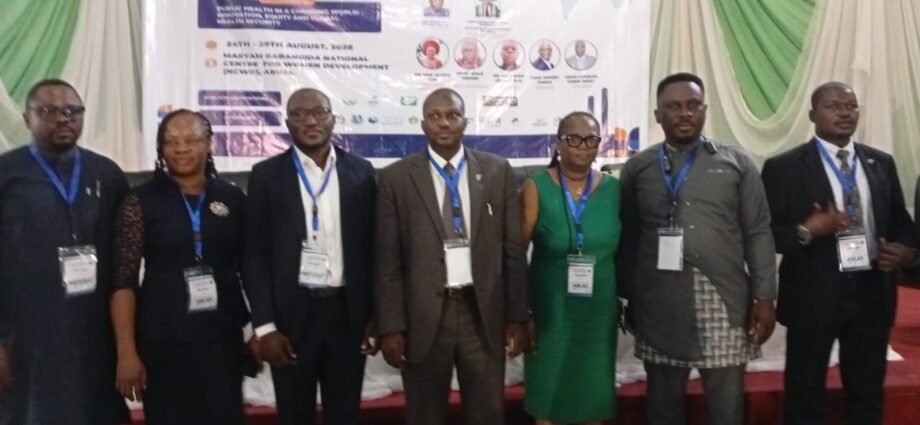
The Executive Secretary of TETFund, Mr Sunday Echono, made the call at the sixth Society for Public Health Professionals of Nigeria (SPHPN) and 37th Professional Association of Public Health Nurses of Nigeria (PAPHNON) Joint Scientific Conference in Abuja on Wednesday.
Echono was represented by Prof. Saidu Ibrahim, a member of the National Research Fund Screening and Monitoring Committee, who delivered his address on his behalf.
The ongoing conference has the theme: “Public Health in a Changing World: Innovation, Equity and Global Health Security.”
Echono said education remained the most sustainable investment in strengthening the health system, adding that COVID-19, Lassa fever, Ebola and antimicrobial resistance had reshaped public health.
“No nation can build a strong health system without investing in education and development of its health workforce.
“Hospitals may be modern and policies well designed, but without competent and motivated professionals, these investments cannot achieve their full potential,” he said.
He said Nigeria’s growing population and changing disease patterns required a new generation of public health professionals who were multidisciplinary, technologically proficient and globally competitive.
Echono said health institutions should produce graduates with theoretical knowledge and practical competencies in disease surveillance, health promotion, health informatics, epidemiology, implementation research and emergency preparedness.
He also identified health economics, policy analysis, environmental health, digital technologies and leadership as essential areas that should be incorporated into public health training.
The TETFund representative advocated introducing business-related courses into health education curricula to equip health professionals with skills in financial management, entrepreneurship, marketing and business planning.
He said such skills would provide health workers with alternative career opportunities, particularly where formal employment opportunities were limited and after retirement.
Echono said TETFund’s mandate was rooted in the conviction that quality tertiary education was critical to national development through strategic investments and interventions.
He said the Fund had continued to strengthen teaching and learning, research, physical infrastructure, libraries, information and communication technology and institutional capacity across public tertiary institutions.
According to him, TETFund had invested substantially in research capacity, postgraduate education, sponsorship of academic staff for higher degrees, international collaborations, laboratory modernisation and innovation across disciplines.
He listed public health-related initiatives supported by the Fund to include research into Lassa fever, infectious disease surveillance and global health, malaria, water, sanitation and hygiene interventions.
He also mentioned the Medical School Revitalisation Programme, aimed at upgrading clinical learning environments, simulation laboratories and lecture theatres in public medical training institutions.
Echono described the investments as strategic interventions in Nigeria’s future health security, economic productivity and national development.
He said research and innovation remained critical pillars of a strong health system, stressing that solutions to Nigeria’s public health challenges should not depend solely on imported technologies.
“Our universities and research institutions must become centres of excellence where multidisciplinary collaboration flourishes, young researchers are nurtured and research findings are translated into policy and practical interventions that improve population health,” he said.
He urged Nigeria to embrace emerging technologies, including artificial intelligence, genomics, telemedicine, digital surveillance systems, geographic information systems, wearable technology and predictive analytics.
Echono, however, cautioned that innovation must be deployed in ways that promoted equity and accessibility rather than widened existing inequalities.
He said healthcare equity must remain central to educational reforms, policy decisions and investments in health workforce development.
He urged institutions to produce professionals who understood the social determinants of health, appreciated cultural diversity and demonstrated empathy, integrity, professionalism and commitment to public service.
On the future of Nigeria’s public health workforce, Echono called for stronger partnerships among government, academia, professional associations, regulatory bodies, development partners, private sector and civil society.
He said industry partnerships, internship opportunities, simulation-based learning, community-based education, interdisciplinary training and collaborative research should become standard practice.
He identified strengthening health education curricula, expanding postgraduate training, investing in research and innovation, improving digital competencies and promoting interdisciplinary collaboration as priorities for the next decade.
Echono also called for enhanced continuous professional development, stronger partnerships among academia, government and industry, evidence-informed policymaking and improved career opportunities for health professionals.
On migration, he said Nigeria must address factors driving health professionals to seek opportunities abroad by creating working environments supporting career progression, professional recognition and research opportunities.
He said the country should also explore mechanisms for professionals in the diaspora to contribute to national capacity building through teaching, mentorship, research collaboration and technology transfer.
Echono said the objective should be to transform the diaspora from a loss of human capital into a source of knowledge and expertise for national development.
Earlier, the National President of SPHPN, Prof. Stephen Abah, called for urgent action to build a future-ready public health workforce and advance health sovereignty.
Abah said the changing nature of health threats, declining external funding and rapid technological advancement made the conference theme particularly relevant.
He described public health as “the invisible infrastructure of a nation,” saying it had implications for child survival, food security, investor confidence and national resilience.
He said the Africa Health Security and Sovereignty Agenda, endorsed by African Union Heads of State in February 2026, represented a shift towards greater self-reliance.
According to him, the agenda focuses on strengthening Africa’s voice in global health governance, institutionalising pandemic preparedness, improving domestic health financing and promoting digital transformation.
“Health sovereignty does not mean isolation.
“It means that African countries must have the capacity to define and lead their health priorities, own critical capabilities, and participate as strong partners in regional and global health cooperation,” Abah said.
He described the public health workforce as the “engine of transformation” and urged professionals to strengthen competence, promote evidence-informed practice and prepare for digital transformation.
Abah challenged participants to ensure that the conference moved “from dialogue to decisions, from decisions to implementation, and from implementation to measurable health gains.”
He said the success of the conference should be measured not by the number of papers presented but by the commitments and actions that would follow.
The SPHPN president also called for stronger collaboration among government, academia, professional associations, development partners and communities to develop practical, scalable and sustainable health solutions.
He said the conference brought together more than 5,000 multidisciplinary public health professionals from Nigeria’s 36 states and Federal Capital Territory, alongside participants from Cameroon and other countries.
Abah reaffirmed SPHPN’s commitment to professional excellence, research, advocacy and workforce development, providing a platform for public health professionals to contribute to national and global policy conversations.(NAN)(www.nannews.ng)
Edited by Abiemwense Moru