

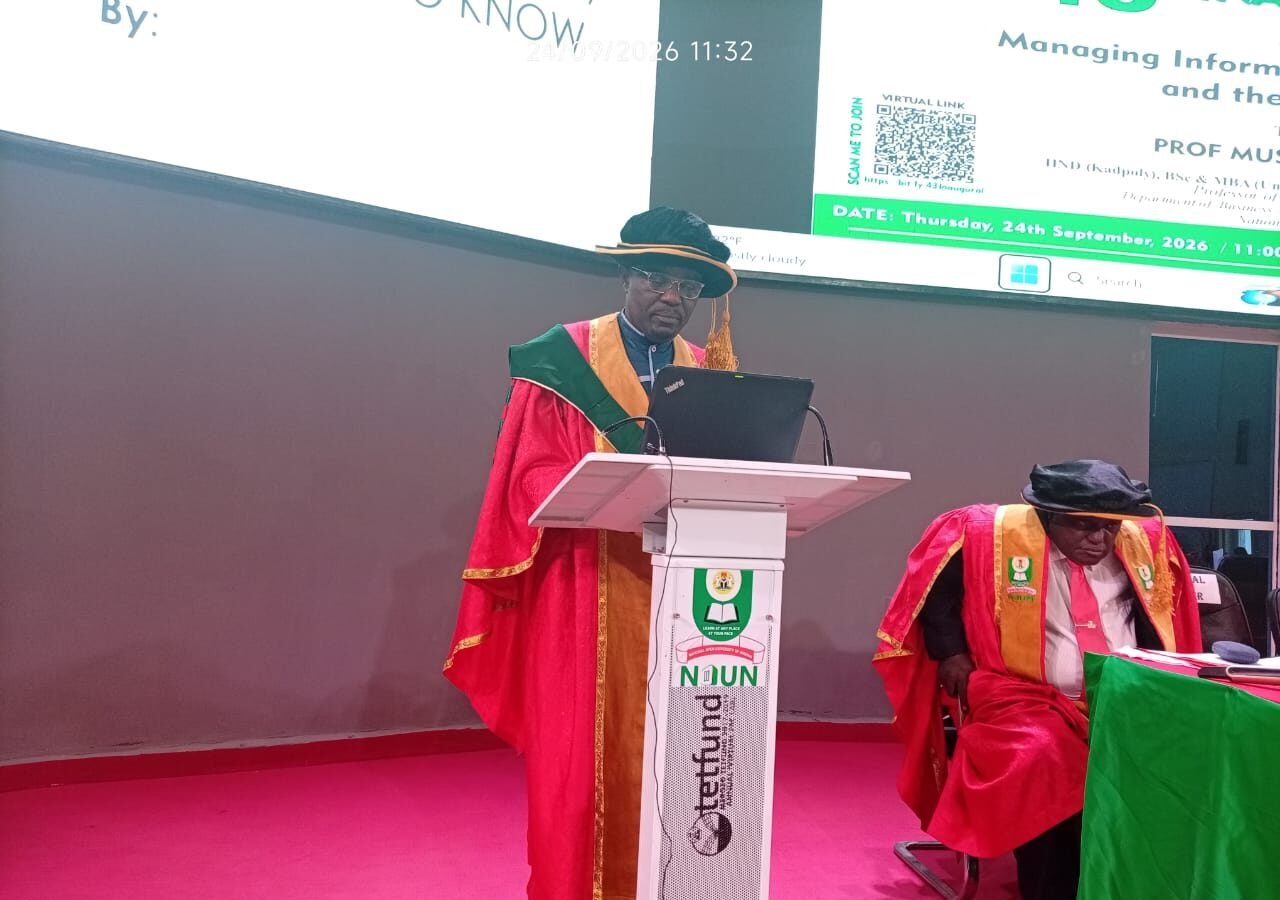
By Edith Tsokar
A Professor of Management at the National Open University of Nigeria (NOUN), Mustapha Momoh, has called for a shift from mere acquisition of information to strategically converting content into knowledge, wisdom and action.
Momoh made the call while delivering NOUN’s 43rd Inaugural Lecture on Thursday in Abuja.
The lecturer, who spoke on the topic, “Managing Information Sources, Utilisation and the Need to Know,” said access to abundant information does not automatically translate into improved individual or institutional performance.
He noted the proliferation of digital technologies and artificial intelligence that had changed the major challenges facing institutions from information scarcity to information overload.
According to him, the real value of information lies in its relevance, clarity, timeliness and usefulness to those required to act on it.
“We live in a world where information is everywhere, but wisdom is not,” Momoh lamented.
He urged institutions to develop systems capable of filtering information and identifying data that could support effective decision making.
He said organisations must move beyond collating, storing and disseminating information to deliberately transforming it into actionable knowledge that could generate innovation and solve societal problems.
Momoh explained that technological advancement, particularly the emergence of artificial intelligence, had significantly increased the volume and speed at which information was generated and circulated.
He noted that the development had created a new management challenge, requiring institutions to distinguish useful information from irrelevant or misleading content.
The varsity don further argued that information remained a critical resource in determining how other resources were deployed, noting that its strategic use could improve organisational effectiveness and decision-making.
“Material creates wealth and energy creates power, but information provides the direction and meaning for how both are utilised effectively,” he said.
Momoh also highlighted the need for higher institutions to strengthen their information management systems to enable researchers, administrators and other stakeholders to access and apply relevant knowledge effectively.
He said universities had a responsibility to ensure that information generated through research and academic activities translated into solutions to real-world challenges.
The professor presented 10 management theories developed from his years of scholarship in information management, infrastructure and dissemination.
He said the theories provided useful perspectives for understanding the management and utilisation of information within organisations and society.
The lecturer urged institutions to regard information management as a strategic function rather than merely an administrative activity.
He said effective information management would help organisations improve planning, innovation, accountability and the quality of decisions taken at various levels.
He urged academics, administrators and other professionals to embrace continuous learning and develop the skills required to navigate an increasingly information-driven society.
NOUN Vice-Chancellor(VC), Prof. Udoma Oji Uduma, in his remarks, said responsible management of information was key to improving decision-making, institutional governance and educational outcomes.
Udoma examined the growing volume of information available to individuals and organisations and the need to transform such information into meaningful action.
The VC said the central message of the lecture was that the true value of information should not be measured by the volume produced, but by the extent to which it improved decisions and outcomes.
He said information management was not merely a technical or administrative issue, and explained that it was closely linked to ethics, governance, accountability and the responsible exercise of institutional power.
“An organisation must understand that not everything that can be known must necessarily be disclosed, just as not everything that is withheld ought to remain hidden,” he said.
Udoma identified course materials, digital platforms, learner records, study centres, learning analytics, research repositories and management information systems as important components of the university’s information ecosystem.
He said inaccurate information could undermine decisions, with inaccessible information could hurting inclusion, while insecure information could erode trust in the institution.
Udoma said the major lesson from the lecture was that organisations should focus not merely on accumulating information, but on transforming information into knowledge, understanding into wisdom and wisdom into responsible action. (NAN)
Edited by Francis Onyeukwu



Comments