


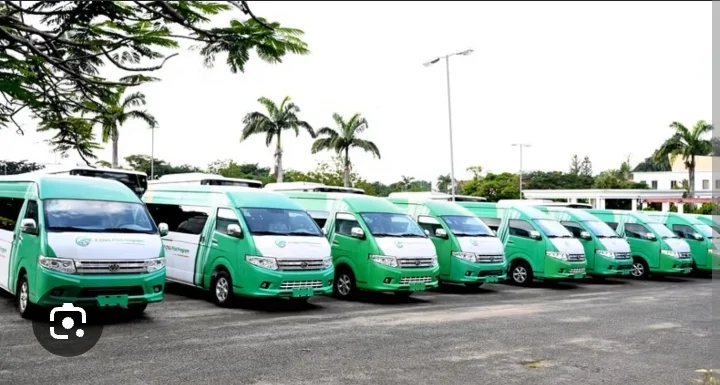
Nigerians in Kaduna, Katsina, and Kano states have urged governments in federal and state levels to deliver on deploying more CNG and electric powered buses on Oct. 1 to reduce costs of transportation for Nigerians.
The News Agency of Nigeria (NAN) reports that President Bola Tinubu had directed state governments to accelerate the deployment of Compressed Natural Gas (CNG) and electric mass transit systems to deliver measurable reductions in transportation fares from Oct. 1.
A cross section of Nigerians who spoke with NAN in Kaduna, Katsina and Kano said they were excited about the promise and look forward to Oct. 1 as Nigerians celebrate the 66th anniversary full of hope.
They said the initiative would provide much-needed relief to commuters and businesses, particularly amid the rising cost of transportation and its impact on household incomes.
Abdulrahman Abubakar, Chairman, Coalition of Civil Society Organisations in Katsina said Nigerians were full of hope that the Oct. 1 target would translate into more cheaper and accessible public transportation.
He urged authorities to make affordability the major consideration in deploying the CNG buses, rather than merely increasing the number of vehicles on the roads.
According to him, high transportation costs affect virtually every aspect of people’s lives because commuters have to spend more to get to work, schools, markets, hospitals and other essential places.
He said a reduction in transport fares would leave more money in the pockets of workers and families and enable them to meet other basic needs.
Malam Bala Adamu, a community leader in Katsina said the government’s promise had created expectations, especially among low-income families who were finding it increasingly difficult to cope with transportation expenses.
He urged the authorities to ensure that the buses were deployed to routes with high passenger traffic and communities where residents were most affected by expensive fares.
The community leader said affordable transportation would make it easier for people to access employment, education, healthcare and markets.
He stressed that the impact would extend beyond individual commuters because traders and small businesses would also benefit from reduced costs of transporting goods.
Adamu urged the government to work closely with transport unions and operators to establish reasonable fares and prevent the initiative from being undermined by excessive charges.
On her part, Hajiya Balaraba Abdullahi said the provision of affordable CNG buses should be viewed as an economic intervention capable of improving the living conditions of millions of Nigerians.
She said transportation was a major component of household expenditure and that any meaningful reduction in fares would provide immediate relief to families.
Abdullahi particularly highlighted the potential benefits to women, youths, students and small-scale entrepreneurs who rely heavily on public transportation.
She urged government to provide adequate refuelling facilities and ensure regular maintenance of the buses to prevent disruptions to the programme.
In Kaduna, where many residents lauded the state government free CNG bus township service, said that additional buses would improve the services to cover more areas in Kaduna city and other towns in the state.
A civil servant, Mr Ibrahim Musa, said cheaper transportation would provide significant relief to workers whose incomes were increasingly being consumed by commuting expenses.
“If transport becomes cheaper, it will immediately reduce the pressure on workers. But the buses must be available on more routes and not only in a select few selected areas,” Musa said.
A student, Aisha Abdullahi, said availability of affordable transportation would enable students to attend lectures regularly without spending a substantial part of their allowances on commuting.
“Many students spend a lot of money going to school every day. More affordable buses, especially on routes connecting residential areas to institutions, will make a big difference,” she said.
Similarly, a businesswoman, Mrs Grace Emmanuel, said high transportation costs affected both traders and consumers because the cost of moving goods was eventually reflected in prices.
“When transportation is expensive, everything becomes expensive. If government can reduce transport costs and make the programme permanent, both businesses and ordinary families will benefit,” Emmanuel said.
In Kano some residents stressed the need for the buses to cover popular inter-state routes like Kano-Katsina, Kano-Abuja, Kano-Kaduna, Kano – Lagos, Kano – Aba and Kano – Port Harcourt.
According to Timothy Musa, many people travelled to Abuja, Katsina and Kaduna and other major towns across Nigeria from Kano and would be very happy to see cheaper sources of transportation.
Abdul Umar, another resident of Kano, expressed appreciation to the Federal Government for the initiative, saying cheaper buses would complement rail transportation.
He appealed to the government to expand the cheaper bus services beyond the major routes, saying connecting Kano with more parts of the country would provide greater relief to Nigerians.
“If the cheaper buses can leave Kano to different parts of the country, it will be of great help to Nigerians.
“It will reduce the burden on families and give people more options when travelling,” he said.
A civil servant who frequently commutes to neighbouring states, Sulaiman Ismail, emphasised that extending CNG mass transit to the Kano-Katsina route would serve as a fitting independence anniversary palliative for workers and regular travelers.
“Currently, we pay over N3,500 from Kano to Katsina. With CNG buses, we expect the fare to drop by almost half. We strongly urge the government to consider inter-state operations as part of these anniversary interventions,” Ismail noted.
A commercial driver, Malam Sani Usman pointed out that transport operators are willing to embrace cleaner energy if supportive infrastructure is expanded along major highways to commemorate the nation’s milestone.
“If we have adequate CNG conversion centres and refilling stations along the Kano-Zaria, Kano-Katsina, and Kano-Maiduguri corridors, drivers will gladly convert their vehicles for sustainable fare reductions,” Usman explained.
The residents collectively lauded the broader framework of the Presidential Initiative on CNG and Electric Vehicles (PI-CNG/EV), expressing optimism that full implementation of the President’s Oct. 1 directive would bring tangible economic relief. (NAN) www.nannews.ng)
Edited by Yakubu Uba
Comments