


By Sarafina Christopher
Nigeria has no shortage of products with the potential to compete in international markets.
From sesame and hibiscus to shea butter, yam, cassava and other agricultural commodities, Nigerian producers have access to raw materials with demand beyond the country’s borders.
Yet a persistent question remains: why do Nigerian products with strong production potential struggle to achieve sustained access to global markets?
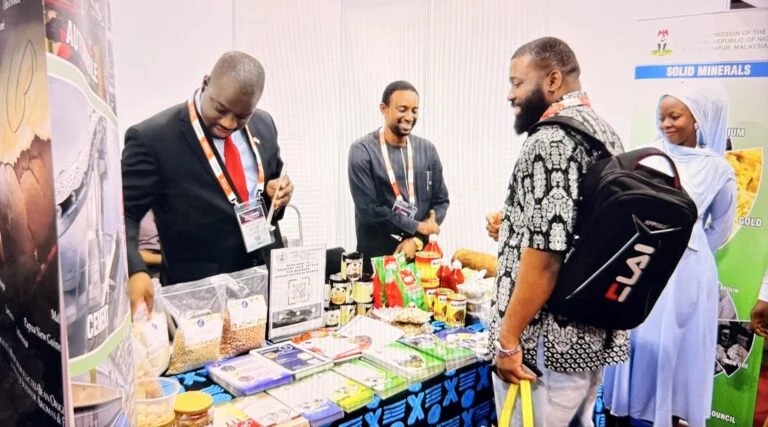
Interviews with government officials, diplomats, exporters, entrepreneurs and business operators at the Malaysia International Halal Showcase, MIHAS 2026, explains why.
The challenge is not simply a lack of products, but rather the systems required to make those products acceptable, competitive and sustainable in international markets.
Between a Nigerian farm, factory or processing facility and a foreign supermarket shelf lies a chain.
These include certification, quality control, processing, packaging, financing, regulation, logistics, market intelligence and business relationships.
Where that chain is weak, a product may have demand and still fail to become a successful export.
For Alh. Magaji Kamal, Chief Executive Officer of Silkim Group and Vice President of Nigerian Entrepreneurs in Malaysia, the consequences can be seen in the experience of Nigerian exporters.
Kamal recalled an attempt to export cassava flour processed in Kano to Mauritius.
Although the product reached Mauritius, it was not accepted for human consumption after inspection detected traces of dust, stones and other contaminants.
The experience, he said, demonstrated the need for Nigerian processing facilities to meet the hygiene and quality requirements of destination markets before products are exported.
“Some companies have already started, but a lot of us are left behind,” Kamal said.
The episode illustrates what could be described as the last-mile problem of Nigerian exports.
Producing a commodity is one thing; producing it consistently to internationally acceptable standards is another.
Kamal said Nigerian commodities including hibiscus flower, sesame and crayfish were already finding their way into the Malaysian market.
He noted, however, that crayfish was largely purchased by Nigerians living in Malaysia, while some other Nigerian commodities were also consumed by Malaysian customers.
That distinction is significant. Diaspora demand demonstrates that a market exists.
However, moving from diaspora consumption to mainstream international consumption requires businesses to understand foreign consumers, regulations, certification and distribution systems.
Kamal also said some Nigerian entrepreneurs operating in Malaysia needed better knowledge of the country’s formal business environment.
He said some continued to rely on informal practices, including operating without proper registration or offices, avoiding tax obligations and conducting transactions outside formal regulatory structures.
“Once you are doing everything by the book, there is a lot of support that the government can give you, whether you’re an international company or a local company,” he said.
He said many entrepreneurs were willing to comply but lacked adequate information on how to navigate the system.
It was partly in response to this gap, he said, that they established the Nigerian Entrepreneurs in Malaysia.
He explained that the group provides information on registration, taxation, licensing, halal certification and other requirements for operating in the country.
The implication is important: market access is not determined by demand alone.
It is also determined by whether businesses understand and can comply with the rules of the destination market.
For Ali Saidu, Chief Executive Officer of Salid Agricultural Nigeria Ltd., certification represents another major barrier.
Saidu said international buyers of Nigerian shea butter in countries including Russia, the Netherlands and India require halal certification before purchasing the product.
He argued that Nigeria should see the halal economy beyond its religious dimension and recognise it as an international trade opportunity and a potential channel for expanding non-oil exports.
“The global Halal economy is not just about religion, but it’s about an international trade certification applicable to the world,” he said.
Saidu said Nigerian businesses sometimes had to seek certification through countries such as South Africa and Kenya.
He argued that the absence of accessible and internationally recognised certification systems in Nigeria could result in lost business opportunities.
The problem, he said, was not merely whether Nigeria could produce shea butter or other commodities, but whether exporters could efficiently obtain the certifications required by buyers.
Mrs Isioma Ona, Managing Director of Ecoepicure Ltd, said Malaysian consumers and African communities in Malaysia had shown interest in Nigerian products.
According to her, they identify shea butter, bitter kola and yam among products with potential.
She stressed that Nigerian exporters needed to understand Malaysian certification and import requirements.
The entrepreneur explained that this was because compliance with Nigerian requirements alone would not guarantee access to the Malaysian market.
That points to a broader reality of international trade, which is that a product is not globally competitive simply because it is acceptable at home.
It must meet the technical, sanitary, regulatory, packaging and certification requirements of the market where it is sold.
The opportunity also extends beyond exporting finished products.
Mr Noah Ibitoye, Chief Executive Officer of ZyNooh Store Nigeria, was upbeat about his exposure to Malaysian manufacturing.
He said the exposure increased his interest in encouraging Malaysian companies to establish manufacturing operations in Nigeria.
Such investment, he argued, could create opportunities for technology transfer, local production and greater use of Nigerian raw materials.
This could help Nigeria move beyond an import-dependent relationship and capture more value locally before products enter international markets.
The diplomatic perspective points in the same direction.
Amb. Ahmed Sulu-Gambari, Nigeria’s High Commissioner to Malaysia, said Nigeria needed to learn from Malaysia’s economic experience.
According to him, this will strengthen collaboration between Nigerian and Malaysian business communities.
He said the mission was working to attract more Malaysian companies to Nigeria while engaging businesses and authorities to address concerns that could discourage investment.
Sulu-Gambari said economic diplomacy should ultimately produce measurable benefits for Nigeria.
“The world is moving from the rhetoric of meetings in and out.
”These meetings to action, what are the benefits, the direct, derivable benefits to Nigeria?” he said.
The question, he said was particularly relevant to international exhibitions.
“Nigerian businesses can meet potential buyers and investors but may struggle to convert those encounters into actual transactions,” he said.
Mr Aliyu Sheriff, Special Adviser to the President on Export and Secretary of Nigeria’s Halal Economy Implementation Committee, also gave an insight into government’s policy.
He said the government was developing a strategy around Islamic finance, certification, market access, capacity development and halal infrastructure.
Sheriff said certification was particularly important because products seeking access to markets such as Malaysia and Indonesia needed to meet recognised standards.
“We need to have some kind of certification in place that is in line with best global practice,” he said.
He also identified the need for deliberate business matchmaking, saying Nigerian businesses often attended international exhibitions but lacked mechanisms for turning contacts into commercial relationships.
“We’re not deliberate in linking these guys. We just let things slide, and nothing happens eventually,” he said.
This highlights another weakness in Nigeria’s export ecosystem. Attendance at an international exhibition is not itself a trade outcome.
The real value lies in what happens afterwards: buyer verification, product samples, certification, financing, logistics, negotiations and completed transactions.
Dr Popoola Olapoju, a consultant to Federal Polytechnic Mubi, Adamawa, said the answer also required stronger knowledge and institutional capacity.
Olapoju, who said he had attended MIHAS 12 times, said he came to the 2026 exhibition to examine halal-compliant products and systems that could be taken back to Nigeria.
He said that the Federal Polytechnic Mubi was engaging with Malaysian halal compliance training.
“Halal is not about religion. It is about the cleanliness of every product that we consume,” he said.
His observation reinforces a crucial point: certification is the outcome of a compliant production system, not a substitute for one.
A certificate cannot compensate for poor hygiene, contamination or inadequate processing infrastructure.
The Federal Ministry of Industry, Trade and Investment is also working on a policy response.
Mrs Hajara Agabi, Chief Commercial Officer of the ministry, said Nigeria was developing a comprehensive halal framework.
She said the government hoped to have a result by the end of 2026 under the National Halal Framework Strategy based in the Office of the Vice President.
Such a framework could provide greater coordination around certification, standards and market access, but its effectiveness will ultimately depend on implementation.
Taken together, the perspectives at MIHAS 2026 reveal that Nigeria’s export challenge is not one problem but a chain of interconnected weaknesses.
A farmer may produce a commodity with international demand, but the processor may lack adequate equipment.
The processor may improve the product but lack certification.
The exporter may obtain certification but lack financing or market intelligence.
A buyer may be found, but logistics or regulatory requirements may prevent the transaction from scaling.
The policy response, therefore, must be equally comprehensive.
Nigeria needs to move from broad export-promotion rhetoric to a measurable export-readiness strategy, with clear responsibilities, timelines and performance indicators.
First of all, the country needs to establish a stronger national system for export certification and conformity assessment.
Relevant agencies should work toward internationally recognised certification infrastructure within Nigeria.
This includes accredited laboratories, testing facilities, traceability systems and competent certification bodies.
Where foreign certification remains necessary, the government should negotiate mutual recognition arrangements with key trading partners.
This would reduce duplication, cost and delays for Nigerian exporters.
Besides, export policy should shift greater attention from raw commodities to value-added processing.
Incentives for exporters should increasingly reward investments in processing, quality assurance, packaging and product development rather than simply the volume of commodities shipped abroad.
Export clusters could be developed around products where Nigeria already has a strong raw-material advantage, linking farmers to processors, laboratories, logistics providers and buyers.
Also, Nigeria needs an export-finance mechanism specifically designed around compliance and market entry.
Small and medium-sized businesses may have viable products but lack the resources to acquire modern equipment, meet certification requirements, conduct laboratory tests or prepare products for foreign markets.
Affordable financing tied to verifiable export-readiness milestones could help close this gap.
Furthermore, Nigeria should build a more systematic market-intelligence and buyer-matching system.
International trade missions and exhibitions should not be treated as standalone events.
Before businesses travel, they should be matched with verified buyers and given market-specific information on tariffs, standards, packaging, consumer preferences and import regulations.
After exhibitions, government and trade-support institutions should track leads until they either convert into transactions or are formally closed.
Also, economic diplomacy should be measured by commercial outcomes.
Nigerian missions in strategic markets could maintain structured databases of potential investors, distributors and buyers and publish periodic reports on opportunities, regulatory changes and unresolved barriers facing Nigerian exporters.
The success of trade diplomacy should be assessed partly through investments facilitated, buyers connected and export transactions supported.
Nigeria should use foreign partnerships such as the relationship with Malaysia to pursue technology transfer and industrial investment, not only commodity sales.
Malaysian companies with expertise in food processing, halal production, logistics and manufacturing could be encouraged to establish operations or partnerships in Nigeria.
This is particularly where they can strengthen domestic value chains.
Also, the proposed National Halal Framework should be integrated into the broader export strategy rather than be treated as a stand-alone initiative.
Its value will depend on whether it produces practical outcomes for businesses: recognised certification, trained personnel, reliable institutions, market access and measurable growth in exports.
Malaysia’s experience provides Nigeria with a useful reference point, but the objective should not be to copy its system wholesale.
Nigeria must identify how Malaysia connected government policy, certification, industry, finance, skills development and international buyers, and determine what can be adapted to Nigeria’s own economic environment.
Nigeria has the commodities. It has entrepreneurs. It has markets willing to buy. What remains is to build the bridge connecting all three.
The question facing Nigeria is no longer simply what it can produce for the world, but whether it can build the institutions, infrastructure and commercial networks.
These institutions allow what it produces to meet global standards, reach global buyers and remain competitive once it gets there.
That may ultimately determine whether Nigeria’s vast production potential becomes sustained international trade.
Edited by Mark Longyen


Comments