


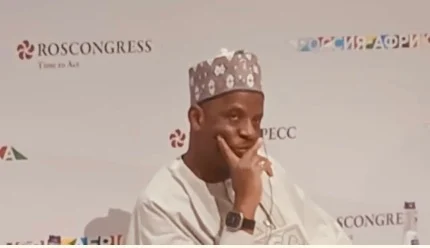
Malam Ali M. Ali, Managing-Director of the News Agency of Nigeria (NAN)during the third Russia-Africa Summit in Moscow (NAN)
By Fortune Abang, News Agency of Nigeria (NAN)
In a media landscape shifting at breakneck speed, how news is delivered is changing almost as fast as the news itself.
Yet, for a gathering of top media executives from across Africa and Russia, one truth remains constant: without unshakeable professional standards, new distribution channels mean very little.
This consensus emerged during a high-level dialogue held on the sidelines of the third Russia-Africa Summit in Moscow from Oct. 28 to Oct. 29.
The stakeholders provided insights during a session themed “Rethinking the Challenges Facing Modern Media,” which was held on the sidelines of the summit; they also spoke in separate interviews with the News Agency of Nigeria (NAN).
The media roundtable mirrored the broader ambitions of the summit itself.
With at least 48 African Heads of State and Government in attendance, the Moscow gathering set out to bolster Africa’s media sovereignty, dismantle long-standing colonial narratives, and carve out a stronger, more authentic space for regional stories on the global stage.
They observed that amid the growth of infotainment and the mass spread of fakes, the media faced the task of maintaining their responsibility to audiences and developing strategies for rapid responses in a crisis.
The stakeholders defined modern media to mean digital, internet-based channels and technologies used to create, share, and consume information, and entertainment such as social media, streaming services, podcasts, blogs, and online news.
They noted that, unlike traditional media such as print newspapers or scheduled TV broadcasts, modern media is typically interactive, on-demand, and open to everyday users publishing content alongside institutions.
Some commended the summit to have further shaped the vision for Russia–Africa media relations, positioned them towards opening broader horizons for the African continent to achieve more meaningful development and build a more secure future.
Why this has become important, the stakeholders opined that the summit offered African countries numerous opportunities to share knowledge, facilitate digital technological transfer and strengthen collaboration in fights against fakes.
They raised concerns about overcoming audience “information blindness” and creating rapid protocols to detect disinformation.
They noted that curbing fake news is difficult due to a crisis of trust, AI misuse, audience fragmentation, censorship, and insecurity—challenges worsened if media educators do not upgrade their skills.
To combat bias, they called for editorial practices that avoid cognitive distortions, one-sided influence, and Western stereotypes. They pledged to adopt innovative information management to build lasting solutions for modern media.
Participants also noted that modern media struggles because digital technology makes it harder for people to distinguish credible news from fakes.
To restore trust, they advocated for stronger editorial gatekeeping and alternative verification methods, warning that widespread challenges to credible sources undermine the entire industry.
They warned that failing to address these issues causes information segregation, calling for global cooperation to counter disinformation.
According to them, the way forward requires media stakeholders to adopt a paradigm shift through investing in quality training of journalists, saying that the old ways of training media professionals must give way for solutions to tackling modern media challenges.
Maria Zakharova, Spokesperson and Director of the Information and Press Department of the Russian Ministry of Foreign Affairs, underscored the need for media operators to carry out measures aimed at countering disinformation, and expanding information cooperation, to achieve targets.
According to her, there can be no direct exchange of information if there is no medium for deepening media collaboration.
“Therefore, tackling challenges modern media face must be done collectively, by joint efforts and not alone,” Zakharova said.
In line with this, Malam Ali M. Ali, the Managing-Director of NAN, advocated global media collaboration to safeguard mainstream media news credibility, in view of the challenges posed by digital technology and AI.
He said that there should be greater reliance on fact-checking tools, as means to verify, and cross-reference news contents before dissemination, to bolster the credibility of media contents.
“The major challenge facing the media in the modern era is that of credibility; the dawn of AI has eroded whatever credibility the media used to have.
“In the past, these challenges were regional, but now, they have become a global concern,” Ali said.
In the same vein, Prof. Abdullahi Musa, Vice-Chancellor of Kaduna State University (KASU), urged media professionals to adopt strategic information management strategy, to advance journalism practices across Africa.
Musa, a panelist during one of the sessions themed, “New Generation of Media Professionals: The experience of Russia and Africa,” at the Russia-Africa forum, underscored the need for information management to achieve targets.
“We are either using information, distorting information, sharing information, avoiding information, rejecting or manipulating information.
“If this is what we do 24 hours a day, then capacity building on information management is indispensable in tackling challenges of modern media, and that is what journalism is all about,” he said.
A stakeholder who pleaded anonymity underscored the need for media organisations to uphold professional in-house standards, to ensure effectiveness of the ways news is presented to audience.
According to him, editorial institutions and infrastructural steps are needed for regional media to draw first and foremost on their own sources, and expertise.
“Journalists and editors must be trained to critically think entrenched narratives beyond the region, to secure them global reach.
“The narrative must be such that there is clarity for audience’s information blindness to be overcome, through formats that include solutions journalism, constructive journalism and podcast that can help them break barriers,” he said.
For the stakeholders, there is a need to work collectively in shaping narratives and tackling the challenges of modern media to strengthen media sovereignty, counter disinformation, and expand information cooperation between Russia and African nations.(NANFeatures)


Comments