


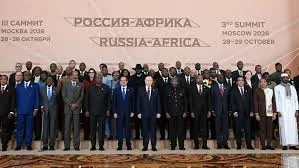
African leaders have urged Russia to expand investment in industry, establish joint production ventures, and cooperate on energy, transport, and artificial intelligence (AI).
They spoke at the plenary session of the Third Russia-Africa Summit at the Grand Kremlin Palace in Moscow, which was co-chaired by Russian President Vladimir Putin and Burundian President Evariste Ndayishimiye, chairman of the African Union (AU).
Putin said Russian companies were already working in energy, mining, manufacturing and logistics, using local contractors and transferring technology.
He said Russia’s trade with African states exceeded 27 billion dollars last year, up by one and a half times from the previous summit. He added that the rouble accounted for 85 per cent of Russia-Africa transactions.
“They invest and reinvest their earnings in the development of your national economies,” Putin said of Russian businesses, according to TV BRICS.
Ndayishimiye urged Russian firms to invest more in African industry and share technology and expertise with local companies.
“Africa will not be content with exporting raw materials and importing finished products,” he said.
He proposed that future cooperation focus on industrial investment, infrastructure, education and technology transfer. He said the new action plan must include specific projects, funding sources and ways to measure results.
Ethiopian Prime Minister Abiy Ahmed said his country was working with Russia to build its first nuclear power station.
He also invited Russian universities to collaborate with Ethiopian institutions on AI, urged Russian firms to expand manufacturing in Ethiopia’s special economic zones, and called for cheaper cross-border payments.
Egyptian President Abdel Fattah El-Sisi called for strategic transport corridors, logistics zones, more intra-African trade and linked electricity grids.
He also cited support for agriculture and relief from African debt burdens.
He said the summit should move from assessing results to implementing new initiatives.
The summit is expected to adopt a declaration, the Partnership Forum Action Plan for 2027-2029, and a separate declaration on civilian AI cooperation.
Intergovernmental and inter-agency agreements were also signed.
About 50 African states were represented, including heads of state and government and leaders of regional organisations.
Edited by Emmanuel Yashim


Comments