


By Okeoghene Akubuike
The Bureau of Public Procurement (BPP) has called for a shift from lowest-cost considerations to sustainable procurement that promotes long-term value, protects lives and strengthens climate resilience.
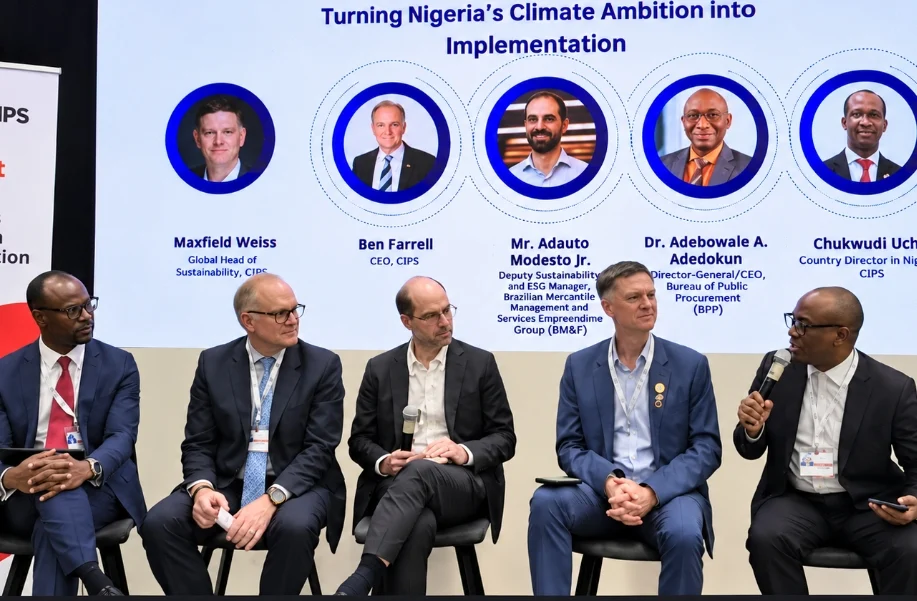
Dr Adebowale Adedokun, the Director -Genera of BPP, made the call in a statement by Ijeoma Chijoke-Adindu, Head, Information and Public Relations in Abuja on Thursday.
Adedokun spoke at the “Great Conversation” organised by the bureau in partnership with the Chartered Institute of Procurement and Supply (CIPS).
The event was held at the Nigeria Pavilion during the 31st United Nations Climate Change Conference (COP31) in Antalya, Turkey, on Wednesday.
Adedokun said Nigeria’s public procurement system must move beyond transactional purchasing to embrace environmental sustainability, infrastructure resilience and national development
He said that traditional procurement practices had not sufficiently integrated the principles of value for money, life, environmental sustainability and long-term infrastructure resilience.
He said ongoing procurement reforms were designed to address these gaps by establishing a stronger relationship between public infrastructure delivery, evolving climate realities, technological advancement and citizens’ quality of life.
According to him, public procurement must now be assessed, not merely by the cost of goods, works and services acquired but by the long-term benefits they deliver to citizens, the environment and the national economy.
Using the health sector as an example, Adedokun questioned the procurement of expensive medical equipment, such as MRI scanners, without considering energy efficiency, operational sustainability, reliability and environmental impact.
He said that Nigerians deserved healthcare infrastructure equipped with modern technology capable of operating efficiently, consuming less energy, reducing carbon emissions and delivering essential services over the long term.
He also urged authorities to design roads, power systems and water infrastructure to withstand changing climate conditions and remain functional over the long term.
“Public procurement decisions should be guided by professional expertise, technical evidence and long-term national development priorities rather than subjective considerations.
“Nigeria’s Nationally Determined Contribution (NDC 3.0) provided a framework for aligning procurement practices with the country’s climate commitments.
“The BPP is working towards a procurement system that encourages environmentally responsible production, energy efficiency, developes reliable power solutions and supports sustainable water and infrastructure solutions,” he said.
Adedokun said that procurement should serve as a strategic instrument for influencing markets, improving production standards and preparing the country for future challenges.
“What are we buying today, and what will be the outcome of what we buy in the next 10, 20 or 30 years?
“We must begin to look beyond the immediate transaction and consider the kind of country we want to build.
“We must also consider the quality of healthcare we want our citizens to enjoy and the infrastructure that will sustain future generations,” he said.
The BPP boss also suggested moving beyond the lowest evaluated bid to incorporating whole-life-cycle costing, durability, environmental performance, operational efficiency and overall value.
He said sustainability requirements should be integrated into procurement planning, needs assessment, specifications, bidding documents, contract implementation and evaluation.
He identified three priorities for achieving the transformation: developing clear and robust procurement specifications aligned with NDC 3.0, strengthening statutory, regulatory and institutional frameworks and deploying digital solutions.
According to him, digital solutions will promote transparency, accountability, efficiency and improved access to procurement information.
He also called for stronger engagement with domestic suppliers, manufacturers and contractors to encourage local innovation, responsible production and development of sustainable supply chains.
Adedokun urged the government to communicate its procurement requirements and expected standards clearly to enable businesses to provide appropriate technologies, products and services that support Nigeria’s economic and environmental objectives.
He reaffirmed the bureau’s commitment to promoting professionalism, innovation, transparency and sustainability in public procurement.
He said public expenditure should be measured, not by how much government spent or how cheaply contracts were awarded, but by the quality, sustainability, resilience and lasting benefits delivered to Nigerians. (NAN)
Edited by Kadiri Abdulrahman

Comments